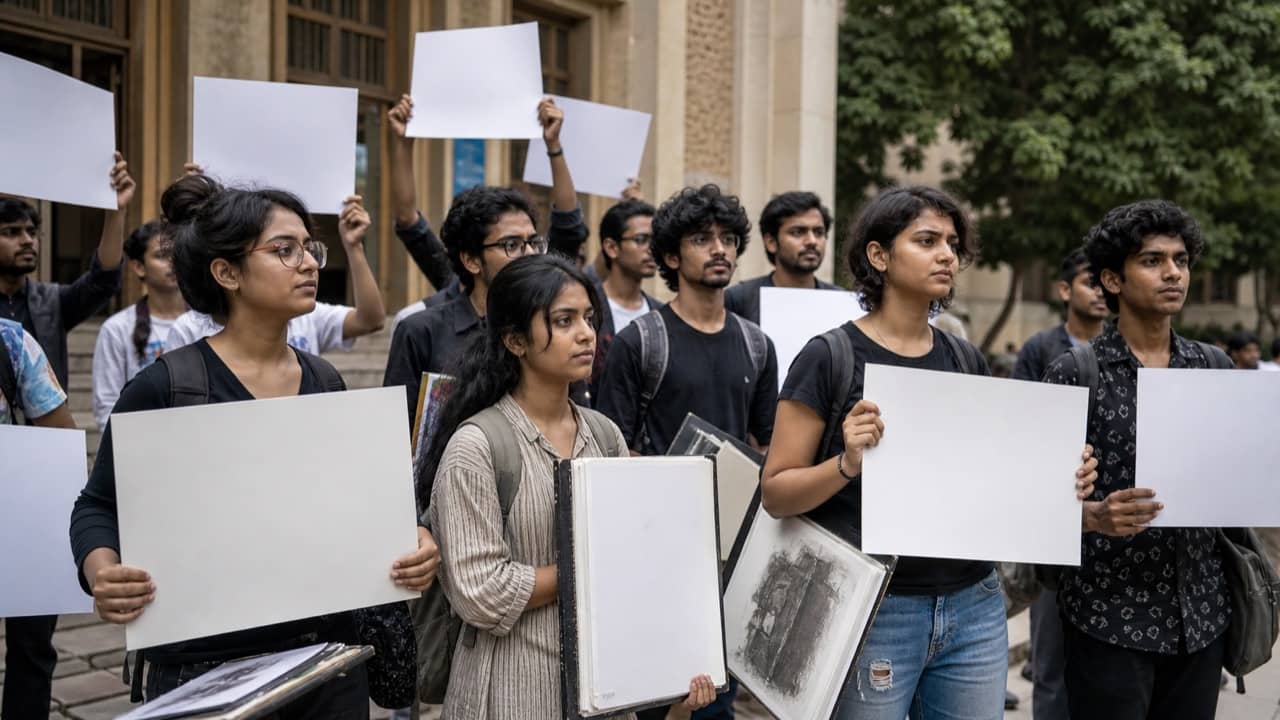
VARANASI: Bachelor of Fine Arts students at Banaras Hindu University returned to the central office with placards on Tuesday after a deadline they had given the administration expired, renewing allegations of irregularities in practical-exam marking. They are seeking a recheck and a transparent explanation of how scores were awarded, particularly where marks fell sharply compared with previous years.
Students told the newspaper that some candidates received between 100 and 200 out of 400 in practical work and cited individual year-on-year drops, including one claim of a fall from 350 to 215. These are student statements and not an independent audit of the mark sheets. The protest concerns current BFA practical results and should not be confused with a separate recent dispute about BFA admission-test scoring.
Fine-arts assessment is more subjective than a multiple-choice paper, but subjectivity is not a licence for opacity. A credible practical exam uses published criteria, more than one evaluator where feasible, signed mark sheets and moderation when a score differs unusually from the cohort or a candidate's documented work. Students need to know the process without demanding that every artistic judgement produce the mark they expected.
Re-evaluation rules for practical exams often differ from those for written papers because the original performance or studio process may not be reproducible. That makes record-keeping essential: photographs, portfolios, rubrics and evaluator comments can support review. The university should state whether rules permit rechecking of totals, moderation, reassessment of preserved work or only an inquiry into procedure.
The dispute affects progression, scholarships and student confidence. Delayed clarification can also disrupt the next academic cycle. At the same time, publishing individual marks or portfolios without consent would violate privacy. BHU can address the collective concern through anonymised distributions and criteria while handling individual appeals through a secure channel.
The administration should acknowledge the representation, name the competent committee and provide a date for response. Any faculty member directly involved in disputed marking should not be the sole reviewer. Students should preserve original submissions, receipts and written communication and avoid altering digital portfolios after the result, as version questions can complicate an appeal.
A protest allegation is not proof that marks were manipulated, and a low score is not proof of weak work. The fair route is a documented review capable of identifying arithmetic error, inconsistent criteria or procedural irregularity. BHU can reduce tension by showing students how the decision was made and what remedy exists if the process, rather than simply the outcome, was flawed.
This report is based on a Live Hindustan account published on 26 August 2026. Dalimss News independently rewrote, checked and contextualised the available information. Where a claim, allegation or opinion is attributed to a person or institution, it remains their statement; no on-scene reporting or independent interview is claimed.