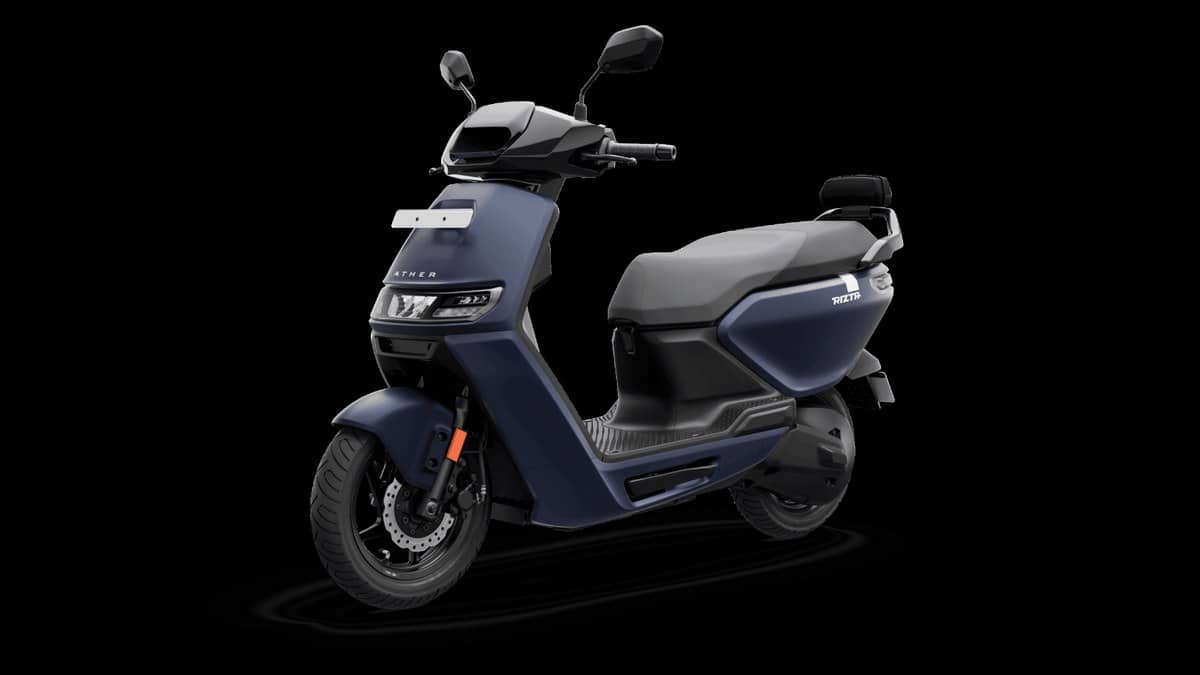
NEW DELHI: Ather's current Rizta specification page lists two home-charging times for both the S and Z: six hours or three hours 25 minutes from 0% to 80%. It also lists different charger ratings and battery capacities. The faster number should therefore not be applied to every Rizta simply because it carries an S or Z badge.
| Current official specification | Rizta S | Rizta Z |
|---|---|---|
| Home charging, 0% to 80% | 6 hours / 3 hours 25 minutes | 6 hours / 3 hours 25 minutes |
| Home charging, 0% to 100% | 7 hours 25 minutes / 4 hours 30 minutes | 7 hours 25 minutes / 4 hours 30 minutes |
| Home charger ratings listed | 450W / 900W | 450W / 900W |
| Installed battery capacities listed | 2.7 / 2.9 / 3.5 kWh | 2.7 / 2.9 / 3.5 kWh |
These are the alternatives displayed in the readable manufacturer table, checked on 4 November 2026. The table does not clearly assign every charging time to every battery-and-charger combination. This article preserves that limitation instead of constructing a variant-level promise that the opened page does not explicitly make.
The S or Z name does not settle the charging time
Ather gives each version the same alternatives in the charging rows. That is useful information for a family comparing the scooters: the trim badge alone is not enough to identify the home-charging arrangement. The relevant details belong in the supplied equipment description and the specifications for the particular battery configuration.
A concrete check is to match the scooter's battery version with the charger's labelled rating and the equipment listed on the invoice. An owner replacing an older scooter or reusing an existing charger has an additional reason to do this. A physically familiar charging unit should not automatically be treated as proof of the timing printed beside a different configuration.
The published full-charge row is also different from the 80% row. Someone planning a departure after a partial top-up should read the latter; someone expecting a full battery should read the former. Keeping both endpoints in the same table prevents the faster partial-charge figure from becoming an empty-to-full claim in conversation.
Home charging has a parking-space dimension
Ather describes the Duo as usable either at a wall mount or as a portable charger carried in the boot. For a Rizta household sharing the scooter between riders, that flexibility raises a practical question: will the charger stay in the parking bay or travel with the scooter? The answer determines what needs to be available at the second destination.
The charging page specifies a six-amp three-pin socket for the Duo. Its user guide also calls for indoor placement protected from water and unobstructed airflow. A convenient wall location should therefore be judged against the equipment instructions, rather than chosen solely because it puts the cable closest to the scooter.
The Rizta product page gives the scooter a 34-litre boot and presents a separate front-storage accessory as part of its family-use proposition. Carrying a portable charger is one use of the available space. A household can make that routine easier by deciding where the charger and cable belong before packing shopping or work bags around them.
Public charging is expressed differently
Ather's public charging page advertises added riding range over a short time interval and says charging status and payments are managed through its app. That is a different measure from a home charger taking the battery between two percentages. Neither number can simply be substituted for the other in a daily timetable.
The Rizta specification table itself distinguishes between public charging entries for the S and Z. This reinforces the need to read the actual model configuration rather than a network-wide maximum. A rider planning an unfamiliar route needs a usable charging stop, not merely the largest replenishment claim visible on a brand's general page.
Apartment charging is another separate issue. Ather's charging page describes AtherNode as a system for managing available power across multiple vehicles in residential and commercial parking. That addresses shared electrical infrastructure. It does not mean that owning a Rizta automatically supplies a dedicated connection in a building's parking area.
Keep a useful record of an unexpectedly long session
If a session seems slower than expected, note the starting charge, finishing charge, charger label and elapsed time. These observations create a comparison that a service team can interpret. A bare statement that a scooter needed an entire evening leaves open whether the owner expected a partial charge, a full charge or a different charger configuration.
For the wider ownership context, see our Rizta storage explanation, Rizta S and Z comparison and Ather booking-refund guide.
Official sources: Rizta specifications, Rizta product page, charging arrangements and Duo user guide.