
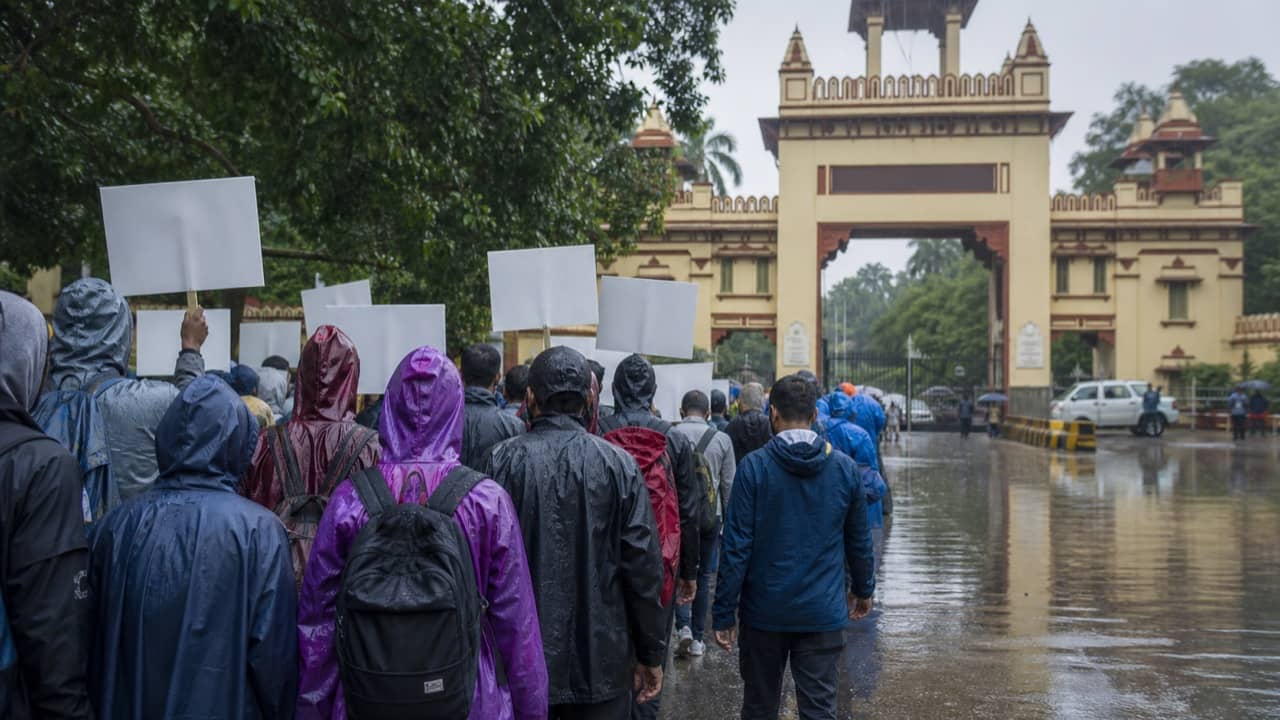
VARANASI: Youth Congress members sat in knee-deep water outside Banaras Hindu University's Singh Dwar on Tuesday, using the lingering flood at one of the city's most visible gateways as the site of a political protest. The demonstration questioned drainage performance after overnight rain left patients, students and commuters struggling through standing water into the afternoon.
Metropolitan Youth Congress president Chanchal Sharma accused the municipal system and the BJP governments of failing to match development claims with usable roads, cleaning and drainage. Other city and constituency office-bearers joined the sit-in, according to the report. Their statements are political allegations; the source account did not include a detailed response from the municipal corporation or state government.
The image of activists sitting in water is designed to travel. It compresses a technical problem—drain capacity, pumping, silt and road levels—into a frame immediately understood on a phone screen. That visual force does not answer which agency controls each drain or why the water remained. A useful follow-up must move from symbolism to maps, maintenance records and response timings.
Singh Dwar and the roads around BHU carry students, hospital traffic, vendors and through-commuters. Waterlogging there has appeared in earlier rain reports, including a previous, less intense episode. The latest protest is a new political development, but the underlying civic issue is persistent. Repetition increases the case for a documented engineering remedy rather than another round of emergency pumping.
The demonstration may pressure agencies to respond, yet participants also entered potentially contaminated water near electrical infrastructure. Protest organisers have a duty of care: gumboots, a medical plan and distance from poles and open manholes are sensible even when discomfort is part of the message. The public should not imitate a staged sit-in in an unknown flooded stretch.
The municipal corporation should answer with specifics: drain ownership, last cleaning date, pump deployment and the permanent work proposed for the Singh Dwar catchment. The Youth Congress, in turn, should publish any complaint numbers or documents it relies on. That would allow residents to track whether the protest produces action rather than only engagement online.
Commuters should avoid walking through water whose depth and electrical safety are unknown. Anyone who experiences a tingling sensation should move away without touching metal and alert the electricity department. Citizens can support accountability by sending time-stamped, location-specific reports and preserving acknowledgements. A clear record is harder for any government—or opposition—to reduce to a slogan.
This report is based on a Live Hindustan account published on 26 August 2026. Dalimss News independently rewrote, checked and contextualised the available information. Where a claim, allegation or opinion is attributed to a person or institution, it remains their statement; no on-scene reporting or independent interview is claimed.