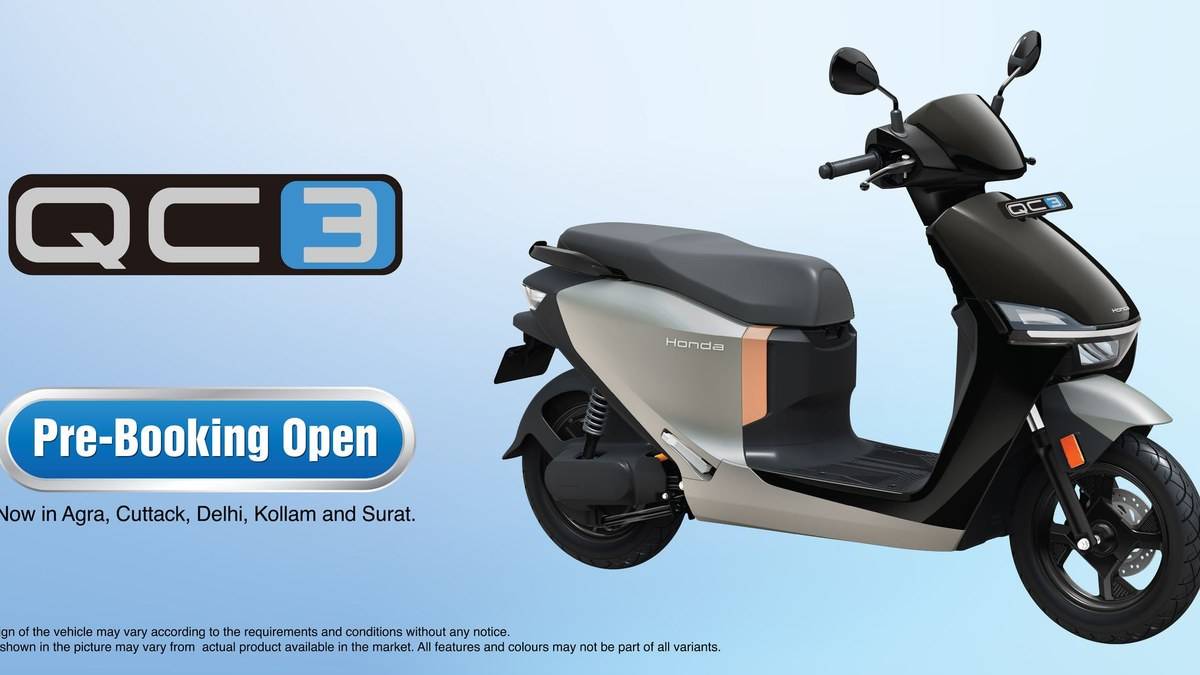
NEW DELHI: Honda's QC3 is listed at Rs 1,35,000 ex-showroom Delhi, below the Rs 1,67,600 Delhi launch price published for Yamaha's EC-06. The two official figures put these electric scooters in different price brackets, but their information is at different stages: Honda still carries a future specification-and-delivery disclaimer, while Yamaha has published a fuller launch specification.
| Official information | Honda QC3 | Yamaha EC-06 |
|---|---|---|
| Published price | Rs 1,35,000 ex-showroom Delhi | Rs 1,67,600 ex-showroom Delhi at launch |
| Battery capacity | 3 kWh | 4 kWh, fixed battery |
| Under-seat storage | 32 litres | 24.5 litres |
| Instrument display | 5-inch TFT | Colour LCD |
| Announcement reference | Portfolio unveiled 24 July 2026 | Price announced 2 February 2026 |
Price as of 7 November 2026, 23:52 IST. The QC3 amount is displayed on Honda's current product page. The EC-06 amount is the official dated launch figure; its readable booking page does not supply a fresh full vehicle quotation. Neither amount is an insurance-and-registration-inclusive bill.
Battery size and storage tell different stories
The battery comparison gives Yamaha the larger stated capacity. The under-seat comparison gives Honda the larger stated volume. These are separate measures of an urban scooter's usefulness, and one does not cancel out the other. A larger battery specification is not a measurement of how much luggage fits beneath the seat.
For a shared family scooter, the storage distinction is particularly relevant to how the vehicle will be used between trips. Work bags, shopping and riding gear put different demands on the boot. The litre figures establish published capacity, but they do not prove that a particular helmet or rigid bag fits the opening and the interior shape.
Honda's portfolio material also identifies a Smart Key and connected features for the QC3. Its electric product page, however, says complete specifications will be unlocked in the third quarter of FY 2026-27, with deliveries shortly afterwards. That limits how far an equipment comparison can responsibly go today.
What Yamaha has already specified
The EC-06 launch release gives peak power of 6.7 kW, maximum torque of 26 Nm and a top speed of 79 km/h. It identifies an Interior Permanent Magnet Synchronous Motor and lists Eco, Standard and Power riding modes, plus a reverse mode. These are manufacturer specifications, not independent road-test results.
Yamaha also specifies disc brakes at both ends with a Combi Brake System and a colour LCD displaying vehicle information. The connected application is named Yamaha Motor Connect R in the release. These points describe the EC-06's published package without assuming that a TFT display on another scooter automatically establishes a richer feature set.
Crucially, the EC-06's battery is described as fixed. The launch material refers to home plug-in charging. For a household evaluating the format, the location where the scooter can physically be parked and charged is therefore part of the use case. Battery capacity alone does not answer that practical question.
Why this comparison leaves some cells blank
Honda's own portfolio blog and homepage material give different QC3 range figures, so no QC3 range number is used here. A range winner cannot be assigned cleanly while that inconsistency remains. Leaving out the number is more useful than selecting whichever official figure makes the comparison look tidier.
Charging figures also need matching conditions. Yamaha's release describes an approximately eight-hour full charge, while Honda's portfolio material describes charging up to an intermediate battery level. This report therefore makes no charging-speed ranking between them. A full-charge statement and a partial-charge statement answer different questions, even when both appear in official launch material.
Those gaps do not invalidate the confirmed battery, storage and price information. They do mean that a claim that either scooter is comprehensively better would run ahead of the evidence. The most useful distinction is between published specifications, unresolved figures and details that Honda has expressly said will follow later.
The booking screen is a separate number
Yamaha's e-shop displays Rs 2,000 as a booking amount and says that it is adjusted against the final vehicle quotation. That is separate from the launch price used above. It should not become the headline purchase price or be treated as evidence of a newly reduced ex-showroom amount.
A fixed battery, a larger boot and a connected display describe different aspects of ownership. None supplies the missing common test conditions needed to turn this specification comparison into a road-test verdict.
Related reading includes our explanation of Yamaha Aerox accessories price list: Rs 365 to Rs 7,216, Honda car prices: Amaze from Rs 6,97,700, City Rs 11,99,900, ZR-V Rs 49,99,900 and Honda City price list: Rs 11,99,900 to Rs 20,99,900. Each illustrates why a specification needs its own operating conditions and model context.
Official sources: Honda QC3, Honda India portfolio release, Yamaha EC-06 launch release and EC-06 e-shop.