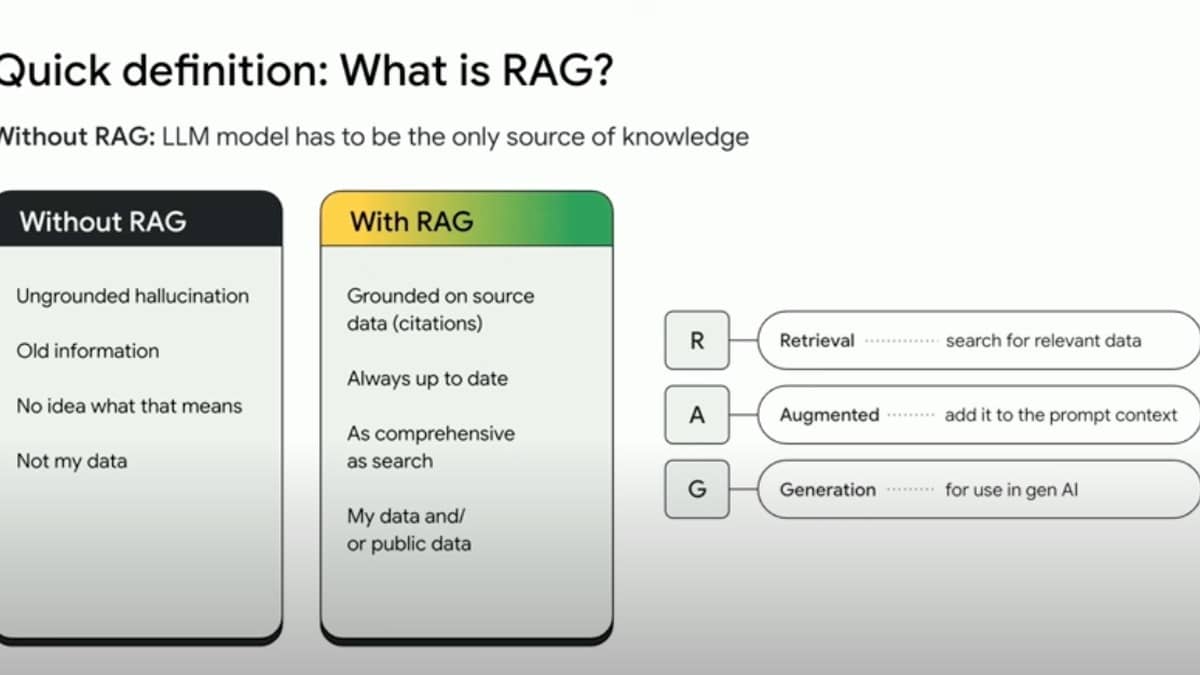
RAG in AI means retrieval augmented generation. It is a way for an AI application to look up relevant information in documents or another knowledge source, then use that material when generating an answer. The model still writes the response, but the application first supplies evidence that may not have been included in its training data.
Think of an assistant answering a question about a college's attendance policy. A general answer about colleges may be unhelpful if your institution has a specific rule. In a RAG system, the application can search the college's actual policy documents, retrieve the relevant passage and give that passage to the model with your question. This is an illustrative example, not a claim that any particular college already offers such a service.
| Term | Plain meaning |
|---|---|
| Retrieval | Finding relevant information in a source collection |
| Augmentation | Adding that information to the model's input |
| Generation | Producing the answer using the question and supplied context |
| Knowledge base | The collection available for the system to search |
How does RAG work?
AWS Prescriptive Guidance describes a workflow that starts with preparing documents for retrieval. In its example, documents are cleaned, divided into smaller sections and represented numerically through embeddings. Those representations are stored in an index. They help the system find material related to the meaning of a question.
When someone asks a question, a retrieval component searches for useful passages. The application adds the selected content to the prompt sent to the language model. The model then generates a response using both the question and that extra context. Preparing the collection and answering a question are different stages, even though the user may see only a familiar chat box.
The NIST definition describes a model paired with a separate information retrieval system or knowledge base. This separation explains an important feature: the available knowledge can change without retraining the model itself. Updating a policy collection is conceptually different from teaching the model new behaviour through a training process.
Why use RAG instead of asking a general chatbot?
Google Cloud's explanation places RAG alongside search, databases and language generation. The useful question is whether your answer depends on information in a particular source. A staff handbook, product manual or course reading list may contain details that a general model cannot reliably supply from training alone.
For an Indian student, a useful example would be comparing two uploaded university notices and asking which deadline applies to a named course. For a small organisation, it might be finding the relevant leave policy before drafting a reply. These are possible applications. They do not establish that every file upload feature uses RAG, or that every answer produced from files is correct.
How is RAG different from a context window?
A context window concerns the material a model can work with in a particular interaction. RAG concerns selecting information to provide to that interaction. Loading a complete short document and retrieving a few passages from a large collection are different ways of supplying context. The amount of storage available for documents is therefore not the same thing as the amount read for each answer.
Claude provides a concrete product example. Its official project help page, checked on 31 October 2026, says that RAG activates automatically as project knowledge approaches or exceeds context limits. The help page describes searching uploaded material for relevant information instead of loading the whole collection into context at once. It also advises descriptive filenames and naming relevant documents in questions.
This is a product example rather than a universal rule for all AI software. Other applications can choose different retrieval designs and access rules. If your goal is to use an existing app, start with its help page and supported file workflow. If your goal is to build a document assistant, you will also need to decide what it can search and how results are checked.
Does RAG stop AI mistakes?
RAG gives the application a way to supply source material; it does not itself prove that the material is current or that the right passage was retrieved. Google Cloud discusses grounding and evaluation, while AWS identifies retrieval, data processing and access management as separate parts of a production system. These components matter because a fluent answer is only the last stage of the process.
Check the cited document, its date and the surrounding text before acting on an important answer. If two documents conflict, ask the system to show both rather than silently choose one. A passage from an old notice can be accurately quoted and still be the wrong evidence for a current deadline. That is a practical reason to maintain the underlying collection as well as inspect the response.
An original prompt for checking a document answer
For comparing notices, try: “Use only the two notices I supplied. Identify the course, deadline and issuing office in each. Quote the supporting line and name the document. If the notices conflict, explain the conflict without selecting a deadline. If a detail is missing, say it is missing.” This original prompt is intended to make the evidence easier to inspect. It cannot guarantee that retrieval or interpretation will succeed.
For related workflows, read our guides to Claude Projects and files, NotebookLM study prompts and what an AI agent does. A document collection, a retrieval method and an agent's ability to take actions answer different questions about an AI application.