
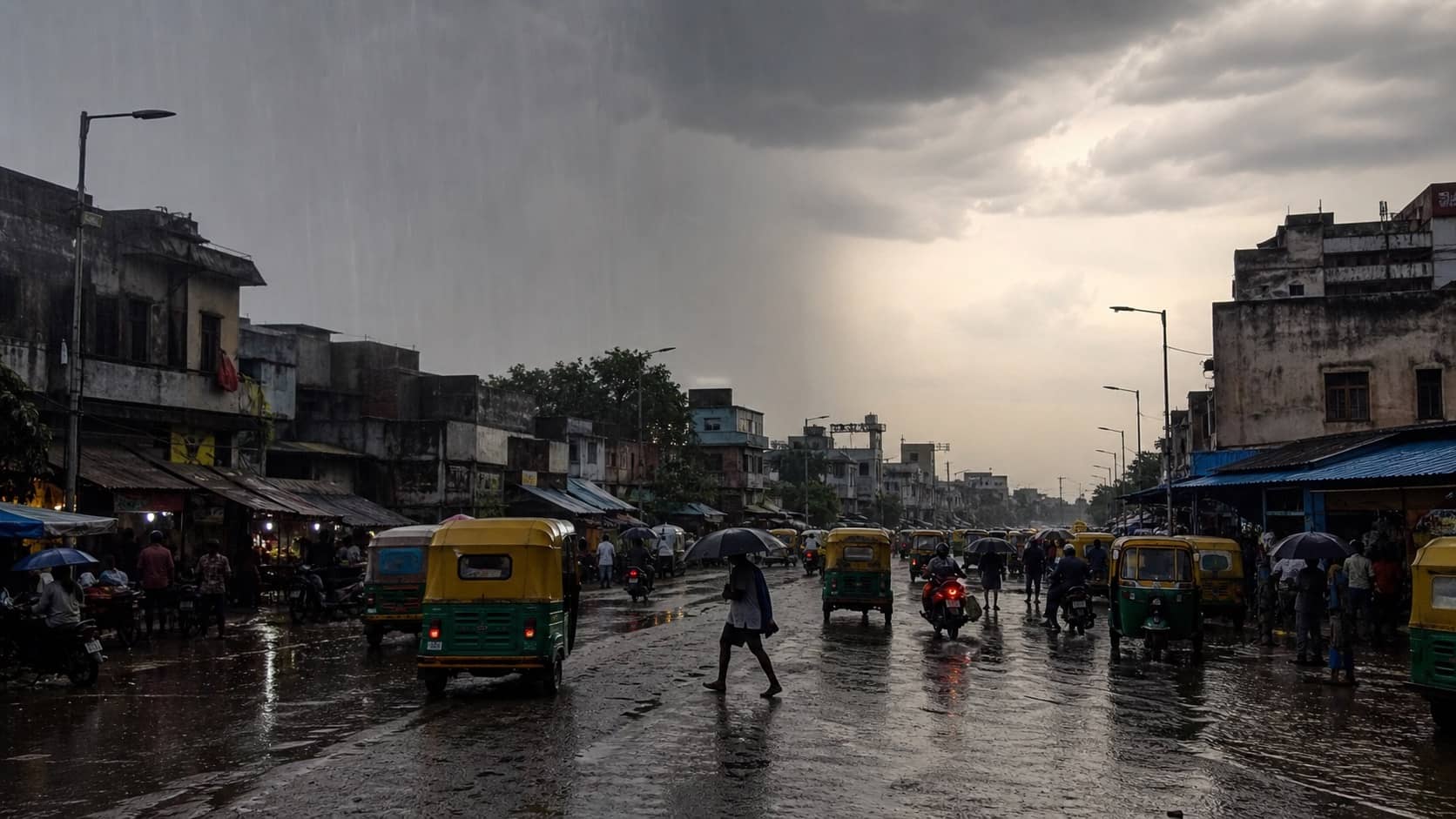
VARANASI: Sunday’s weather delivered a familiar but increasingly important lesson: a single rainfall figure cannot always describe what residents experience across Varanasi. Amra, Akhari, Chitaipur and neighbourhoods along the Varuna received spells strong enough to produce waterlogging, while other pockets saw only drizzle and the official Babatpur gauge recorded no rain.
A heavy burst of roughly 15 minutes was reported around 4 pm. Earlier, a spell lasting about half an hour affected Rohaniya, Chitaipur, Jakhini, Amra and Bachhav from around 11.30 am. The showers were short, but in low-lying lanes even a brief downpour can overwhelm drains already carrying silt and solid waste.
The maximum temperature was reported at 34.2 degrees Celsius and the minimum at 27 degrees. Cloud cover and light rain were expected to continue over the following two days. Humidity remained the more persistent discomfort, especially in neighbourhoods where the shower cooled the air only temporarily.
Babatpur’s zero reading does not contradict accounts from the southern city. Rain gauges record what falls at a specific point; monsoon clouds can release intense rain over one corridor and leave another almost dry. In a district spread across urban, peri-urban and rural zones, that spatial variation can be large enough to affect farming, traffic and drainage differently on the same afternoon.
For civic planning, neighbourhood-level observations matter. A city may receive modest average rainfall yet still face repeated flooding where drains are narrow, outlets are blocked or roads have been built above house thresholds. Mapping complaints by lane and duration would show which waterlogging points are structural and which were caused by an exceptional cloudburst.
Residents can reduce immediate risk by avoiding submerged electrical boxes, open drains and underpasses where water depth is unclear. Two-wheeler riders should slow down near pooled water because potholes disappear from view. Parents should keep children away from fast-flowing roadside channels even after the rain stops.
The municipal response is most effective before the next shower: clearing trash traps, checking pumps and keeping drain covers secure. Emergency desilting during rainfall is slower, more dangerous and often shifts the blockage downstream. Transparent ward-level updates would help residents know whether a recurring problem has been logged for repair.
Sunday’s patchwork of heavy rain, drizzle and dry gauges was not unusual. It was a reminder that Varanasi’s monsoon has to be read street by street. Forecasts give the broad signal; the real measure of preparedness is whether a fifteen-minute shower can pass without turning a daily route into a waterlogged obstacle.