
Varanasi's 113-Year-Old Lal Bhawan Enters ₹2.5-Crore Restoration
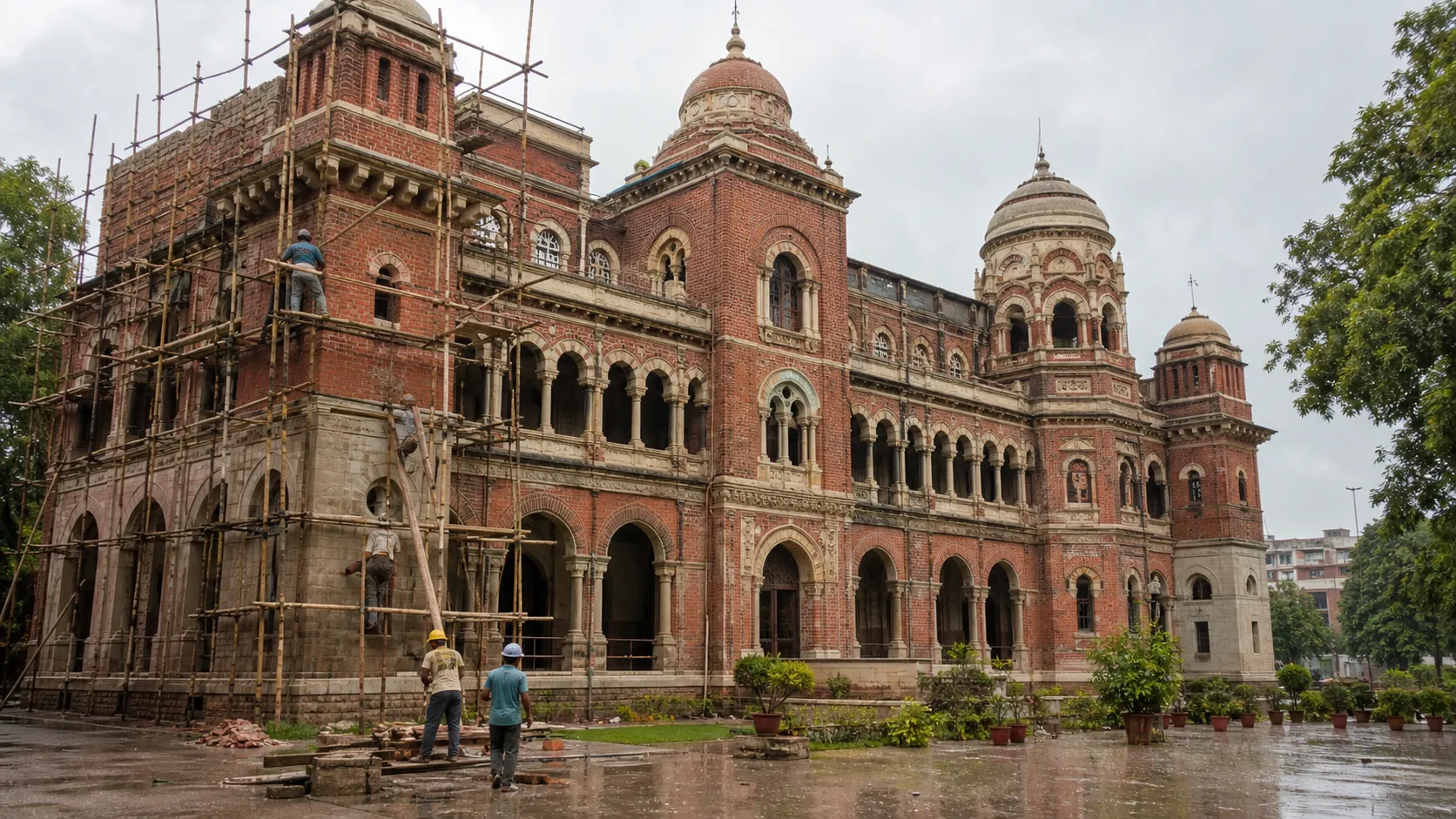
VARANASI — The district court's Lal Bhawan, a red-brick building that has watched 113 years of legal and political history pass through its corridors, is undergoing a restoration expected to cost about ₹2.5 crore and take one year.
Construction and Design Services is carrying out the work under the supervision of the Archaeology Department. The project aims to repair and beautify the structure while retaining the features that make it one of the most recognisable buildings in the Banaras court complex.
Completed in 1913, Lal Bhawan was built with brick and stone in a style associated with Byzantine architecture. Its courtrooms were designed for natural light and ventilation, and its iron spiral staircases remain a focal point. A former Banaras Bar office-bearer said the stairs leading to the second floor have resisted rust for more than a century.
A BUILDING WITH A COURTROOM MEMORY
The building's importance is not limited to architecture. Former members of the Bar association connect it with the Quit India movement, saying the Union Jack was removed and the Indian tricolour raised there during the August movement of 1942. They also point to notable hearings, including the Dhanapur case — sometimes described locally as Banaras's Chauri Chaura — and proceedings associated with Deendayal Upadhyaya.
Those historical claims are based on accounts from former Bar office-bearers. A careful restoration should use archival records and physical evidence to document them, rather than allowing colourful stories to become a substitute for conservation research.
The project's most eye-catching description is that renovated rooms will resemble the comfort of a seven-star hotel. That line may sell the makeover, but the more serious benchmark is whether the work respects the original material, proportions and airflow of a functioning courthouse.
RESTORATION IS DIFFERENT FROM RENOVATION
Heritage buildings can be damaged by well-intentioned upgrades. Modern cement, glossy tiles, sealed windows or concealed wiring may look neat but can trap moisture or erase historic fabric. Archaeological supervision is therefore essential, especially when a century-old structure must also meet present-day safety, electrical and accessibility standards.
The public should be able to see what is being repaired, which materials are being used and how original features are being protected. A completion report with before-and-after documentation would give the ₹2.5-crore project more credibility than cosmetic photographs alone.
Lal Bhawan also remains a working legal space. Restoration must manage dust, noise, temporary court movement and public access without creating confusion for lawyers and litigants. That operational detail is part of conservation, because a courthouse cannot be treated like an empty monument.
If the work is done with restraint, the result will be more than a polished room. It will preserve a building in which Varanasi's legal history is still being made — one hearing, one petition and one crowded corridor at a time.
Sources and reporting
Based on details available on 1 August 2026 from former Banaras Bar office-bearers and about the C&DS restoration under Archaeology Department supervision. Historical claims are attributed to those quoted sources.
Related Stories

Ramnagar Constable’s WhatsApp Resignation Withdrawn After ACP Counselling

Municipal Commissioner Inspects Jangambadi Ward 89 Sewer Overflow and Damaged Lanes

Civic Body Invites Tenders for ₹13 Crore Drainage Works in Newly Extended Areas

Mirzamurad Police Arrest Mother After Probe Finds Role in Stepdaughter Assault Case

Sigra Police Arrest Man Over Alleged ₹6 Lakh Fake BHU Assistant Professor Letter
