With Navratri starting on Sunday, 11 October, the idol workshops of Varanasi are in their last and busiest stretch. Around 90 per cent of the city's puja pandals are ready, and roughly 80 per cent of the Durga idols have been shaped, according to idol makers working in Khojwan and other workshop areas.
This year the work of Kashi's artisans will travel well beyond the city. More than a hundred idols of Maa Durga and the accompanying deities are being made for buyers outside Varanasi, idol maker Abhijit Biswas of a Khojwan workshop said on Friday.
About 40 idols will go outside Purvanchal. Lucknow has ordered 24, Jabalpur in Madhya Pradesh eight, and one full set is headed for Odisha. Districts closer home, including Mirzapur, Jaunpur and Ghazipur, will take more than 60 idols.
The Odisha order stands out. It is a Bangla chaal set, the traditional Bengali style in which Maa Durga and the other deities share a single arched frame. "The Bangla saaj on this kind of idol is always white, but this time it has been made in pink," Biswas said. The set has eight figures in all, including Shri Ganesh, Lakshmi, Saraswati, Kartikeya and the demon Mahishasur along with the goddess.
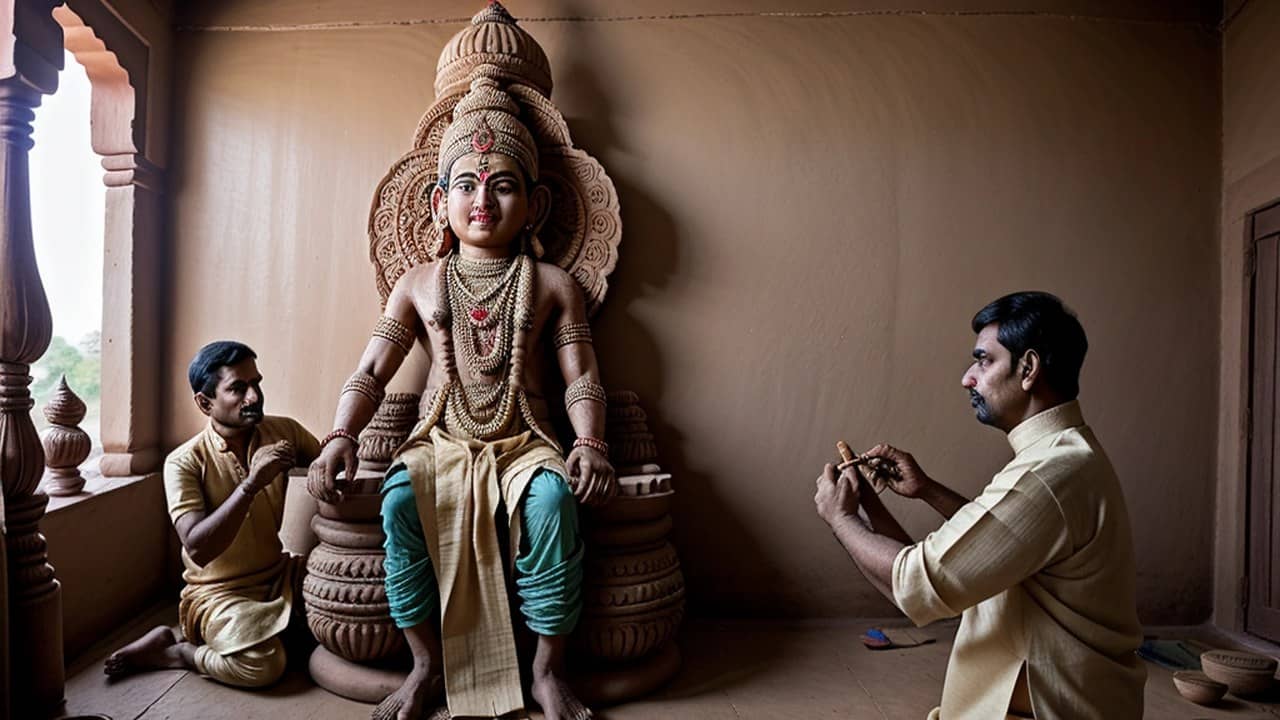
Biswas said the clay work on most idols is finished. What remains is painting and the saaj-shringar, the decoration with clothes, jewellery, crowns and weapons that brings each idol to life. That stage is the most time-consuming and usually runs until the night before the idols leave the workshop.
Prices have gone up. Biswas said the cost of decoration material has risen, and idols are about 10 per cent dearer than last year as a result. Committees that ordered large idols early in the year have mostly locked in their price, but late orders reflect the increase.
A 10 per cent increase may look small, but for a large committee idol it adds up. Committee members usually pay part of the price at the time of booking and the rest on delivery, and many raise the money through neighbourhood contributions. Artisans said the rise in material costs covers items such as cloth, artificial jewellery, zari and paint. Labour has also become harder to find in the peak weeks, as skilled painters are in demand in several cities at the same time.
Varanasi has a long Durga Puja tradition of its own, shaped by the Bengali families who settled around Bengali Tola, Sonarpura and Bhelupur generations ago. Over time the city's artisans, many of whom trace their roots to Bengal, have built a reputation that brings orders from across Uttar Pradesh and neighbouring states. The Khojwan, Lahartara and Durgakund areas are among the places where workshops cluster during the season.
Within the city, the scale of this year's festival is large. The municipal corporation's planning, covering 512 pandals and 725 idols, was laid out in our report on civic preparations for Durga Puja. At a peace committee meeting on Friday the district administration and police also told organisers that immersion will be allowed only at designated sites and that no new tradition will be permitted.
For visitors, the best time to see the workshops at work is in the next few days, before the idols are carried to the pandals. Workshops are working spaces, so it is polite to ask before taking photographs and to keep clear of artisans handling wet paint or heavy frames.
The idols will be installed in pandals in the run-up to Saptami, when Durga Puja's main days begin. Navratri runs from 11 October to Navami on 19 October, with Vijayadashami and immersion on 20 October. Devotees planning to visit the city's Nava Durga temples over the nine days can use our day-by-day Navratri temple guide.
The pink Bangla saaj headed to Odisha is a small change, but it shows how Kashi's idol makers are trying new looks while keeping to the traditional forms that committees expect. Workshop owners say the coming week will decide whether every order leaves on time.