Two research groups at IIT (BHU) Varanasi have reported a compound that kills bacteria and breaks down the slimy protective layers they form, called biofilms, when it is switched on by ordinary green light. The work has been published in Communications Chemistry, a journal from the Nature Portfolio.
The research was done in the laboratories of Dr Samya Banerjee, Associate Professor in the Department of Chemistry, and Dr Sudip Mukherjee of the School of Biomedical Engineering. The paper is titled "Green-Light-Activated Osmium Metallophoto-Antibiotics for Antibacterial Therapy and Infected Wound Healing".
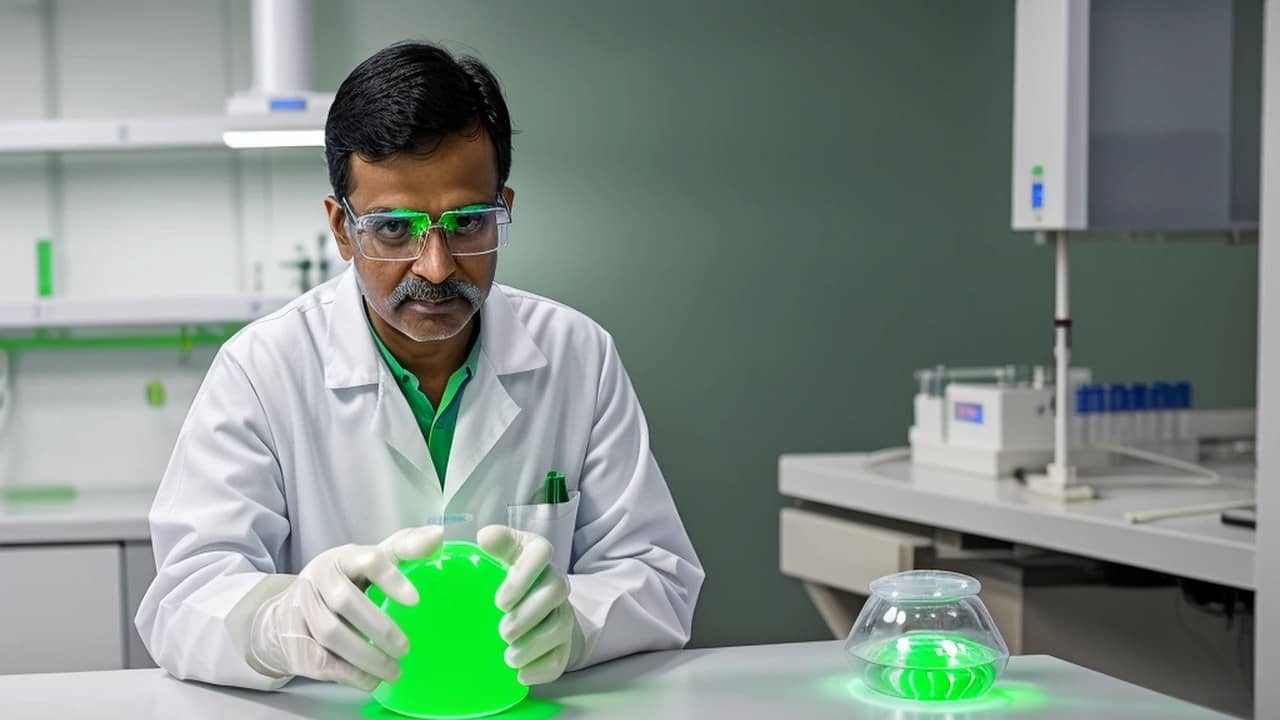
The compound at the centre of the study, referred to as OS-1, contains osmium, a heavy metal. On its own it is meant to stay relatively quiet; the idea is that it becomes active against bacteria only when green light falls on it. This kind of approach is often called photodynamic or light-activated therapy.
Light-activated antibacterial treatment is not a new idea in itself. Researchers around the world have studied compounds that react to light and produce reactive oxygen, which damages bacterial cells. The challenge has been to find compounds that respond to safe visible light, work against tough biofilms and do not harm the surrounding tissue. Many earlier compounds needed ultraviolet or blue light, which penetrates poorly and can damage skin. Green light passes a little deeper into tissue, which is one reason researchers are interested in compounds that respond to it.
When OS-1 was used with green light, biofilms of E. coli and Bacillus subtilis fell by about 85 per cent, according to the institute. The team also tested the treatment on mice with bacteria-infected wounds. By the 11th day of treatment, the wounds had healed by close to 99 per cent, the researchers reported.
Biofilms are among the biggest headaches in treating infections. Bacteria inside a biofilm sit behind a protective layer that makes it hard for antibiotics and the body's own defences to reach them. That is one reason infections on wounds, catheters and implants can drag on for weeks and keep coming back.
A treatment that can be targeted with light has a practical appeal. The light can be shone only on the infected area, which in principle limits the effect on healthy tissue and on the useful bacteria elsewhere in the body. Green light is also easy and cheap to produce with LEDs.
The results so far come from laboratory tests and animal studies. Before any such compound can be used on patients in India, it would need detailed safety studies, including on how the body handles a metal-based drug, followed by clinical trials and regulatory approval. The institute has not announced any timeline for human trials, and readers should not expect a product in clinics soon.
Still, the work adds to a growing body of research at IIT-BHU and BHU on low-cost scientific tools. Earlier this week, BHU researchers reported a way to turn lamp soot into carbon nanodots to detect lead in water, which we covered in our report on the lamp soot lead test. IIT-BHU scientists have also worked on recovering gold and copper from electronic waste, described in this earlier story.
Doctors and public health bodies, including the Indian Council of Medical Research, have repeatedly warned that antibiotic resistance is rising in India, partly because of overuse and self-medication. New ways of attacking bacteria that do not rely only on conventional antibiotics are therefore of wide interest to researchers.
For students in Varanasi interested in this area, the study is also an example of chemistry and biomedical engineering labs on the same campus working together on a single problem. Such cross-department projects have become more common at IIT-BHU in recent years, with joint papers in chemistry, materials and health.
The findings point to a possible new line of treatment for stubborn wound infections rather than a replacement for existing antibiotics. Dalimss News will follow up if the researchers announce the next stage of testing.