IIT-BHU Metallurgist Recovers 92% Gold, All Copper From E-Waste Circuit Boards
An IIT (BHU) Varanasi metallurgist has shown a way to recover all the copper and 92 per cent of the gold from discarded circuit boards. Prof. Kamlesh Kumar Singh presented the research this week at an international scientific conference in Nalchik, Russia.
Singh, of the Department of Metallurgical Engineering, presented his work on recycling electronic waste at GEO-SUSTAINABILITY BRICS 2026, held from 23 to 25 September. The conference's theme was geophysical processes, environmental sustainability and the rational management of natural resources in an era of global change.
It was organised by Kabardino-Balkarian State University (KBSU) and the High-Mountain Geophysical Institute, with official support from Russia's BRICS Expert Council. Scientists from Russia, Brazil, China, India, South Africa, Turkey and Uzbekistan took part.
Singh was invited as a plenary speaker and was also made a member of the conference's international scientific committee. The invitation from KBSU specifically mentioned his experience in metallurgical engineering, e-waste recycling, extraction of critical metals and sustainable resource management. The conference website lists him on its International Board of Experts.
His paper was titled "Recycling of electronic waste for sustainable environmental management". It focuses on an integrated recycling process for recovering valuable metals from e-waste.
The research starts from a problem. Electronic waste contains toxic substances such as lead, mercury, cadmium and brominated epoxy resins. At the same time, the printed circuit boards (PCBs) inside electronic devices are an important source of valuable metals such as gold, silver, copper and tantalum.
Using leaching and solvent extraction on delaminated PCBs, the study achieved 100 per cent recovery of copper and 92 per cent recovery of gold. It also recovered 99 per cent of the manganese from tantalum capacitors, at a purity of 99.6 per cent. The study describes processes for separately recovering silver and other metals as well.
For metals present in extremely small amounts, at parts-per-million level, the research examined polymer inclusion membrane technology, which was found to be effective in recovering metal ions.
Singh's work suggests combining several techniques, including hydrometallurgy, bio-hydrometallurgy, electro-winning, solvent extraction and polymer inclusion membranes, to recover as much valuable material as possible from e-waste. The aim is maximum resource recovery with a zero-waste approach to environmental management.
On the conference's opening day, scientists from Brazil, China, India, Uzbekistan and Turkey presented research in plenary sessions. The topics included climate governance, carbon markets, monitoring of pasture degradation, land-atmosphere interactions and e-waste recycling.
The research lands at a time when e-waste is becoming a civic issue in Varanasi itself. The city's municipal corporation has just launched a doorstep collection arrangement for discarded electronics, under which residents are paid for handing over old devices that are then sent for authorised recycling.
The gold figure in Singh's study, 92 per cent from delaminated circuit boards, is the number most likely to catch attention outside the laboratory. It is also a reminder of how much value sits inside the old phones and computers that the city is now trying to collect.
Sources and reporting
IIT (BHU) information on Prof. Kamlesh Kumar Singh's plenary at GEO-SUSTAINABILITY BRICS 2026, Nalchik, 23–25 Sep (KBSU and High-Mountain Geophysical Institute): paper 'Recycling of electronic waste for sustainable environmental management'; 100% Cu, 92% Au from delaminated PCBs; 99% Mn at 99.6% purity.
Related Stories
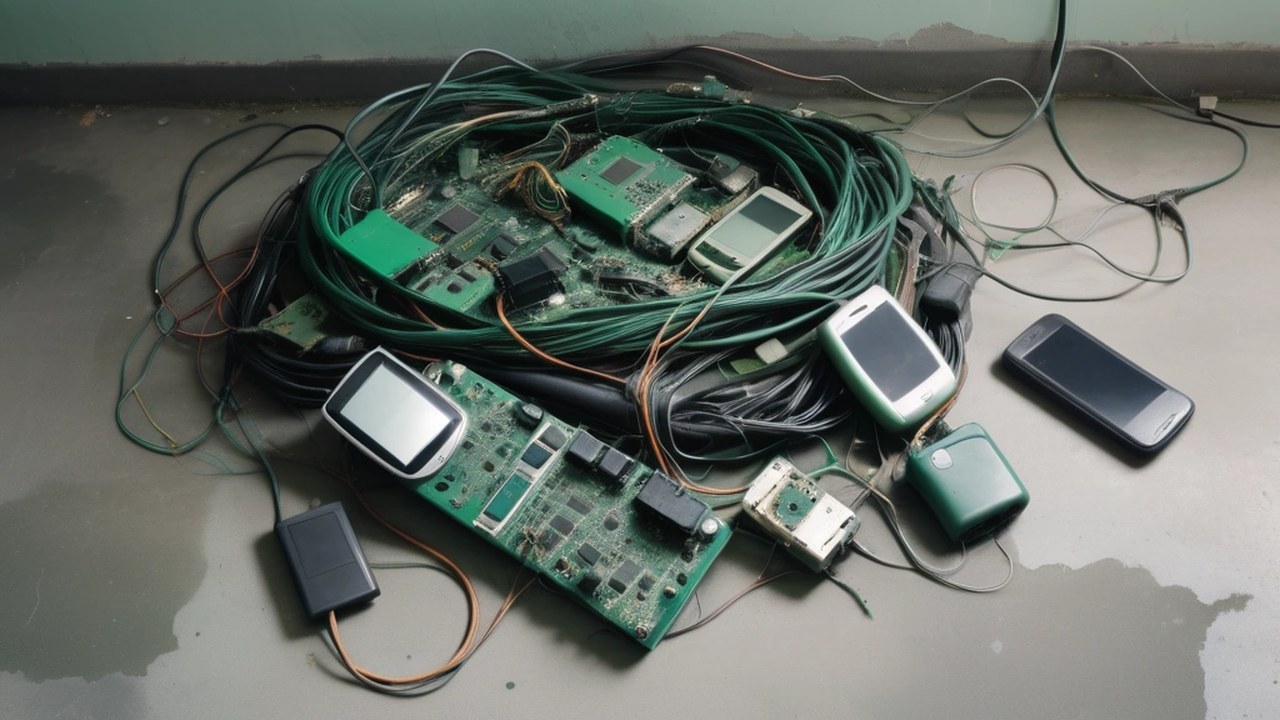
VMC Launches Doorstep E-Waste Pickup With On-the-Spot Payment
Family Alleges Youths Chased Car, Assaulted Women and Children Near V-2 Mall in Lanka
Sigra-Trained Shooter Kamaljeet Wins Asian Games Gold in Mixed Air Pistol
Sarnath Police Arrest Three Over Locked-House Burglaries, Claim ₹7 Lakh Recovery
NER Varanasi Division Runs 2,915 Chlorine Tests on Station and Colony Water