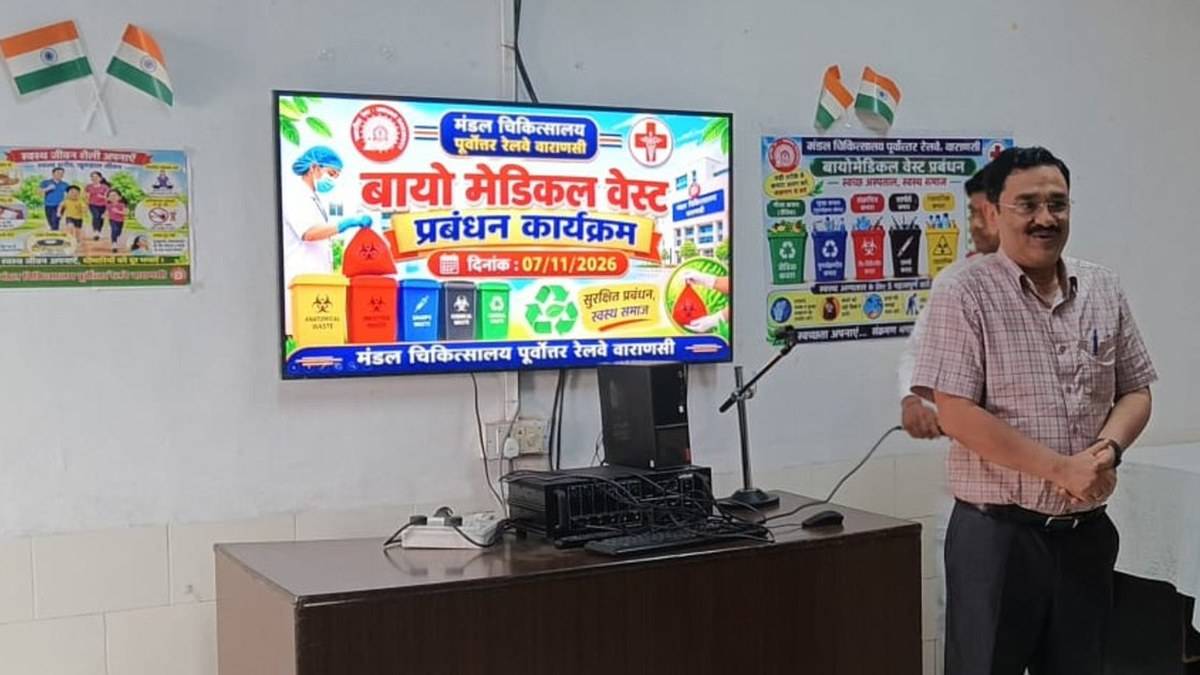
VARANASI: North Eastern Railway held a seminar on biomedical waste management at its Varanasi divisional hospital on Saturday, November 7, 2026, bringing doctors and paramedical staff together to discuss segregation, safe collection and scientific disposal. The railway division’s official announcement identifies Divisional Railway Manager Ashish Jain as chair of the programme.
For people using the divisional hospital, the practical issue is how treatment waste moves from a consultation room or ward into secure storage and onward for disposal. Patients and attendants should follow staff instructions about designated containers and alert a hospital worker if they see discarded needles or other treatment materials. They should leave handling those materials to trained personnel.
The event was part of the November 1 to 7 BRICS Sustainable Lifestyle Week under Mission LiFE, according to reports of the programme. The hospital session focused specifically on healthcare waste. It did not announce a new outpatient timetable, patient charge or restriction on access to treatment.
What the hospital discussed
The railway division’s announcement describes the three linked subjects as separation of biomedical waste, secure collection and scientific disposal. These are relevant to doctors, nursing and paramedical personnel, as well as workers who collect material after a procedure.
Reports of the seminar identify Chief Medical Superintendent Dr R J Chaudhuri as leading the hospital programme. Additional Chief Medical Superintendent Dr Kalpana Dubey explained the importance of separating waste according to the prescribed colours, storing it safely and arranging disposal under the applicable standards.
Jain asked healthcare workers to follow the prescribed standards responsibly. At the close, doctors and paramedical employees took a pledge covering proper segregation, safe management and scientific disposal, together with keeping the hospital clean and preventing infection. The reports do not give a participant count or a new waste collection contract.
What the colour system means
The national biomedical waste rules, available through the Central Pollution Control Board, explain why different treatment materials require different containers. The categories concern the nature of the waste and its treatment route. They should not be treated as ordinary household recycling instructions.
- Yellow covers categories including blood or body fluid contaminated dressings, cotton swabs and other soiled treatment material.
- Red covers specified contaminated recyclable plastic items, including tubing, intravenous sets and gloves, which require the prescribed treatment before recycling.
- White translucent containers are intended for metal sharps, including needles, blades and other contaminated sharp objects. The containers must resist punctures, leakage and tampering.
- Blue covers specified contaminated glassware, such as medicine vials and ampoules, with exclusions for material contaminated by cytotoxic waste.
These distinctions give substance to the seminar’s emphasis on separation. A used needle and a disposable plastic tube present different handling problems. The rules assign treatment and disposal arrangements to the responsible healthcare establishment and authorised operators, rather than to patients waiting in the building.
What residents and hospital workers should do
Visitors should ask a hospital employee where an item belongs if there is uncertainty, particularly where treatment material is involved. Reporting a visible problem to staff is more useful than moving clinical waste between bins. The Saturday announcement gives no new public telephone number for this programme.
For staff, the rules set out continuing responsibilities beyond a single awareness session. People involved in biomedical waste handling are to receive training when they join and at least annually thereafter. The occupier must also provide appropriate protective equipment and arrange health checks at induction and at least once a year.
The rules require a safe, ventilated and secured place within the premises for segregated waste storage. This is intended to prevent scattering, spillage and unauthorised handling before transport for the appropriate treatment. They also require protection for workers through immunisation against relevant diseases, including hepatitis B and tetanus, under the applicable national guidance.
Those are existing responsibilities, not fresh measures claimed to have been completed at the Varanasi hospital on Saturday. The programme report records discussion and a staff pledge. It does not publish an inspection score, waste quantity or evidence that every part of the disposal chain was audited.
Readers planning treatment can also consult our Varanasi hospital guide. Related local reporting covers the Kabirchaura hospital quality assessment and hospital emergency preparations for Diwali. Those concern separate institutions or arrangements and do not change the scope of the railway hospital’s waste seminar.