The black soot that collects over a mustard-oil lamp, the same soot Indian households have long scraped off to make kajal, has been turned into a tool for spotting toxic lead in water by a research team at Banaras Hindu University. The appeal is simple: a cheap, familiar material doing a job that usually needs costly laboratory equipment.
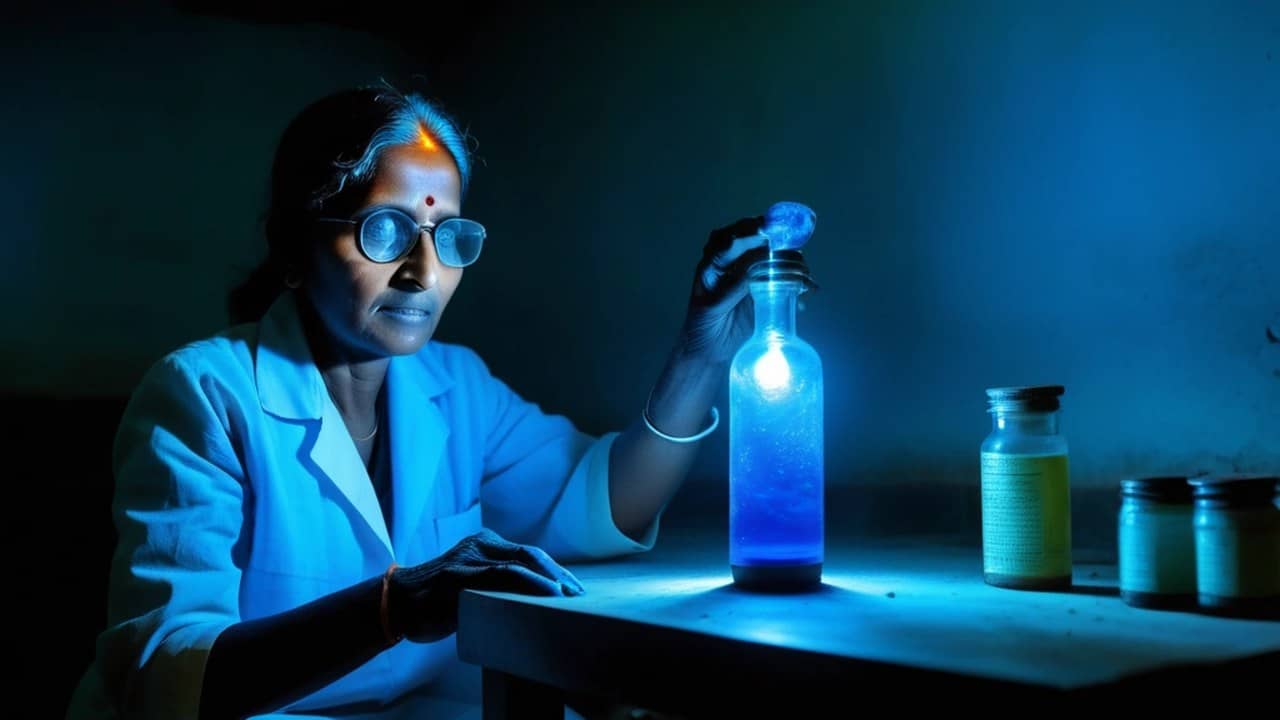
Sonam Lamu Sherpa, a junior research fellow at BHU working under the supervision of Dr Archana Tiwari, has converted the lamp soot into photoluminescent carbon nanodots that can detect lead ions dissolved in water, according to details of the recently published work shared on Wednesday. The nanodots are tiny particles of carbon that give off light.
Dr Tiwari is an Assistant Professor in BHU's Department of Physics, according to her official academic profile, and her group works on carbon quantum dots for optical sensing. Researchers from Sikkim, the University of Hyderabad and IISER Bhopal also contributed to the study. A junior research fellowship is usually the first funded rung for doctoral scholars in Indian science, awarded through national tests such as the CSIR-UGC NET, which makes a published study at this stage a real step for a young researcher.
The starting material could hardly be more ordinary. The study describes how the soot is gathered at home: an earthen pot is held upside down over the flame of a mustard-oil lamp, and the carbon settles on its inner surface. In many homes that layer is then mixed with a binding material to make black colour, or blended with ghee to make kajal.
What the team did differently was treat that soot, chemically known as carbon black, as raw material for nanoparticles. At the nanoscale, carbon behaves in ways it does not in a lump of soot. Particles only a few billionths of a metre across can glow when light falls on them, and that glow is the property the researchers have put to work.
Sensors built on carbon dots generally work by watching that light. When a particular metal ion in the water latches on to the dots, the glow changes, often growing dimmer, and the change can be measured. The BHU team reports that its soot-derived dots can detect lead ions, which chemists write as Pb2+. The information shared did not spell out the exact response the team measured or the lowest concentration the method can pick up, and those details are not reported here.
Lead is among the best known toxic metals in drinking water. It can enter supplies from old pipes, solder, industrial discharge and some paints, and the World Health Organization's guideline value for lead in drinking water is 10 micrograms per litre. India's drinking water standard uses the same limit.
The difficulty is in measuring it. Testing for lead at such low levels usually depends on laboratory instruments that are expensive to buy and run, and on trained staff to operate them. Atomic absorption spectroscopy and mass spectrometry are among the standard techniques. That is why researchers in many countries have been looking for simpler optical methods, and why a sensing material made from something as cheap as lamp soot draws attention.
It is worth being clear about what this is and is not. The work is a laboratory study of a sensing material. It is not a test kit that households can buy, and the researchers have not announced any product. Turning a promising lab result into a reliable field test usually takes further validation with real water samples, and the information shared does not say whether the method has yet been tried on tap water or groundwater.
The study also fits a broader pattern at BHU and IIT-BHU, where researchers have been applying laboratory science to everyday environmental problems. Earlier this month a BHU scientist helped shape a new protocol for monitoring microplastics in the Ganga, and last month an IIT-BHU metallurgist reported recovering gold and copper from discarded circuit boards.
There is a certain neatness to the idea. The lamp that lit Indian homes for centuries, and the soot it left behind on an upturned clay pot, may one day help a laboratory find lead in a glass of water, starting from a material that costs next to nothing.