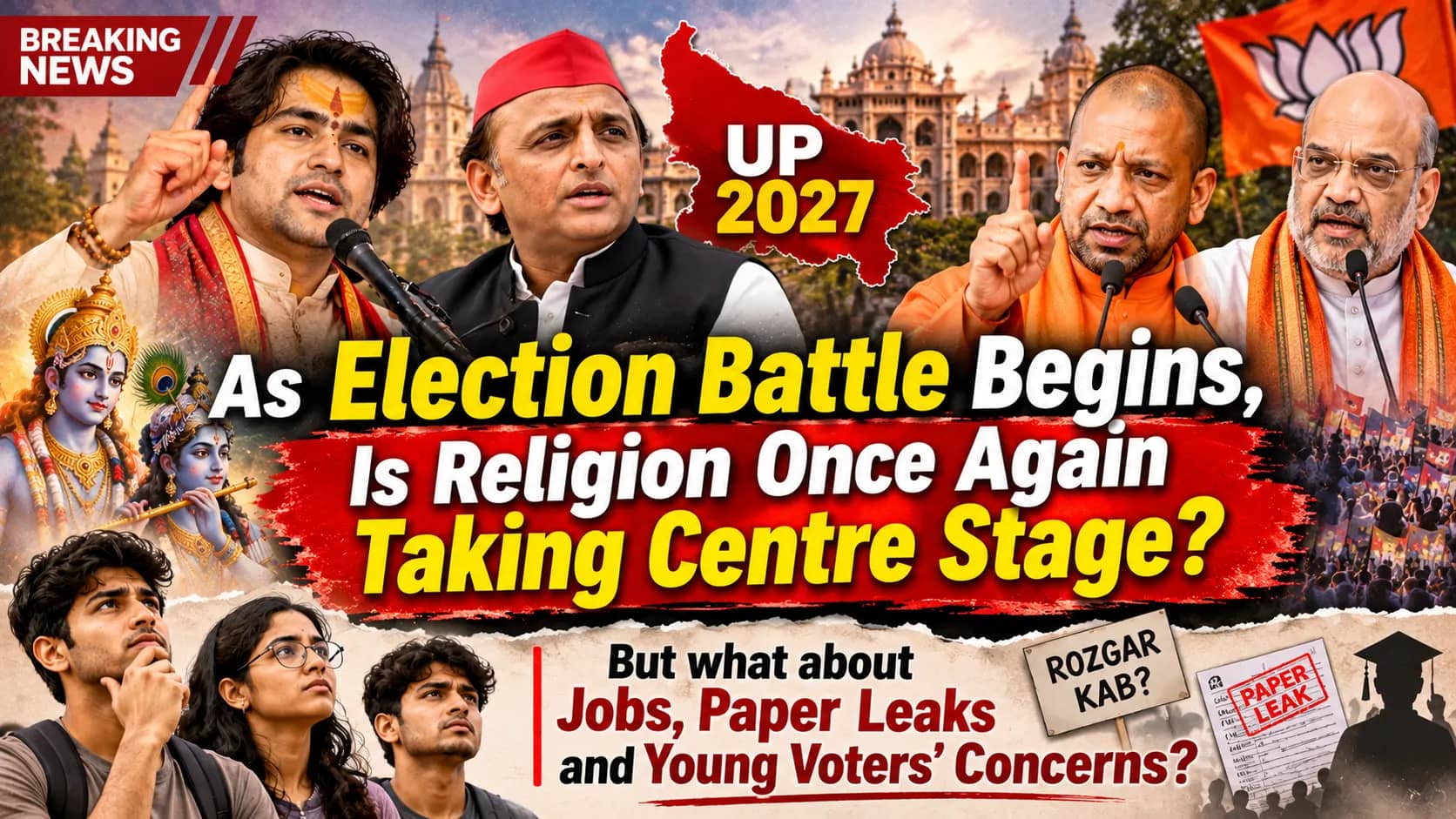
From the Ram-Krishna controversy and political poster wars to Amit Shah's Uniform Civil Code announcement, early signs suggest that religion could once again play a major role in Uttar Pradesh's 2027 Assembly elections. But what about jobs, paper leaks and the concerns of young voters?
The political atmosphere in Uttar Pradesh is slowly heating up as the state moves towards the 2027 Assembly elections. Although the elections are still some months away, the early signs of the political battle are already becoming visible.
Once again, the main contest is expected to be between the Bharatiya Janata Party (BJP) and the Samajwadi Party (SP). Both parties have started preparing their political strategies and setting the tone for the upcoming elections.
But one thing that stands out in the early political developments is the growing focus on religion, religious identity and caste.
Interestingly, this political discussion is not being shaped by politicians alone. Religious leaders, public speakers and other influential personalities are also becoming part of the conversation, sometimes through statements that quickly turn into political controversies.
And one of the biggest examples of this is the recent controversy involving Bageshwar Dham chief Dhirendra Krishna Shastri.
From Ram vs Krishna to a Political Poster War
On October 29, 2026, during a religious programme in Shivpuri, Madhya Pradesh, Dhirendra Krishna Shastri made remarks while comparing Lord Ram and Lord Krishna. His use of the word 'tedha' while describing Lord Krishna upset many devotees and led to criticism from religious leaders and political groups.
The controversy soon reached Uttar Pradesh's political circles.
Outside the Samajwadi Party headquarters in Lucknow, posters appeared with the slogan "27 Mein Krishna Aayenge", showing Lord Krishna playing the flute. The message was clearly connected to the 2027 Assembly elections.
Another set of posters criticised Dhirendra Shastri and stated that neither Lord Ram nor Lord Krishna belongs to any one political party. It also said that both are loved and respected by people across the country.
The BJP responded with its own posters carrying the slogan "Jo Ram Ko Laaye Hain, 27 Mein Shri Krishna Ko Laayenge." Through this message, the BJP tried to connect its Ram Mandir narrative with the issue of Lord Krishna and Mathura.
BSP supporters also joined the poster battle. A hoarding in Lucknow's Gomti Nagar area carried the message "Doglon Se Savdhan", taking a dig at the Samajwadi Party.
What started as a religious controversy has now turned into a political exchange between parties.
The bigger question is: Why are religious symbols and religious figures becoming such an important part of political messaging even before the election campaign has officially started?
When Religious Leaders and Public Figures Become Part of Politics
The Dhirendra Shastri controversy is not the only incident adding to the political discussion.
Another controversy involving Delhi University professor Sangit Kumar Ragi has brought caste into the spotlight.
During a television debate, Ragi made remarks about the Yadav-Ahir community while speaking to Samajwadi Party spokesperson Manoj Kaka. His comments led to criticism, especially from people who felt that the remarks targeted an entire community.
Ragi later apologised and said that his comments were directed at individuals involved in the argument and were not meant to insult the entire community.
However, the controversy once again brought caste identity into the political discussion. This is important because the Yadav community has traditionally been an important support base for the Samajwadi Party in Uttar Pradesh.
When statements about religion and caste become major talking points, they quickly enter the larger political debate.
Of course, every controversial statement by a religious leader or public figure cannot be linked directly to a political party. But the way political parties react to such statements shows how quickly these issues can become part of election discussions.
Amit Shah's Lucknow Speech: A Clear Message for 2027?
Another important development came on October 30, when Union Home Minister Amit Shah addressed the BJP's State Working Committee meeting in Lucknow.
During his speech, Shah announced that if the BJP comes back to power in Uttar Pradesh in 2027, the party will implement the Uniform Civil Code (UCC) in the state.
He also brought up the October 30, 1990 police firing on kar sevaks in Ayodhya under the then Mulayam Singh Yadav government. Questioning the Samajwadi Party, he asked how a party associated with the firing on Ram devotees could expect to return to power.
This speech gave an idea of the issues the BJP may focus on during the upcoming election campaign.
The announcement on UCC and repeated references to Ayodhya and the Ram Mandir movement show that religious and ideological issues will remain an important part of the BJP's political messaging.
Shah also spoke about dissatisfaction among BJP workers. He acknowledged that some party workers were unhappy but defended the leadership's efforts to give them positions and responsibilities in government bodies and organisations.
Meanwhile, BJP national general secretary and Uttar Pradesh in-charge Vinod Tawde made it clear that the party would contest the 2027 Assembly elections under the leadership of Chief Minister Yogi Adityanath.
Together, these developments show that the BJP is already working on its leadership message, party organisation and key election issues.
The Samajwadi Party, on the other hand, will have to build its own strong narrative to challenge the BJP and connect with different sections of voters.
But Where Are the Issues That Matter to Young People?
This is perhaps the biggest question that needs attention.
Uttar Pradesh has a large young population. Millions of students and job seekers are preparing for government examinations, looking for employment and trying to build a better future.
For them, the upcoming election should also be about some very basic questions.
Where are the jobs?
What is being done to prevent paper leaks and examination irregularities?
What happens to students who spend years preparing for government jobs but continue to face delays and uncertainty in recruitment?
What steps are being taken to improve colleges and universities?
How will the government create more employment opportunities so that young people do not have to leave their hometowns and move to other states in search of work?
These are not small issues. They affect the lives and future of millions of young people in Uttar Pradesh.
The BJP can talk about its work on roads, infrastructure, investment, welfare schemes and law and order. The Samajwadi Party can question the government's performance and present its own plans for employment and development.
Both parties have the opportunity to tell voters what they have done and what they plan to do.
But these questions deserve as much attention as religious controversies and political slogans.
A poster war can dominate the news for several days. A controversial statement can become a major political issue overnight. But the concerns of a student waiting for a recruitment examination or a graduate searching for a job should also receive the same attention.
The Real Election Battle Is Yet to Begin
It is still too early to say that the 2027 Uttar Pradesh Assembly elections will be fought only on religious issues. The official campaign has not started, and many other issues, political developments and local concerns may change the direction of the debate.
The Samajwadi Party may focus on employment, caste representation and other public issues to challenge the BJP. The BJP may combine its religious and ideological message with its claims of development and good governance. The BSP and Congress will also try to find their place in the political battle.
There is also a difference between the issues that dominate news headlines and the issues that matter to voters in their daily lives.
Political posters, controversial statements and speeches may attract public attention. But voters also have questions about roads, electricity, education, employment, prices and basic facilities.
The early developments are certainly worth watching. From the Ram-Krishna controversy to the remarks about the Yadav-Ahir community, from the poster war in Lucknow to Amit Shah's UCC announcement, religion and identity have already become important parts of the political discussion.
And this raises an important question for every political party:
Will the 2027 Uttar Pradesh elections once again be dominated by religion and identity, or will political parties also talk seriously about jobs, education, paper leaks and the future of young people?
As the elections approach, different parties will bring their own issues and promises before the public. But voters must also get the chance to question them about their work, their plans and their promises.
For now, religion and identity are clearly getting a lot of attention in the early political exchanges. Whether employment, education and other everyday issues will get the same space in the coming months remains to be seen.
Because an election is not just about which political party creates the loudest headlines. It is also about which party answers the questions that matter to ordinary people.