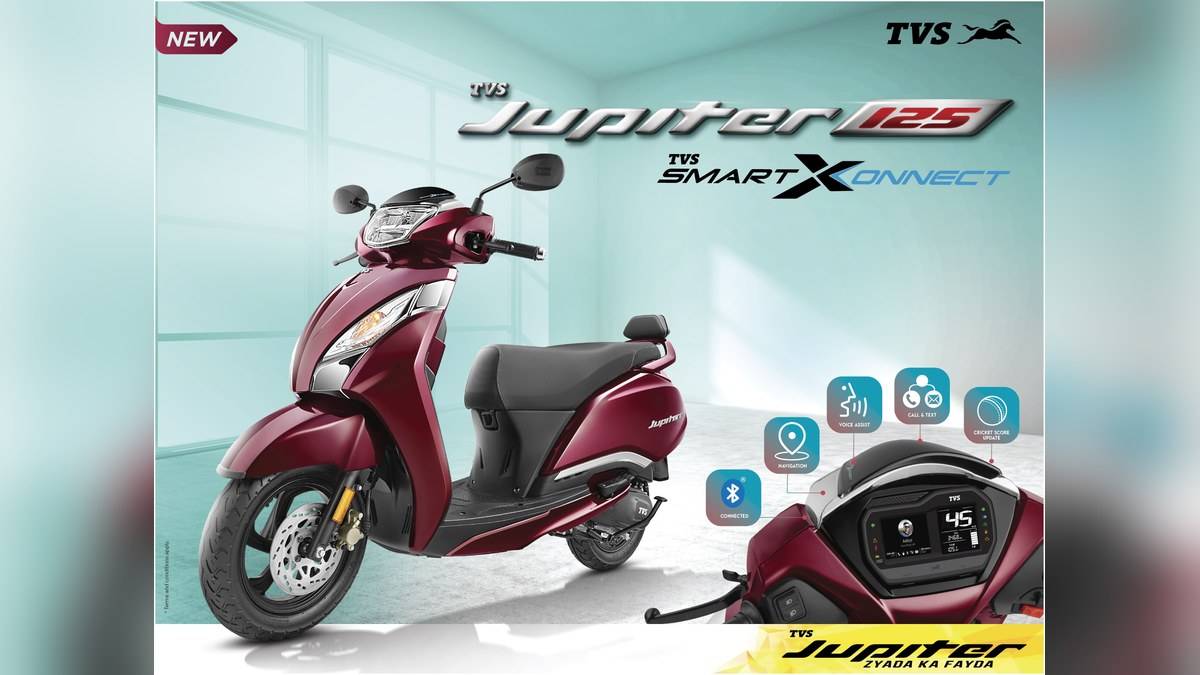
NEW DELHI: The TVS Jupiter 125 SmartXonnect's follow-me headlamp stays illuminated for 20 seconds after the engine is switched off, according to TVS's official description. That short lighting window is intended to help in dark parking areas. It sits alongside hazard lamps, a connected instrument console and a pillion backrest in the SmartXonnect equipment package.
| Item | Official description |
|---|---|
| Model covered | Jupiter 125 SmartXonnect |
| Follow-me lighting | 20 seconds after engine switch-off |
| Other lighting equipment | Hazard lamps, LED headlamp |
| Connected functions | Navigation with voice assistance, call and message alerts |
| Comfort equipment | Pillion backrest, 790 mm seat |
| Rear suspension | 3-step adjustment |
What the lighting window is useful for
For a scooter parked facing a gate, the headlamp can briefly illuminate the space ahead while the rider gets off. The useful area depends on where the scooter points. A lamp facing a wall cannot light a staircase behind it, so the parking position matters as much as the presence of the feature.
The quoted duration should also set expectations. It is a short interval for the transition from riding to parking, rather than lighting for a lengthy unloading session. A rider carrying shopping or helping a passenger dismount should consider whether the building's permanent lighting covers the rest of the task.
TVS gives a duration, but the launch description does not provide an illumination-distance figure or a promise that the entire parking area will be lit. Those would be separate measurements. The practical check is whether the headlamp reaches the ground and doorway that the owner actually uses.
Check the function on the correct scooter
The timed-lighting description belongs to the Jupiter 125 SmartXonnect announcement. Anyone comparing a showroom vehicle with an online photograph should confirm the full variant name on the quotation. A Jupiter badge by itself is insufficient to establish that every convenience function shown in a promotional image is included.
A useful handover demonstration would show the normal switch-off sequence in a shaded area, with the scooter stationary. The owner can then see where the beam falls and how the delayed lighting behaves. The public description should not be turned into an invented button sequence, since it does not spell out a universal activation procedure.
Ask for that demonstration before relying on the function at home. If the expected lighting does not appear, the next step is to check the supplied owner's instructions and have the equipment explained. Guessing at controls in a dark, crowded parking area defeats the purpose of a convenience feature.
Hazard lamps serve a separate purpose
TVS lists hazard lamps alongside the follow-me function. The former make the scooter conspicuous; the latter provide a brief period of forward illumination after stopping. Owners should recognise the controls for both and understand which problem each is meant to address.
This distinction is relevant to apartment parking. A scooter stopped temporarily near an entrance and a scooter already parked for the night create different visibility needs. Knowing which control does what is more useful than treating all the lighting equipment as a single feature on a specification sheet.
The related TVS Jupiter price: Rs 74,400 to Rs 90,225, Jupiter 125 from Rs 82,100 covers another area where variant identification matters. Lighting and braking should each be checked against the exact scooter supplied, rather than inferred from a family name.
The connected console adds another set of checks
The current SmartXonnect product page lists navigation with voice assistance, call and social-media alerts, distance to empty and average fuel economy. These functions address the ride itself, while follow-me lighting addresses the moment after it. They are different reasons to inspect the equipment during a handover.
TVS's launch material describes smartphone pairing through the TVS Connect app. A demonstration using the intended phone is more informative than a powered-on dashboard alone. It helps establish whether the owner can access the functions they expect, without assuming that every notification or navigation capability operates independently of a phone.
For riders who mainly want straightforward transport, the relevant question is which of these functions they will use. An illuminated route home from the parking spot may be immediately useful even when live updates on the console are of little interest. A feature list should support that personal assessment.
Look beyond the dashboard at handover
The same product page specifies a 790 mm seat, a cushioned pillion backrest and rear suspension with three adjustment steps. Try the normal seating arrangement with the passenger who will regularly travel. Seat length and the presence of a backrest do not describe how a particular pair of people will fit.
Families comparing carrying arrangements can also read our TVS Jupiter trims: 130 mm drum or 220 mm front disc and TVS Apache price list: Rs 1,15,140 to Rs 2,62,240, on-road Delhi from Rs 1,40,949. These are separate model guides, rather than evidence that their equipment is shared with the Jupiter.
For the Jupiter 125 SmartXonnect, a useful final check is simple: identify the variant, see the timed headlamp work, try the connected console and sit on the scooter with the usual passenger. That turns an equipment list into something the owner understands before the first evening ride.
Official sources: TVS SmartXonnect launch description and current Jupiter 125 SmartXonnect equipment page.