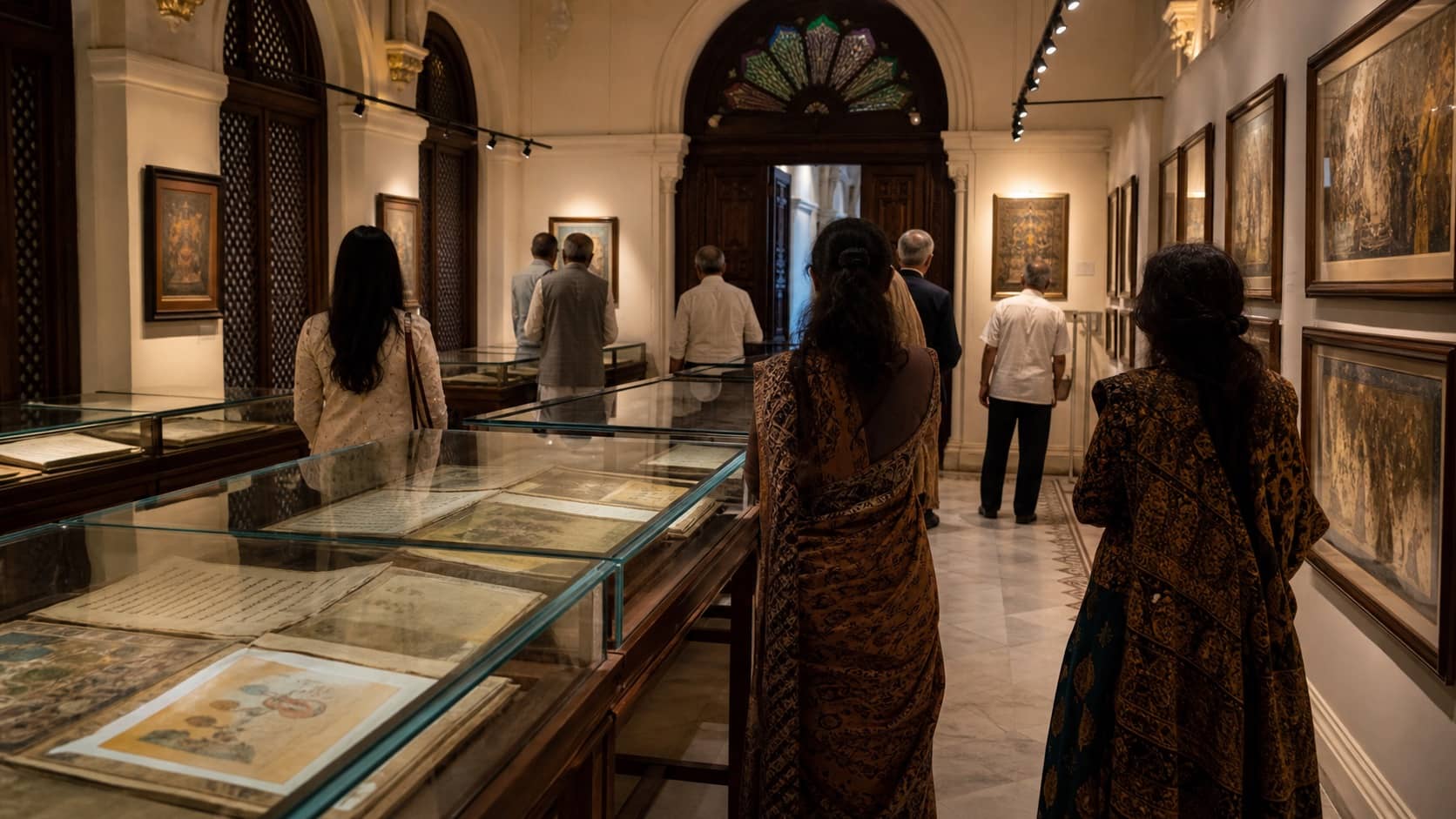
VARANASI: Central Tourism Secretary Bhuwanesh Kumar visited the Nagari Pracharini Sabha on Sunday and toured three recently developed galleries that bring together the institution’s literary, artistic and archival holdings. The visit placed fresh attention on one of the city’s most important Hindi-language institutions and on the challenge of presenting fragile cultural material to a contemporary public without stripping it of context.
Kumar was shown through the Shadang, Nepathya and Pratipada galleries. The displays include paintings, rare manuscript pages and personal objects connected with some of modern Hindi literature’s defining figures. Among the material presented were handwritten pages associated with Premchand, Jaishankar Prasad, Acharya Ramchandra Shukla and Maithilisharan Gupt, alongside objects linked to Madan Mohan Malaviya, Shyamsundar Das and former president Rajendra Prasad.
A section devoted to Mahavir Prasad Dwivedi traces the editor and critic’s influence on the development of modern Hindi prose and public debate. For visitors who know these names mainly through schoolbooks, seeing drafts, correspondence and working material offers a different route into literary history: not as a finished canon, but as writing shaped through revision, publishing networks and argument.
The tourism secretary also viewed a monsoon-themed exhibition of Bengal-school paintings organised with Bharat Kala Bhavan. The seasonal display gives the galleries a visual counterpoint to the manuscripts, connecting poetry’s familiar imagery of clouds, rivers and longing with the pictorial vocabulary developed by Indian artists in the late nineteenth and early twentieth centuries.
Tourism officials Arun Srivastava and Uttank Joshi accompanied Kumar during the tour. Poet and theatre practitioner Vyomesh Shukla welcomed the visitors and explained the curatorial ideas behind the spaces. The Sabha’s collections have long attracted researchers, but the new galleries are designed to make at least part of that scholarship visible to residents, students and travellers who may have only a short window in the city.
That matters in Varanasi, where the tourist circuit can easily become confined to temples, ghats and a handful of monumental sites. A stronger network of small museums, libraries and archival galleries would allow visitors to encounter Kashi as a city of printing, debate, music and language as well. It could also create reasons for repeat visits beyond the standard itinerary.
The practical test will be conservation. Paper, textiles and old photographs are vulnerable to light, humidity and frequent handling, particularly during the monsoon. Clear rotation policies, stable display conditions and digitised access can help institutions show valuable material while protecting originals. Good labels in Hindi and English would further open the collection to younger visitors and researchers from outside the region.
Kumar’s visit did not include an announcement of new funding or a tourism project. Even so, the attention from the Union tourism administration gives the Sabha an opportunity to make a broader case for literary heritage as part of Varanasi’s public identity. The three galleries show that the city’s past survives not only in stone and ritual, but also in the pages, paintings and everyday possessions left by its writers.