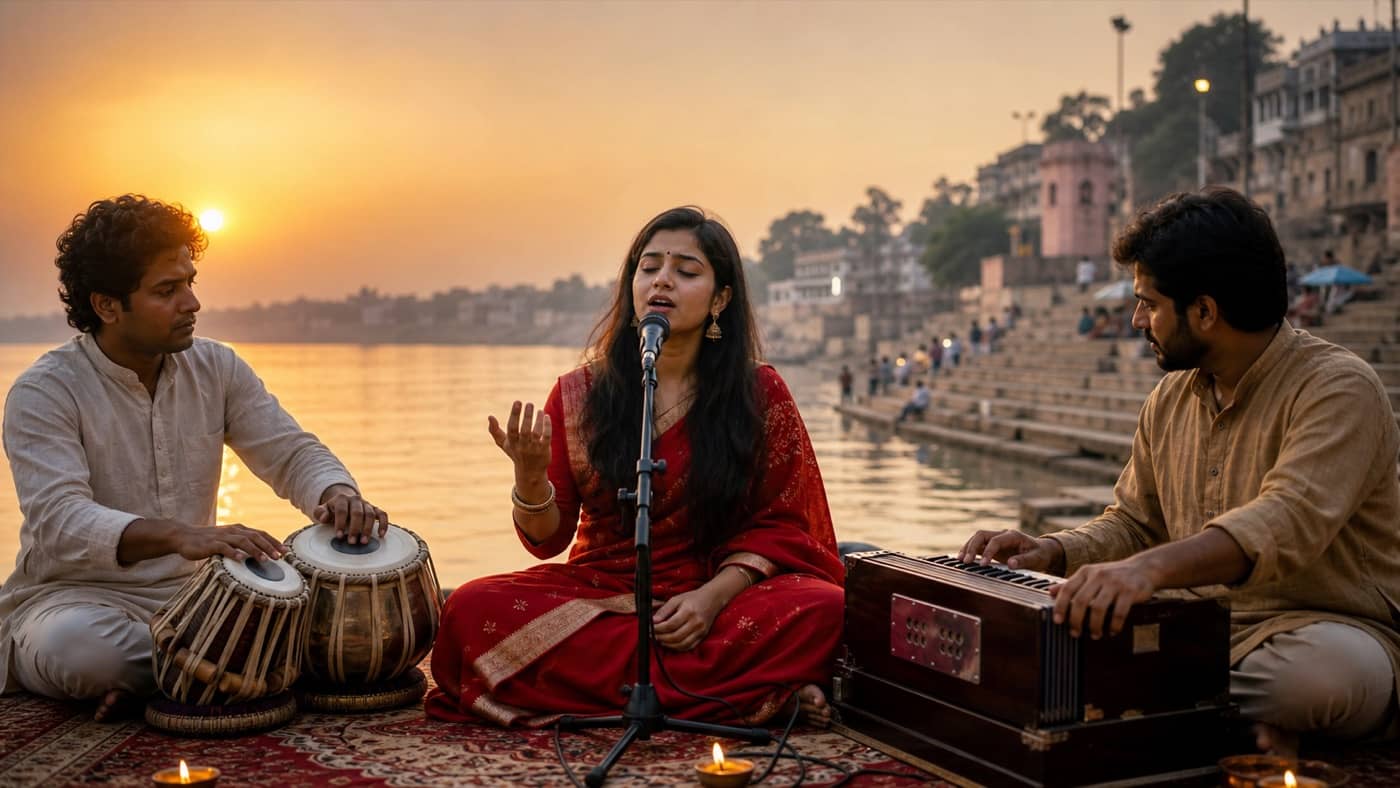
VARANASI: Assi Ghat’s morning soundscape took a classical turn on Saturday as emerging vocalist Shikha Dwivedi presented Raga Basant during the Subah-e-Banaras programme. Nikhil Soni accompanied her on tabla and Mohit on the harmonium-like samvadini, creating a compact recital for people gathered beside the Ganga at daybreak.
The performance was brief in the published account, but its setting gives it a particular character. A morning raga at a ghat is heard alongside bells, birds, boat engines, footsteps and the ordinary opening of the riverfront. The musician is not separated from the city by a closed auditorium; the city becomes part of the acoustic frame.
Raga Basant is commonly associated with spring and carries a distinct melodic grammar within the Hindustani tradition. A recital depends not on repeating a fixed song exactly, but on developing the raga’s identity through disciplined improvisation. The vocalist introduces phrases, explores their emotional colour and works with the rhythmic cycle established by the tabla.
For an emerging artist, an open public platform can be more demanding than it appears. The audience includes trained listeners, tourists, walkers and people who did not arrive specifically for a concert. Holding their attention requires clarity and restraint, while outdoor sound conditions demand careful coordination with accompanists.
The samvadini supports the melodic line and gives the singer a tonal anchor. Tabla accompaniment does more than keep time; it responds to the architecture of the improvisation and intensifies the return to the composition’s main phrase. When the partnership is balanced, the audience hears a conversation rather than a solo voice with background sound.
Subah-e-Banaras has helped make such performances part of the public morning at Assi. That accessibility matters for classical music, which can otherwise feel locked behind specialised venues and formal invitations. A passer-by may stay for only ten minutes, but those minutes can become a first encounter with a raga performed live.
Varanasi’s musical identity is often spoken of in grand historical terms. It survives through smaller, recurring occasions: a young singer taking the stage, accompanists listening closely and an audience arriving before the heat and traffic. Saturday’s Raga Basant belonged to that living chain—tradition presented not as a museum piece, but as part of the city waking up.
Morning programmes also need careful stewardship of the ghat. Amplification should remain sensitive to residents and other users, stages must not obstruct walking routes and waste should be cleared immediately. Cultural continuity works best when the performance feels woven into the riverfront rather than imposed upon it. That balance is part of what makes an open-air recital distinctly Banarasi.