Shankar Chowk Traffic Revamp Put on Hold to Align With RRTS Corridor
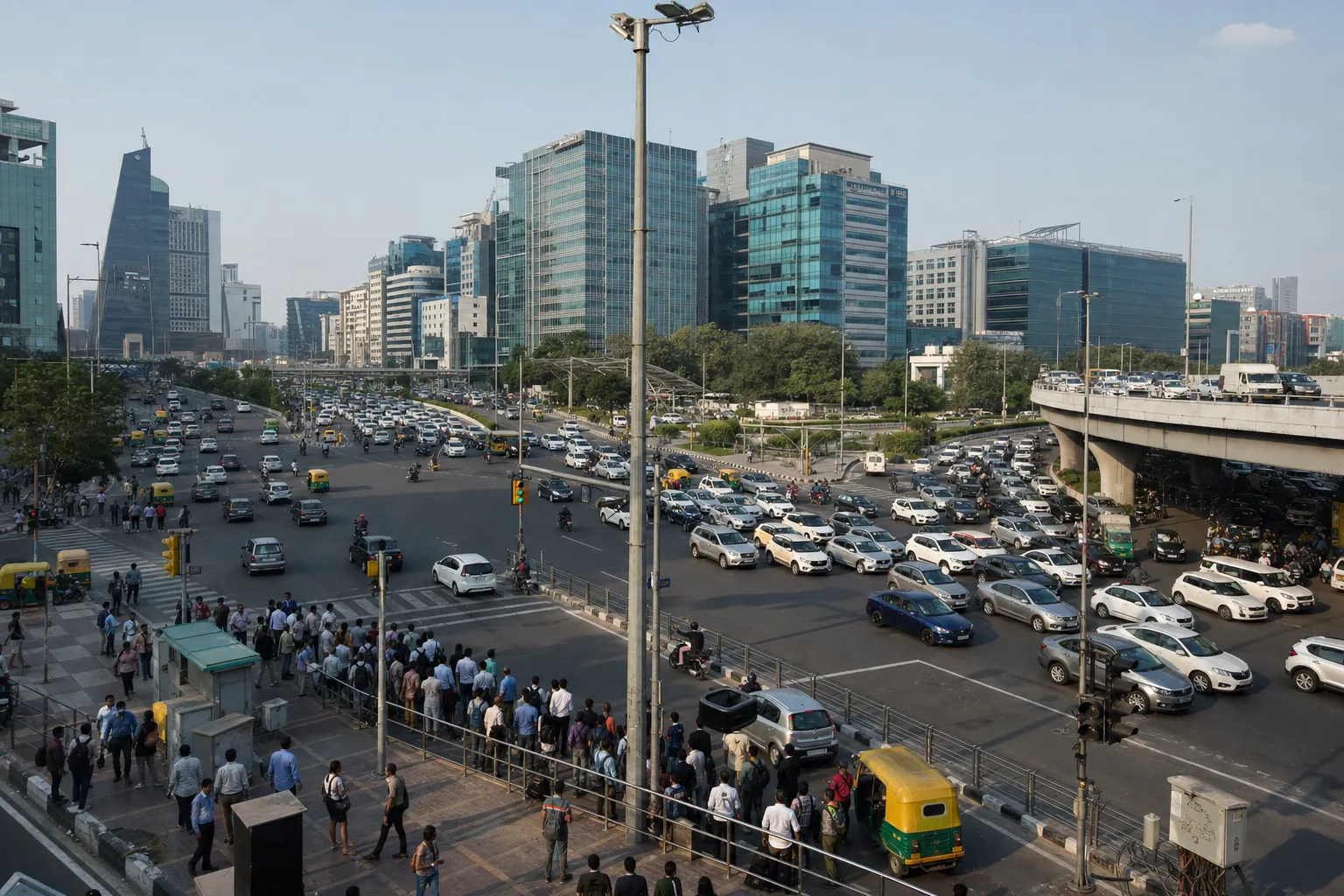
GURUGRAM: A Rs 19.8 crore plan to reorganise traffic between Shankar Chowk and Shyam Chowk has been paused while authorities redraw the project around the proposed Regional Rapid Transit System corridor. The decision delays a long-awaited intervention at one of Gurugram’s busiest office-district gateways, but it also avoids building road geometry that could be disturbed when the rapid-rail station takes shape.
The Haryana State Industrial and Infrastructure Development Corporation had invited bids for the approximately 1.5km corridor in April. The plan included widening service roads from about seven metres to 14 metres, changing one section to one-way movement from the Jaipur side towards Delhi, improving merging and turning points, and providing grade-separated pedestrian facilities.
That tender has now been withdrawn. Officials are expected to incorporate the location of RRTS station entrances, exits and passenger circulation areas before floating a revised package. The station layout was cleared earlier this year, making coordination unavoidable at a junction that already carries metro users, office commuters, cabs, buses and a large pedestrian load.
Shankar Chowk’s challenge is not simply high vehicle volume. During the peak period, close to 4,000 vehicles and about 1,000 pedestrians can pass through the area in a 15-minute window. Movement becomes especially tangled where office cabs stop near service lanes, pedestrians cross turning streams and vehicles make late lane changes to reach NH-48 or the internal Cyber City network.
The safety record adds urgency. Traffic police data has linked 24 crashes to the area since 2023, resulting in 10 deaths and injuries to 22 people. Those figures underline why the eventual design must treat walking routes as core infrastructure, not an accessory added after vehicle lanes are fixed.
A separate 640-metre pedestrian connection between the Cyber City Metro station and the Atrium side is also part of the broader mobility response. Railings, elevators and other access elements are expected to help channel foot traffic away from unsafe surface crossings. Until permanent works are ready, however, lane segregation, visible barricading and enforced pickup points will remain necessary.
Putting the road project on hold carries a short-term cost: congestion and risky conflict points will persist longer. Yet proceeding with a design that ignores a future high-capacity transit station would be a more expensive mistake. The revised tender must now emerge quickly, with a construction sequence that keeps the junction functional and prevents the RRTS, metro, road and pedestrian plans from competing for the same space.
For thousands who negotiate Shankar Chowk every day, the pause will be acceptable only if it produces a genuinely integrated design. The measure of success will be a junction where commuters can change modes safely and traffic moves predictably, rather than another patchwork of barriers and last-minute diversions.
Related Stories

Wildlife Scientist Jamal A Khan Takes Charge as AMU Life Sciences Dean
AMU Schedules Campus March for Suicide Prevention on 10 September

Bhopal Teacher Aspirants Enter Day 20 of Protest Over Recruitment Vacancies

Telangana Puts Pending Student Fee Reimbursements at ₹8,591.62 Crore

Odisha Releases D.El.Ed Merit Lists for Urdu and Kandhamal Quotas