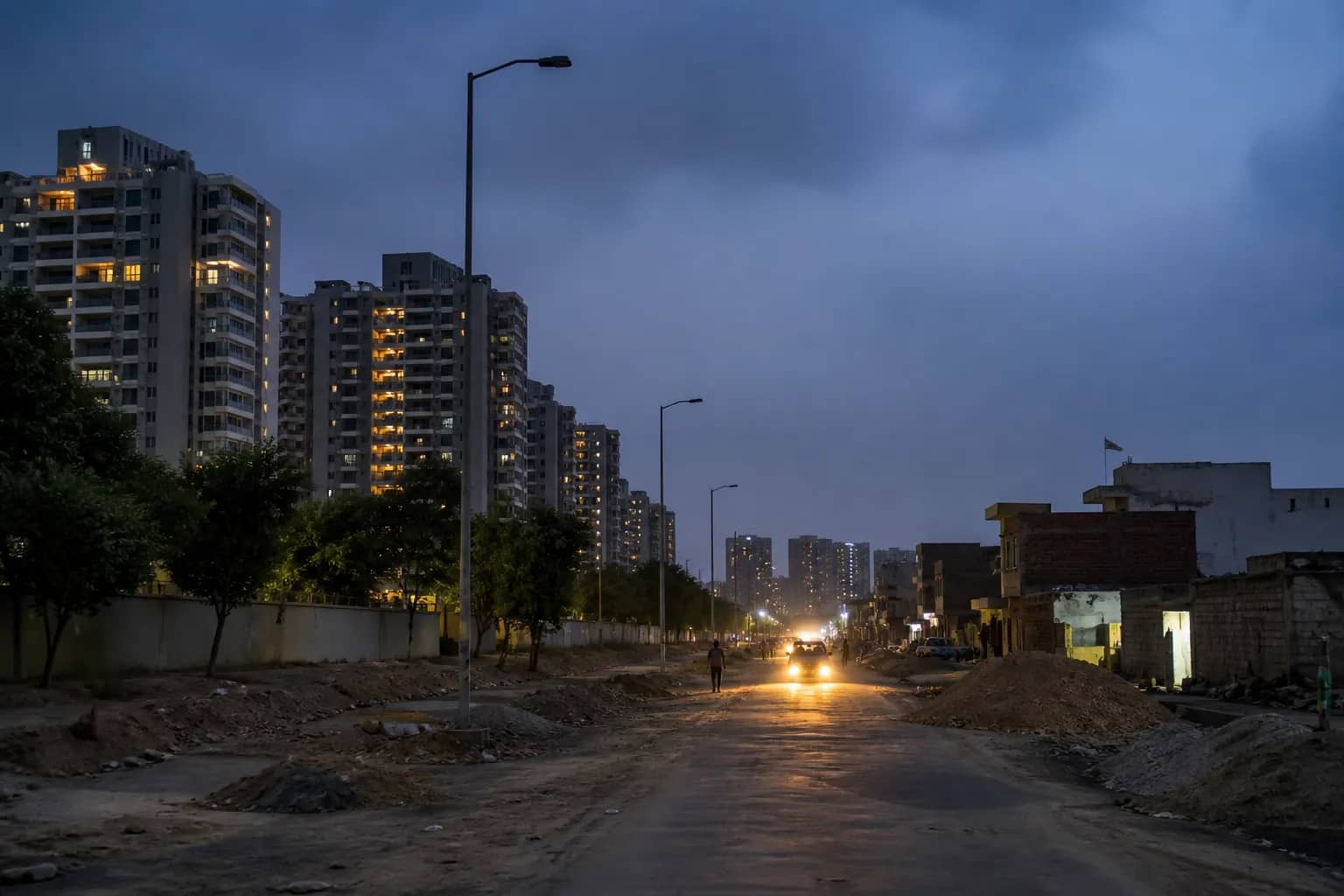
GURUGRAM: A two-kilometre road serving housing societies and Garhi village in Sector 99A has remained without functional streetlights for nearly two months, leaving residents to navigate the stretch in vehicle headlights after dusk. The blackout has become entangled with a road-reconstruction project that has not begun, despite poles being removed in anticipation of the work.
The affected road runs past the Pareena Lakshi and Pareena Coban societies and carries regular movement between the apartment clusters and the village. Residents say the lights were installed only about seven months ago but developed faults soon afterwards. The Municipal Corporation of Manesar floated a repair tender in April, yet the system was not restored before the next civic project intervened.
Streetlight poles were uprooted in stages during May and July for the proposed reconstruction of the road. Residents allege that no visible rebuilding followed. The sequence has left them with neither the recently installed lighting nor the promised improved carriageway, and they say repeated complaints have not produced a temporary arrangement.
The corporation has indicated that restoration may take another two months after the road work is completed and that interim lights cannot be arranged. That response does not offer a clear date because it ties one unresolved service to another project whose start and finish are uncertain. For people using the stretch every evening, the absence of a calendar is part of the safety problem.
Darkness changes how a neighbourhood moves
Streetlights are often treated as a minor electrical amenity, but they influence whether women feel comfortable walking after work, whether children can use outdoor space and whether a driver sees a pedestrian, stray animal or broken road edge in time. On a developing-sector road with uneven shoulders and mixed local traffic, the margin for error is already narrow.
Residents are also questioning the coordination behind the expenditure. If a repair tender was floated in April and poles were to be removed in May and July, the two agencies or departments should have worked from a common construction schedule. Repairing equipment immediately before dismantling it would waste money; removing it months before road work begins transfers the cost to residents through avoidable risk.
A temporary solution need not replicate the final streetlight network. Solar towers at critical crossings, functioning lights at society gates, reflective markings and lower enforced speeds could reduce exposure until permanent poles return. The corporation should also identify a safe walking edge and clear vegetation or construction material that may be invisible at night.
The immediate requirement is a public sequence: when reconstruction starts, how long each section will remain open, when poles will be reinstalled and who maintains them afterwards. Sector 99A is not asking for decorative illumination. It is asking that a heavily used road remain legible after sunset. Until the timeline is published or interim lighting appears, every further dark evening becomes evidence of a preventable coordination failure.