
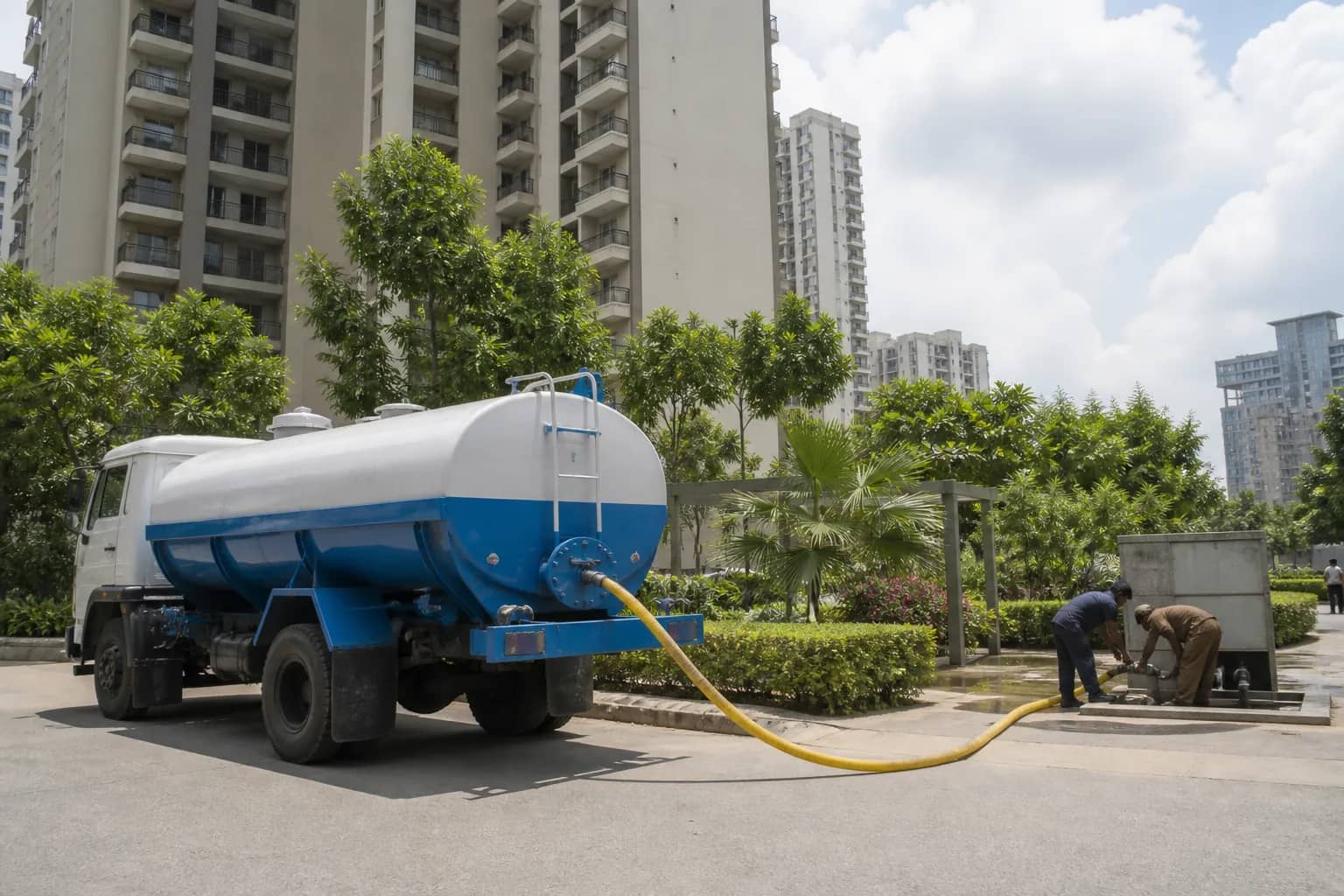
GURUGRAM: Taps have been running weak or dry for more than two weeks in parts of Greenwood City, Sector 45, pushing families to arrange private tankers and packaged water while two public agencies point to different parts of the supply chain. Residents estimate that about 500 households across the township's three blocks have been affected to varying degrees.
Some homes are receiving enough water for limited use; others have had to call tankers repeatedly. Residents say private suppliers are charging roughly Rs 2,400 to Rs 3,500 per load as demand rises. The exact price and quantity can vary, but the range illustrates the household cost of a disruption that has entered its third week without a clear restoration schedule.
Borewell trouble and low pressure are both being examined
Residents have been told that mud accumulated in the township's main borewell, affecting its output. A Municipal Corporation of Gurugram official also cited low pressure in bulk water received from the Gurugram Metropolitan Development Authority as a contributing factor and said the borewell problem would be attended to.
GMDA, which supplies treated water in bulk, said no fault had been reported on its side but agreed to send a team for inspection. These positions are not necessarily mutually exclusive: a township can face trouble at its local borewell, distribution pumps or internal network even when the city main is operating, while lower inlet pressure can make that local weakness harder to manage.
The fastest way to settle the question is measurement. Teams should record pressure and flow at the GMDA delivery point, the municipal inlet, storage tanks and the farthest homes in each block. Pump operating logs, reservoir levels and borewell output can show where supply is being lost rather than leaving residents between two verbal explanations.
Emergency supply needs basic safeguards
Where public supply is inadequate, the civic body should provide a temporary tanker plan with fixed delivery points and timings. Residents buying private water should know its source and whether the tanker is authorised for potable supply. Water intended for drinking should be stored separately in clean containers; not every tanker load is suitable for consumption without treatment.
The township also needs an equitable distribution plan. Low pressure often favours homes closer to the inlet or at lower levels, while distant lines receive little. Restricting non-essential use, repairing leaks and rotating supply zones can stretch available water, but these measures cannot replace restoring the source.
September is not peak summer, which makes a long disruption less easy to dismiss as seasonal demand. A dense central sector should have redundancy when a borewell fails, particularly if it is also connected to treated canal-water supply. The permanent solution may involve repairing or replacing the borewell, improving storage and pumps, or correcting bulk pressure; the inspection must determine which.
Residents do not need another open-ended promise. They need daily pressure readings, a repair completion time and a fallback tanker schedule until normal supply returns. Publishing those three pieces of information would turn a three-week argument over responsibility into a service-recovery plan.