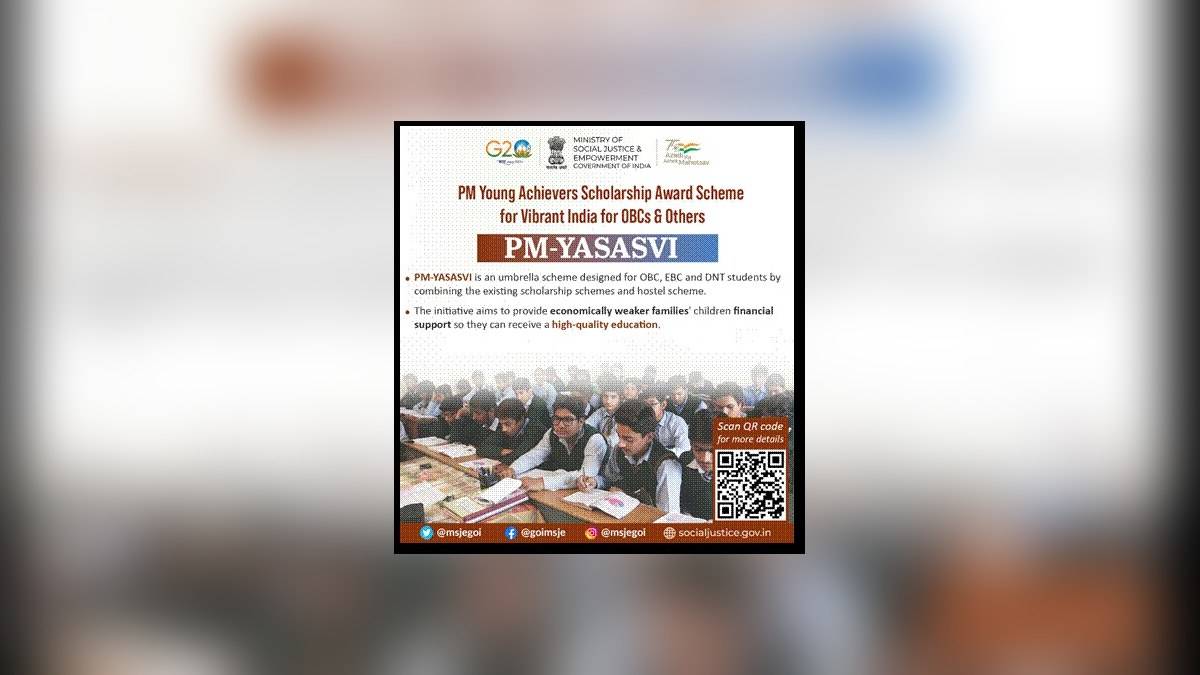
PM YASASVI Top Class School scholarship eligibility depends on your category, family income, marks and school. It supports eligible OBC, EBC and DNT students in shortlisted schools, with annual assistance capped at Rs 75,000 for Classes 9 and 10 and Rs 1.25 lakh for Classes 11 and 12. These are ceilings for eligible educational costs. Meeting the entry conditions does not guarantee selection or payment.
There is also a location restriction to check before applying. When checked on 14 November 2026 at 11:21 AM IST, the National Scholarship Portal announcement said fresh applications were open, but students belonging to Rajasthan, Keralam and Karnataka needed to wait. Families should read the announcement again before beginning because the application position can change.
| Question | Official position |
|---|---|
| Eligible groups | OBC, EBC and DNT students |
| Annual family income | Up to Rs 2.50 lakh, subject to scheme conditions |
| Fresh entry classes | Class 9 and Class 11 |
| Previous examination | At least 60% in Class 8 or Class 10 |
| Application route | National Scholarship Portal, for shortlisted schools |
Who is eligible for PM YASASVI school scholarship?
The Ministry of Social Justice and Empowerment runs PM YASASVI as an umbrella for several educational support programmes. The Top Class School component has its own rules. An applicant cannot assume that conditions for a college scholarship or the ordinary pre-matric component also apply here.
The ministry's school scholarship operating procedure says fresh registration is for Classes 9 and 11. Applicants must study in a shortlisted school with a UDISE+ code and have at least 60% in the relevant previous final examination, Class 8 or Class 10. Check the school's inclusion with its scholarship nodal officer before spending time on the form.
The family income threshold is up to Rs 2.50 lakh annually, and the eligible categories are Other Backward Classes, Economically Backward Classes and De-Notified Tribes. Category and income certificates need to support the claim. The official rules and current portal conditions determine eligibility, rather than a school's informal assurance.
How much scholarship can a student receive?
The ministry's 17 December 2024 parliamentary reply sets out the school component's limits: up to Rs 75,000 per student annually for Classes 9 and 10, and up to Rs 1,25,000 for Classes 11 and 12. Assistance covers tuition, hostel fees and other charges required by the school.
A ceiling is the highest permitted support under that rule, rather than a flat amount payable to every applicant. Keep fee receipts because the operating procedure includes payment or fee receipts among the documents students upload. A family should confirm admissible charges with the institution before treating any particular expense as covered.
How to apply and which documents are needed
Start at the National Scholarship Portal. Its student section provides One Time Registration, scholarship applications, scheme information and application status. OTR is required for scholarship applications. The portal describes it as a unique 14 digit number based on Aadhaar or Aadhaar Enrolment ID, usable throughout the student's academic career.
- Check the current PM YASASVI announcement and confirm that applications are enabled for your state.
- Ask the school nodal officer to verify that your school is shortlisted for this component.
- Complete OTR through the official student route, then choose the correct school scholarship scheme.
- Enter details matching your certificates and upload the documents the form requires.
- Submit the application and retain its reference details for school verification and status checks.
The ministry's school scholarship operating procedure lists income certificate, caste or category certificate, domicile, marksheet and payment or fee receipts. Keep these ready before beginning. Follow any additional requirements shown in the current form, especially where a certificate needs correction or renewal.
Selection, renewal and payment status
The procedure bases merit on marks in Class 8 or Class 10. It also describes verification at school, district and state levels, followed by account validation through PFMS, deduplication, merit generation and financial approval. Payment through direct benefit transfer comes after those stages. Submission and final selection are separate steps.
Moving from Class 10 to Class 11 does not bring automatic renewal under the published procedure. A student must apply afresh in Class 11. Families should ask the school about that transition rather than assuming an existing award continues through every subsequent class.
Use Application Status in the NSP student section to follow the form, and Track Your Payment for payment enquiries. An application awaiting institutional verification needs attention from the relevant nodal officer. A payment enquiry is a different question from whether the form has been verified.
Last date and official help
The current homepage announcement opened for this guide did not state a closing date for this component. Check its scheme listing for the student deadline and the separate verification deadlines. A closing date displayed for another scholarship should not be copied into a PM YASASVI application plan.
For technical assistance, the ministry's operating procedure lists the NSP helpdesk at 0120-6619540 and helpdesk@nsp.gov.in. Check the portal's Helpdesk section for current contact details. For context on related processes, read our guides to NSP scholarship rules, the revised NSP framework shared with schools and PM Vidyalaxmi education loans.