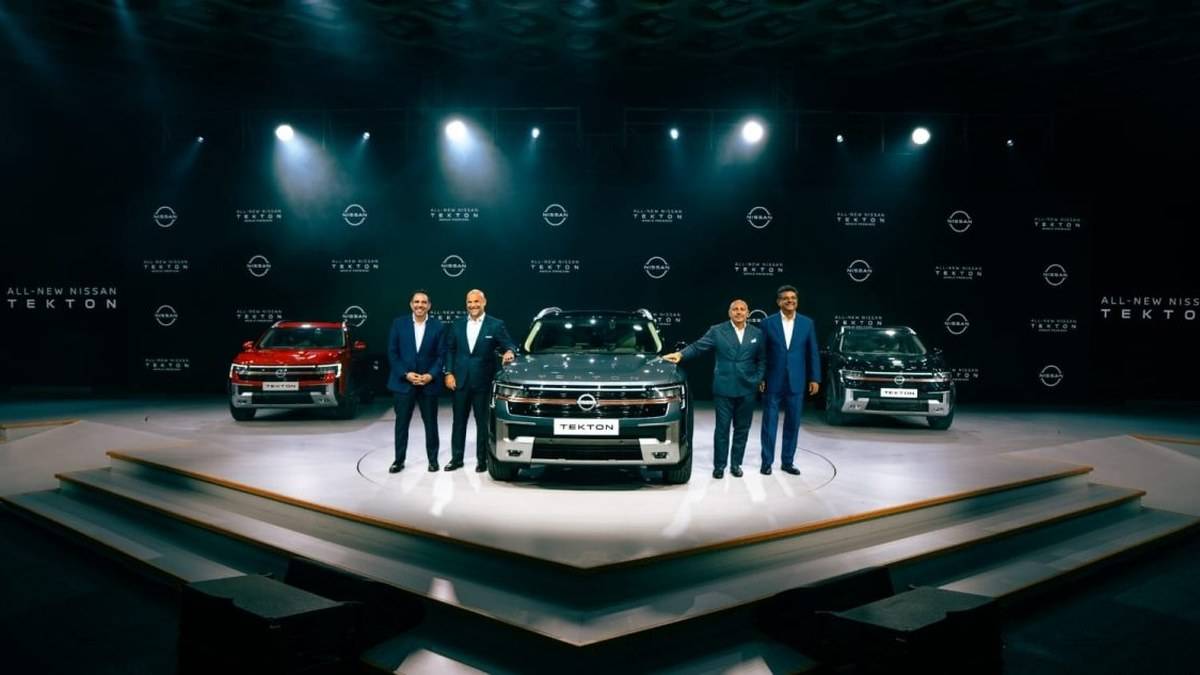
NEW DELHI: Nissan's Tekton specifications put ADAS on Tekna and Tekna+ grades, with 15 functions on Tekna and 17 on Tekna+. The lowest published price for an ADAS-equipped Tekton is Rs 15,39,000 for Tekna T160 MT. Adaptive cruise control with Stop & Go requires the DCT automatic, an important distinction within the higher grades.
| ADAS-equipped Tekton version | Ex-showroom price | Published grade allocation |
|---|---|---|
| Tekna T160 MT | Rs 15,39,000 | Tekna: 15 ADAS functions |
| Tekna T280 MT | Rs 16,39,000 | Tekna: 15 ADAS functions |
| Tekna T280 DCT | Rs 17,79,000 | Tekna; Stop & Go is DCT-only |
| Tekna+ T160 MT | Rs 16,49,000 | Tekna+: 17 ADAS functions |
| Tekna+ T280 DCT | Rs 18,59,000 | Tekna+; Stop & Go is DCT-only |
Price as of 11 November 2026, 23:40 IST. Figures are from Nissan India's public ex-showroom price table. They do not include registration or insurance. The table isolates ADAS-equipped versions and is not a complete Tekton price list.
The grade name and gearbox both matter
A broad claim that Tekton has ADAS is incomplete when applied to a specific car. Nissan's model FAQ starts that equipment at Tekna. A family comparing a lower grade with a higher one should therefore separate the safety equipment provided throughout the range from the assistance functions added further up.
The second distinction is between a manual and the DCT. The page explicitly restricts adaptive cruise control with Stop & Go to the DCT. That condition matters more than a simple count of functions for someone expecting assistance during slow-moving traffic. A Tekna T160 manual and Tekna T280 DCT therefore need separate equipment checks.
Do not interpret the grade counts as proof that every gearbox delivers every function in exactly the same way. Ask for the equipment specification applicable to the precise engine and transmission, and use the owner's instructions for operating conditions. The useful question is what the chosen car can do in the situation the driver actually encounters.
Separate warnings, intervention and parking views
Nissan lists autonomous emergency braking, lane-keeping assistance, lane-departure warning, blind-spot warning, traffic-sign recognition and driver-drowsiness warning among the Tekton's assistance features. The launch release also says drivers can choose which ADAS functions to activate. These functions do not all perform the same task.
A warning asks the driver to respond; an intervention can act on the vehicle within its operating conditions. When exploring the menu, establish which setting changes an alert and which changes an active function. That is more useful than judging the system only by whether the demonstration produces an audible beep.
Tekna+ also adds a 3D around-view monitor, according to the model FAQ. A parking view helps the driver inspect the area shown by the cameras. It should be assessed as a separate visibility tool rather than treated as another reason to assume the car can manage a road journey independently.
What Level 2 means for the driver
Nissan's own ADAS explainer describes Level 2 as assistance that can combine steering and speed control under continuous human supervision. It does not remove the driver's responsibility. The person behind the wheel still needs to watch the road and remain ready to operate the car.
For an Indian household sharing a Tekton, the practical handover is therefore about controls as much as keys. Each driver should know where the assistance settings are displayed, which functions are enabled and how to recognise a warning. Familiarity matters particularly when drivers have different preferences for alerts.
A quiet demonstration on a clearly marked road cannot establish performance in every traffic situation. Nor should a driver deliberately create a dangerous encounter to check emergency braking. Learn the system through its instructions and an ordinary demonstration of controls, keeping the driving task with the person at the wheel.
Core protection remains a separate specification
The Tekton page lists six airbags as standard, together with electronic stability control, traction control and ISOFIX child-seat mounts. Those provisions should be recorded separately from the ADAS grade allocation. A higher assistance-function count is not a substitute for understanding restraints, seating and child-seat installation.
Readers who need the mechanical context can consult our Tekton T160 and T280 engine explainer. The Tekton price guide covers the wider range, while our Tekton warranty explanation addresses ownership cover.
For the ADAS question, begin with Tekna or Tekna+, then verify the gearbox-specific functions. The price, function count and transmission condition answer different questions. Keeping them together on the same comparison sheet avoids expecting a manual car to deliver an automatic-only assistance function.
Official sources: Nissan Tekton specifications and FAQs, Nissan India prices, Tekton launch release and Nissan's ADAS explanation.