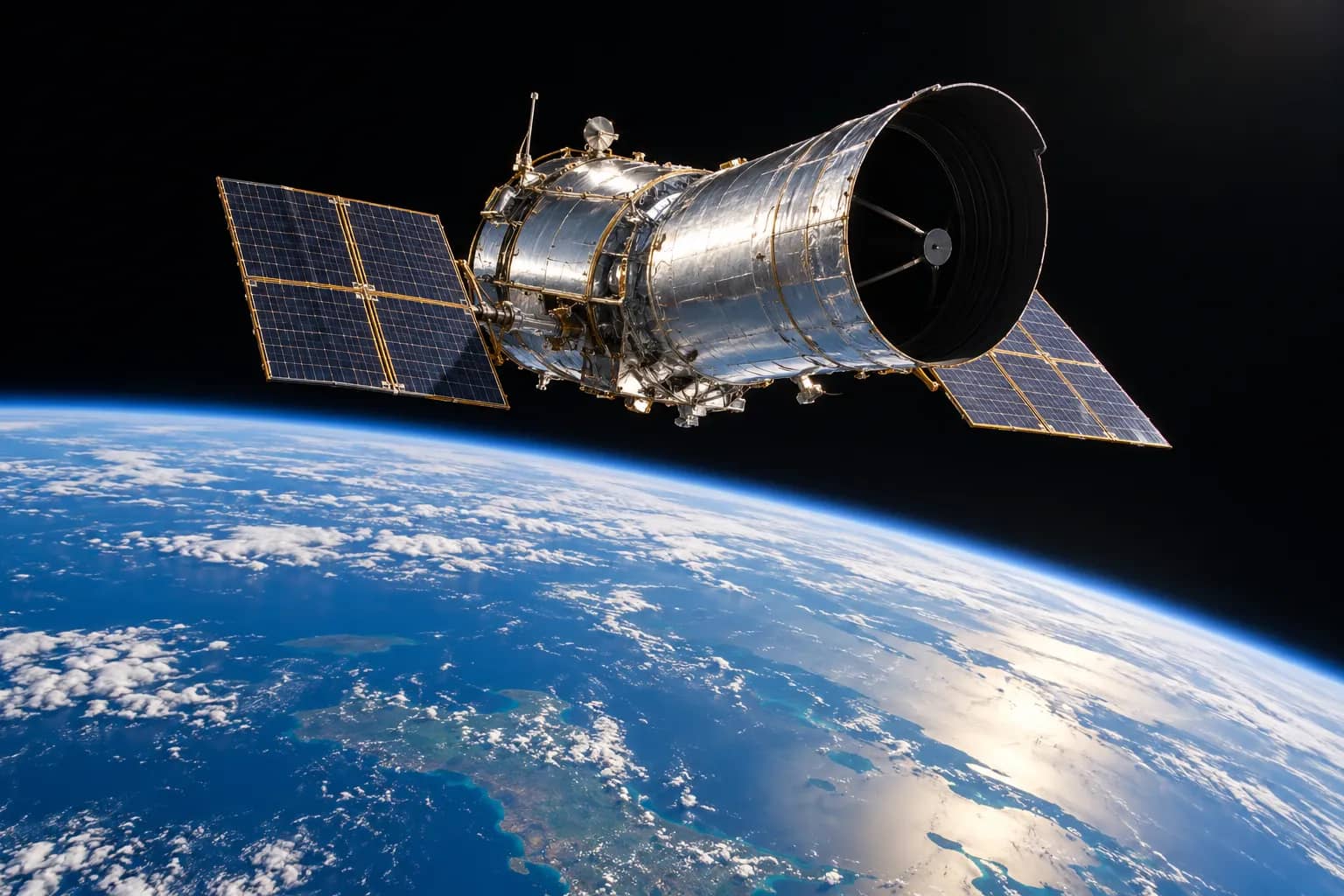
NASA is seeking industry ideas for extending the Hubble Space Telescope's working life, including raising its orbit or servicing it in space. The agency announced the exercise on October 30, following a request for information issued on October 29. Responses are due by 3 pm EST on November 30.
Atmospheric drag is gradually lowering Hubble's altitude, and the telescope has no propulsion system to restore its orbit. NASA says a supporting mission would need to take place by 2032. It is also examining safe end-of-mission handling, including controlled re-entry, alongside options that would keep the observatory operating.
The announcement concerns commercial capabilities and possible approaches. It does not name a selected operator or announce a launch.
What NASA wants to learn
The public request on SAM.gov is labelled Sources Sought and expressly says it is not a request for proposals. It is intended for information and planning, without committing the government to a mission. One option asks for a vehicle able to capture Hubble and lift it to an altitude of at least 600 kilometres.
NASA is asking respondents to explain how they would launch, approach and capture the telescope, control the combined spacecraft and manage risks. The notice also seeks cost estimates, the earliest service date and the readiness of key technologies. These questions put technical feasibility and safety ahead of any assumption that an available spacecraft can simply dock with Hubble.
The notice says NASA would supply telescope information, expert consultation and coordinated operations. A contractor would supply the other resources, including launch and the servicing vehicle. Its July 2026 lifetime analysis estimated a 10% chance of re-entry by September 2032 and 50% by December 2033. Those are modelled probabilities, not a scheduled return date.
Servicing and pointing are different problems
Hubble has benefited from hands-on repairs before. NASA's historical account records its fifth and final shuttle servicing mission in May 2009, when Atlantis carried seven astronauts to the telescope. The crew secured Hubble in the cargo bay using the shuttle's robotic arm before beginning the work. That history shows what servicing previously involved, not the design of any future commercial mission.
During the mission, astronauts installed Wide Field Camera 3 and replaced the science instrument command and data-handling system. They also replaced all three gyroscope rate-sensing units and began replacing battery modules. A capture mechanism for a future spacecraft or propulsion module to assist end-of-life disposal was activated. This was preparation installed in 2009, not equipment being added under the new request.
NASA's technical explanation distinguishes pointing from orbital altitude. Gyroscopes measure the telescope's movement so its control system can maintain the direction required for an observation. Reaction wheels respond to those measurements. Keeping an instrument steadily aimed at a distant target is a separate engineering task from adding the propulsion needed to raise the whole observatory's orbit.
The same documentation describes a one-gyroscope mode that uses other sensors to guide Hubble towards its target in stages. Magnetometers and Sun sensors provide an initial orientation; star trackers and fine-guidance sensors then refine it. Once on target, pointing stability can be almost comparable with three-gyroscope operation. Such adaptations explain how observing can continue despite equipment losses, without removing the problem of orbital decay.
Science that still needs observing time
The case for keeping Hubble operating extends beyond its age. In a September 23 update, NASA said the telescope had completed its 200,000th Earth orbit on September 19 and recorded more than 1.7 million observations. Astronomers were requesting about seven times the observing time available annually. Its ultraviolet and visible-light observations complement the capabilities of Webb and Roman.
That September account described repeated observations looking for the return of supernova Athena's light through a foreground galaxy cluster. Gravity bends the light along different paths, so the same explosion can be observed at different times. Measuring those delays helps researchers study the cluster's mass and the universe's expansion. It is an example of research that depends on returning to a target, rather than taking a single photograph.
Related reporting: TRACERS satellite measurements and two gas rings around a white dwarf.