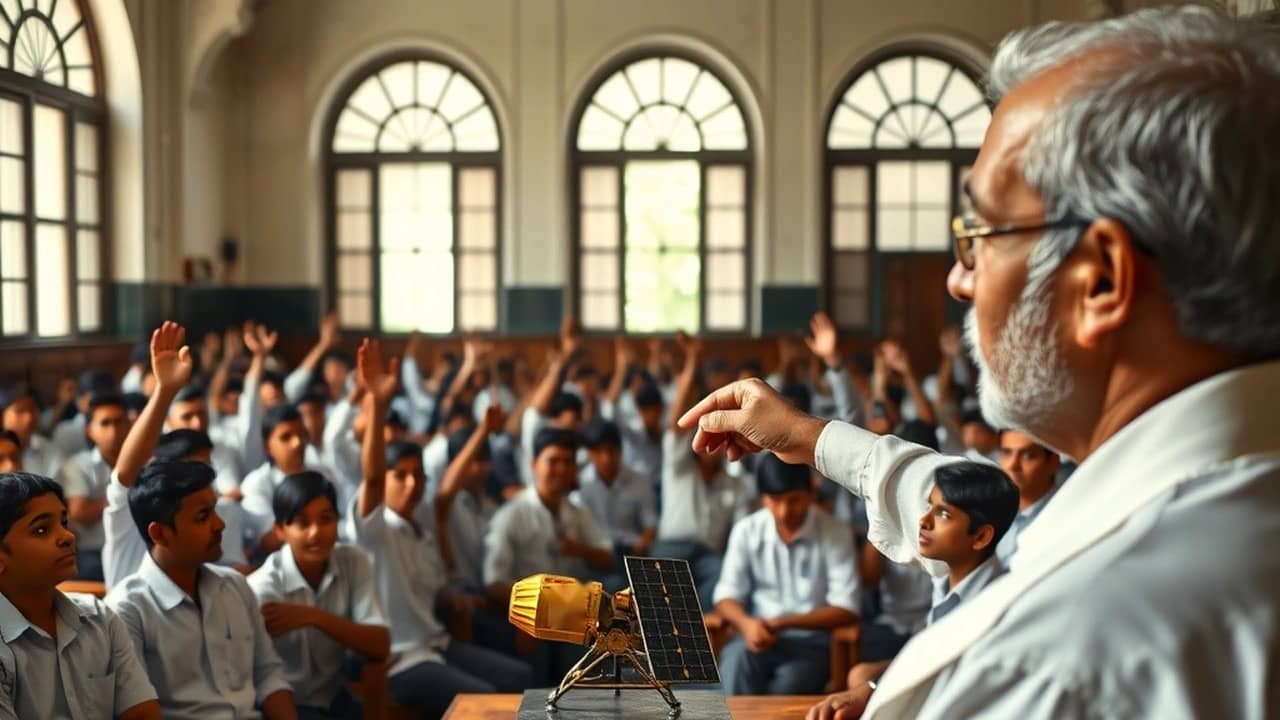
Four decades after he left its classrooms, Dinesh Kumar Singh walked back into Queen's College on Monday as the man in charge of the centre that builds India's satellites. Singh, who took over as Director of the U R Rao Satellite Centre (URSC) of the Indian Space Research Organisation in Bengaluru on 1 September, spoke to students at the Vivekananda auditorium of PM Shri Rajkiya Queen's Inter College in Varanasi.
Singh studied at the college from 1981 to 1984. His father, the late Amrit Lal Singh, worked at the Ayurvedic hospital of Sampurnanand Sanskrit University, so the city was home long before the space agency was. On stage he bowed to the teachers who had taught him and remembered a time when pupils competed hard just to get a seat in the college's classes.
He gave the school much of the credit for his career. The disciplined way of studying at Queen's College, he told the gathering, had trained him to think through problems properly and had strengthened his memory.
The URSC is ISRO's lead centre for designing and building satellites, from communication and navigation spacecraft to scientific missions. Known earlier as the ISRO Satellite Centre, it was renamed in 2018 after U R Rao, the former ISRO chairman who led the team that built Aryabhata, India's first satellite, launched in 1975.
Singh succeeded M. Sankaran, who retired on 31 August. Before moving to Bengaluru, he headed ISRO's Human Space Flight Centre from July 2024 to August 2026, the centre responsible for the Gaganyaan crewed mission programme. S.R. Biju now leads that centre. Singh is also an alumnus of Banaras Hindu University, so his years at Queen's College and his university studies both took place in Varanasi.
When the conversation turned to the future, Singh's message to students was less a celebration than a warning. He said the rivalry among humans for territory on Earth would soon be repeated on the Moon and on other planets. In the same vein, he described the rising number of satellites in orbit as one of the big challenges of the coming years.
That concern is shared widely in the space community. Every launch adds hardware to orbit, and old satellites, spent rocket stages and fragments from collisions stay there for years, raising the risk to working spacecraft. For an engineer who now runs the centre that designs India's satellites, crowding in space is a practical question rather than an abstract one.
Singh also told students that India is moving quickly towards building its own space station. The government has set 2035 as the target for the Bharatiya Antariksh Station, with the human spaceflight work he oversaw until August forming part of that path. He spoke about careers in space science and the routes open to young people who want to work in the field.
The second half of the session belonged to the students. They put their questions to him, some sharp and some simply curious, and he answered them in plain, simple language.
Varanasi's campuses have had a busy few weeks of science and innovation events. At IIT-BHU, the Traction 2026 entrepreneurship programme ended at the weekend with hands-on sessions for early founders, and a BHU scientist helped shape a new protocol for monitoring microplastics in the Ganga. School-level events have mixed science with tradition too, as at Central Hindu Boys School's Sanskrit Day programme.
Queen's College is one of the city's best-known government schools. Monday's interaction gave its present pupils a direct line to someone who sat on the same benches in the early 1980s, at a time when India's satellite programme was still in its early years.
For Singh, the visit began with his teachers and ended with their students. Between the two he drew a line from a Varanasi classroom to a satellite centre in Bengaluru, and left the students with the idea that the next contest over territory may be fought far above the city.