Rising workplace heat could remove working time equivalent to about 147,000 full-time jobs in Sri Lanka and the Maldives by 2040, the International Labour Organization said on October 30. The projection applies even under a low-emissions pathway. It measures lost labour capacity, rather than announcing redundancies or counting people who have been dismissed.
The underlying country studies were launched on October 29 as part of research covering six economies, including Ethiopia, Ghana, Lebanon and Senegal. The ILO says exposure depends on local climate, the kinds of jobs people do and their ability to adapt. Outdoor and physically demanding employment makes some economies particularly vulnerable.
For the two South Asian countries, the projected annual loss is approximately 145,000 full-time equivalents in Sri Lanka and 2,400 in the Maldives. The comparison is with the historical reference period of 1985 to 2014. These are conditional estimates for 2040, not a forecast of next month's hiring figures or a claim about today's unemployment rate.
What the job-equivalent figure measures
The Maldives study explains how hours become a job-equivalent number. It uses a standard working year of roughly 2,006 hours, based on a five-day week, eight-hour days and an allowance for holidays. Estimated hours lost to workplace heat are divided by that annual total. Reduced capacity spread across many workers can therefore appear as a smaller number of full-time equivalents.
That approach has limits. The model uses an average worker response to heat and does not separately capture every difference in age, health, occupation or access to shade. It also assumes existing acclimatisation and work routines continue. Wider use of earlier shifts, rest breaks or mechanisation could reduce losses compared with the model's projections.
The report's 2040 low-emissions case puts Maldivian losses at about 1.8 per cent of available labour time. Services account for the largest absolute burden, followed by construction. The report connects construction's exposure with outdoor tasks, heavy physical work and humid heat, rather than treating all jobs as equally affected.
Different workplaces need different responses
In Sri Lanka, the study identifies agriculture as the largest source of projected lost working time, with services next. Its low-emissions 2040 table estimates roughly 58,600 full-time equivalents in agriculture and 38,700 in services. Retail, hospitality and informal urban commerce are exposed where workers have limited climate control, while workshop and factory conditions also matter.
The analysis uses wet-bulb globe temperature, or WBGT, to assess heat stress. Unlike a simple air-temperature reading, this combines temperature with humidity, wind and thermal radiation. That distinction matters because humid conditions and weak air movement can increase the burden on workers even when the thermometer alone does not show the most extreme temperature.
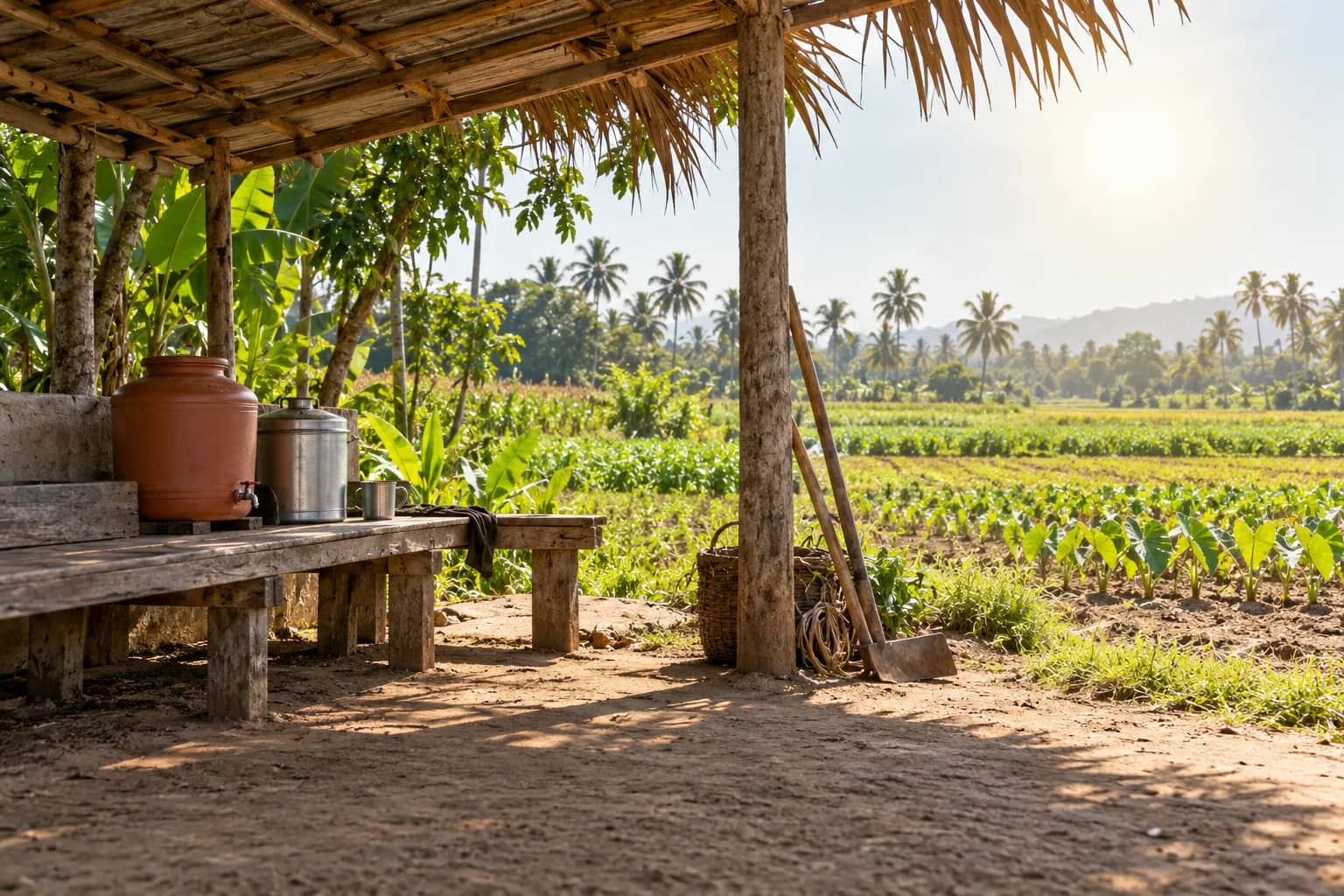
The Sri Lanka report recommends matching protection to the job. For agriculture, it proposes shade, drinking water and changes to work schedules, alongside training. For construction, suggested measures include cooler working hours, scheduled breaks and portable shading. These are research recommendations, not evidence that a new nationwide workplace rule has taken effect.
A wider loss of working capacity
A separate October 30 ILO account of the African studies projects a combined loss equivalent to about 2.46 million full-time jobs in Ethiopia, Ghana and Senegal by 2040 under a low-emissions pathway. Agriculture and construction feature prominently, but the agency also identifies exposure in services, manufacturing, transport and trade. Ethiopia accounts for about 1.78 million equivalents, Ghana 550,000 and Senegal 129,000. The country mix changes where the largest burdens fall.
The research was commissioned with support from the Climate Vulnerable Forum and the Vulnerable 20 Finance Ministers, with funding through their joint multi-donor fund. At the launch, the ILO stressed discussion between governments, employers and workers when designing responses, so that changes reflect the conditions people actually face at work.
The agency also highlights income protection. A worker who cannot afford to lose pay may have little room to shorten a shift during dangerous heat. Its proposed responses combine workplace monitoring and cooling facilities with social protection, rather than relying only on individuals to alter their behaviour.
Related coverage: WMO's call for earlier climate preparation and WHO's healthy-housing appeal.