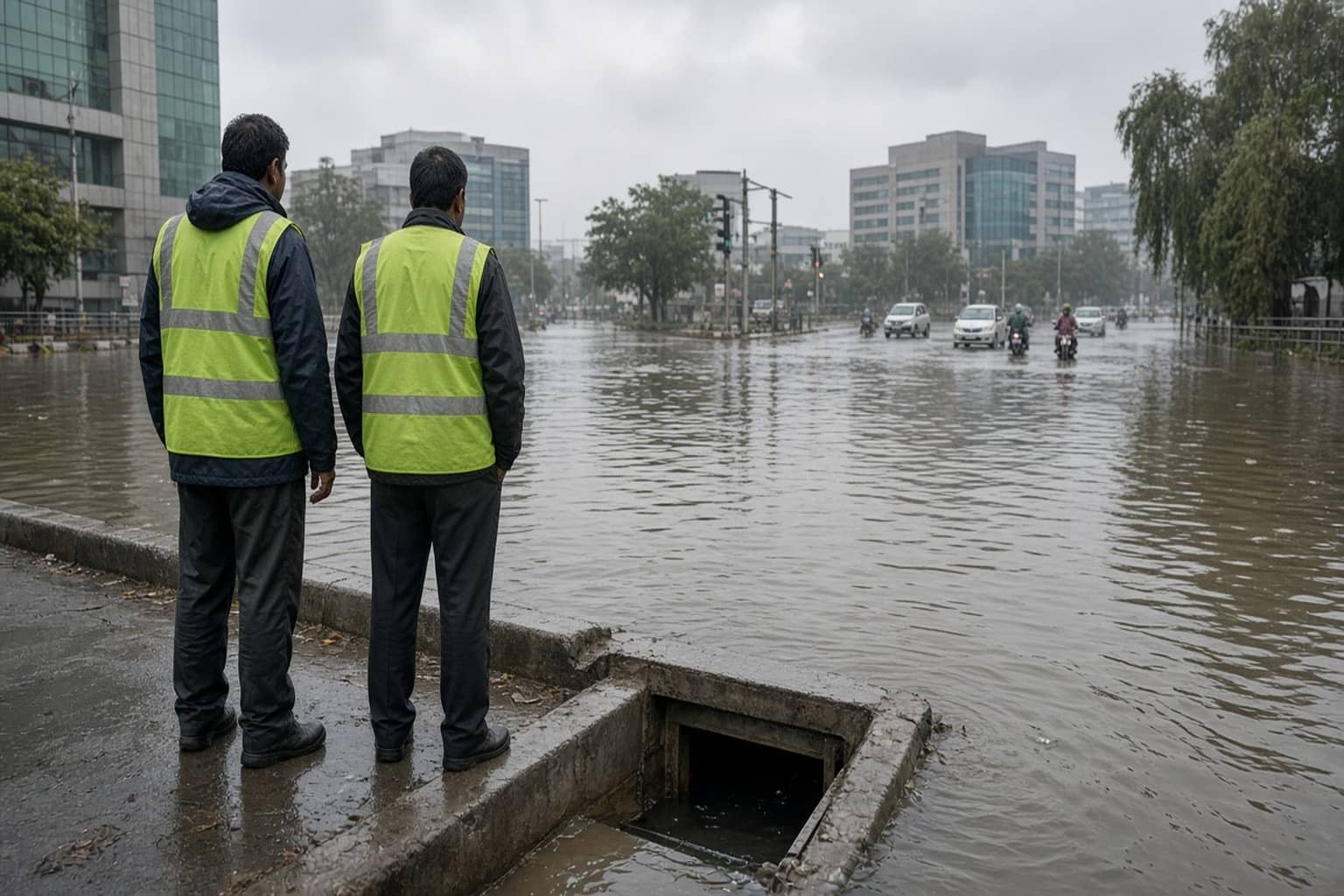
GURUGRAM: Two professors from IIT Gandhinagar walked Subhash Chowk and Rajiv Chowk on Wednesday with officials of the Municipal Corporation of Gurugram and the Gurugram Metropolitan Development Authority, looking at where monsoon water sits and how it might be stored or sent underground instead of being pumped from one flooded junction to the next.
The visit followed Monday's downpour, when Gurugram tehsil logged about 75 mm of rain between 8 am and 3 pm and short, intense bursts left Subhash Chowk, Sheetla Mata Road and the Medanta Hospital Road stretch under water. School buses had sat in the Subhash Chowk pool for hours. Civic teams spent Tuesday on pumps and desilting. Wednesday's exercise was meant to test whether a longer plan — underground tanks paired with injection wells — can actually work on these soils.
According to an official statement, Professors Vivek Kapadia and Udit Bhatia discussed technical options for storage and drainage with MCG and GMDA engineers. The group also went through Sectors 46 and 47 and other pockets to map catchments, so rain can be held closer to where it falls rather than racing towards already overloaded storm drains.
A senior MCG officer said work has been fast-tracked on high-capacity underground storage tanks and injection wells at chronic flood points. The idea is simple on paper. Excess runoff would first drop into a buried tank when the storm network cannot take the full load. After filtration, the water would be pushed into an injection well, rated between 48 and 80 litres per second, and released into permeable layers below if the geology allows. The civic body has said the combined tank-and-well system is being designed for about three times the volume of a design storm, so a short, violent burst has somewhere to go besides the carriageway.
The first phase, officials said, would cover four trouble spots named after Monday's flooding: Subhash Chowk, Rajiv Chowk, Medanta Hospital Road and Sheetla Mata Road. The package also lists a SCADA-based monitoring system and a proposed link with the Central Ground Water Board, because injection is not a plug-and-play drain. It depends on local permeability, the water table and the quality of what is being put underground. That is why the IIT team was asked to judge feasibility on site rather than from a map.
MCG Commissioner Pradeep Dahiya, who held a joint review with the same professors, GMDA officers and councillors on Tuesday, has set a one-year mark for completing the works and asked for a coordinated implementation plan. "The initiative aims to capture and store rainwater at source, enhance groundwater recharge, improve water discharge and develop permanent solutions to waterlogging," he said, adding that MCG and GMDA were working "towards a more water-resilient Gurugram."
He has also said the city needs technology that can store and inject rainwater, ease pressure on drains and recharge groundwater, instead of only shifting floodwater with pumps. Conventional pumping, officials noted, mainly moves the same water to the next low point.
The geology question will decide how much of this can be built. If the strata under Sheetla Mata Road or Subhash Chowk are not permeable enough, or if the water table is already high in late monsoon, injection wells will not swallow 48 to 80 litres a second. The IIT inspection is meant to answer that before tenders go out. Until those findings are written down, the four spots remain on the same emergency roster: pumps, tankers, barricades, and a prayer that the next 70 mm does not fall in 35 minutes.