How Education Minister's Resignation Restored My Faith in Indian Democracy
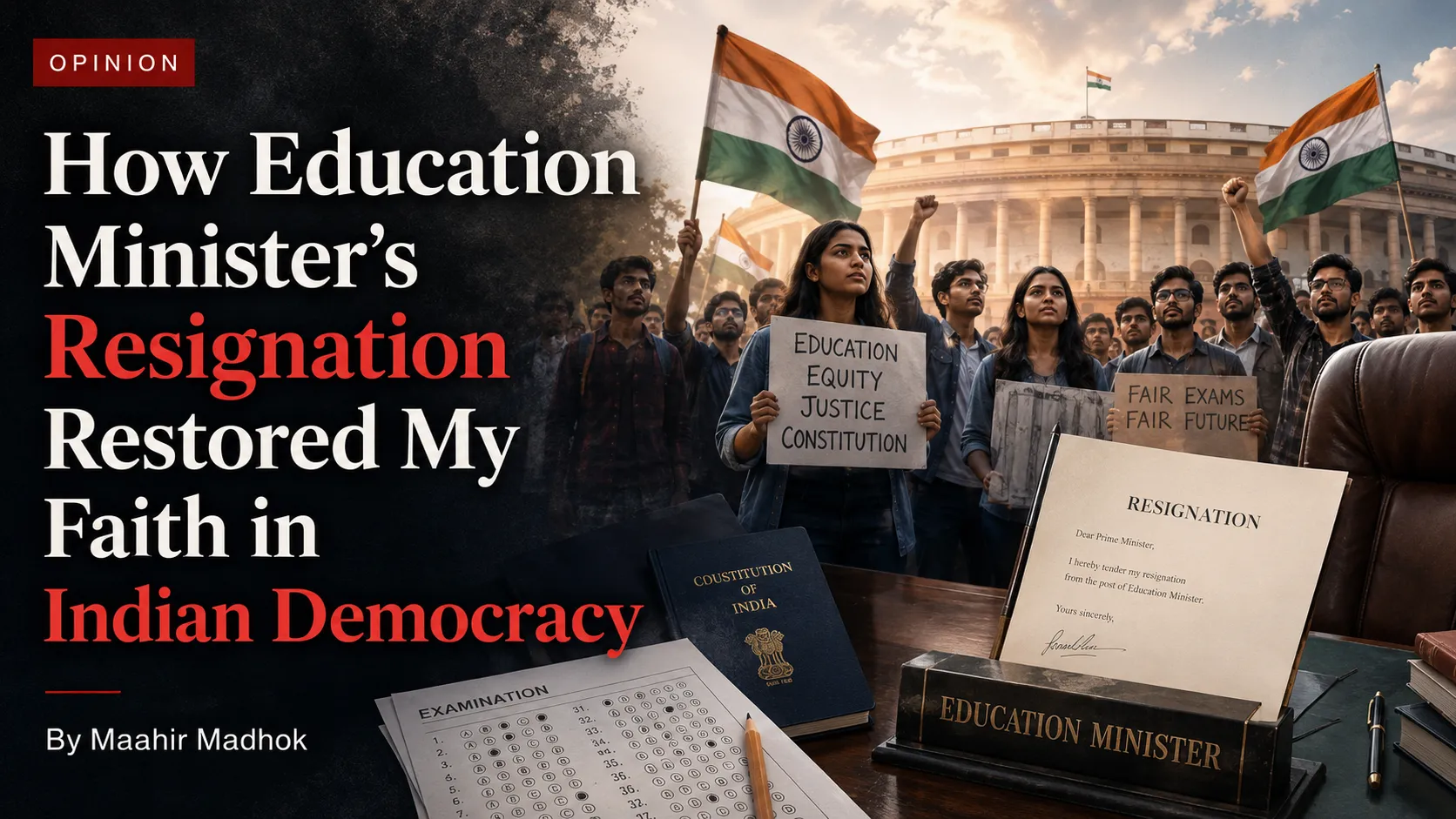
When the protests began, I don't think anybody seriously believed that the students of this country would actually see a Union Education Minister step down. I certainly didn't , and not because of any one party. Ministerial resignations on grounds of accountability have simply become rare in India, across governments and across decades. Most of us grew up hearing about Lal Bahadur Shastri resigning as Railway Minister in 1956 after a train disaster precisely because such a thing almost never happens any more. Somewhere along the way, in every political dispensation, we quietly stopped expecting it.
So let me keep the detailed politics aside , who is right, who is wrong, which party gains what and simply say what these past weeks have meant to me.
I live in Varanasi for most of the year and in Gurugram for the rest. Unlike when I was growing up, politics is now a large part of Kashi's everyday culture; you cannot sit through a chai or a family lunch without it coming up. And I have watched Haryana politics fairly closely too, because a relative of mine served as a minister there for a while.
For a very long time I had convinced myself that most Gen Z youngsters simply don't care about any of this, and that most people around me are perfectly content with how things are. Earlier this year I was at a wedding in Jaisalmer, and somehow the conversation at our table turned to politics. I asked my friend Ayush's wife, Ayesha, what she made of the present government. Her answer was five words: "If not them, then who?" It was said without hostility and without much doubt , and almost everybody at that table felt broadly the same way. I remember thinking that whatever happened, this settled confidence was not going to be disturbed by anything as small as an argument at a dinner table.
Then came this summer.
NEET-UG was held on 3 May for over 22 lakh aspirants, and cancelled nine days later, after investigators found that a guess paper circulating beforehand overlapped with the actual question paper. A re-test was announced for 21 June. In the forty-six days between those two dates, at least eleven NEET aspirants were reported to have died by suicide. I don't need a news report to tell me what those forty six days did inside classrooms and inside homes. I watched it up close.
It is worth recording that the cancellation itself came from the system working , the irregularity was detected and the paper was pulled, at enormous administrative cost .Mr. Pradhan also said publicly that he took responsibility for the CBSE marking-system defects and that they were being fixed. None of that undid the damage to a single aspirant's year. But it is not honest to pretend nothing was acknowledged.
Still, somewhere in those weeks, I stopped expecting anybody to be answerable for any of it. There were nights when I genuinely wondered where India's democracy had gone. After all, we ARE the mother of democracy. So why does nobody ever have to answer?
And then a meme became a movement.
The Cockroach Janta Party exists because on 15 May, in a completely unrelated hearing, the Chief Justice of India used the word "cockroaches" while describing young people without employment who go on the attack in public life. He clarified afterwards that he had been referring to those practising with fraudulent credentials, and that he had been misquoted. But by the next day a thirty-year-old named Abhijeet Dipke had already turned the word into a badge of honour and put up a signup page for "all the 'cockroaches' out there."
Within a week the CJP had nineteen million followers on Instagram. By 6 June they were sitting at Jantar Mantar with tricolours, copies of the Constitution, and red roses that they handed to the policemen guarding them.
And then a fifty-nine-year-old man from Ladakh sat down and stopped eating.
Mr. Sonam Wangchuk fasted for twenty-six days from 28 June and lost eleven kilos before being moved to hospital. Thanks to the CJP, and big big thanks to Mr. Wangchuk , between them, they gave a voice to lakhs of students who wanted to speak but were afraid of being crushed for it. There were days when it turned ugly on both sides: on 20 July, a march towards Parliament ended in tear gas and baton charges, with the Delhi Police reporting close to 180 injured , the majority of them security personnel, along with sixty protesters. Nobody should pretend that fortnight was tidy. Students marched here in Varanasi too, in solidarity. Right here. In this city.
Protest is a fundamental right in a healthy democracy, and we should never allow ourselves to forget that. Asking questions and demanding accountability is not disloyalty to the nation. It is the job description of a citizen.
I had become a pessimist. Everything around me told me that nothing would change, and that Mr. Wangchuk's fast would ultimately be for nothing.
But I WAS WRONG.
What I had underestimated was not one side or the other. It was the machinery itself. Two senior Union Ministers sat down with the protest leaders. The Honourable Prime Minister went on record promising a tougher law against paper leaks and faster court proceedings against those responsible, and said the Cabinet would take it up. Assurances were given on the cases filed against young protesters, and on that basis Mr. Wangchuk ended his fast and described it as a victory of patience.
On 25 July, Mr. Pradhan sent his resignation to the Prime Minister, saying he did not want students to remain entangled in the situation, and the President accepted it. The CJP then wound up its agitation and asked its supporters to go home.
That is not a story of one side defeating the other. That is a demand being made peacefully and persistently for fifty days, and a government choosing to hear it rather than simply outlast it. Both halves of that sentence matter. A movement that had stayed non-violent enough to be heard, and a system that proved capable of responding , that is the whole point of the arrangement our Constitution set up.
I want to be careful here, because I am not naive, and I have been in this profession long enough to know the difference. A resignation is not a reform. The NTA still has to be strengthened. The assurances given about the cases still have to be honoured in full. And eleven families are still waiting. Ministers change relatively easily in this country. Systems do not, unless citizens keep paying attention long after the crowds have gone home. That obligation now sits with us, not with the students.
But something happened this month that I did not think was still possible here. Young people who had been publicly written off as idle and chronically online organised themselves, stayed largely peaceful, held their ground, and were answered. Not shouted down. Answered.
Democracy in India is alive. It always was. It was simply waiting for somebody to use it.
Related Stories
Mayor Announces Stricter MCG Drive Against Stray Cattle
Court Stays Further Eviction at Baba Balak Nath Temple Complex
HRERA Orders Rs 19.28 Lakh for Delayed Sector 82 Flat Possession
STF Arrests Agra Man With Six Country-Made Pistols in Sohna

FDA and Police Seize Codeine Syrup, Alprazolam in Sohna Raid