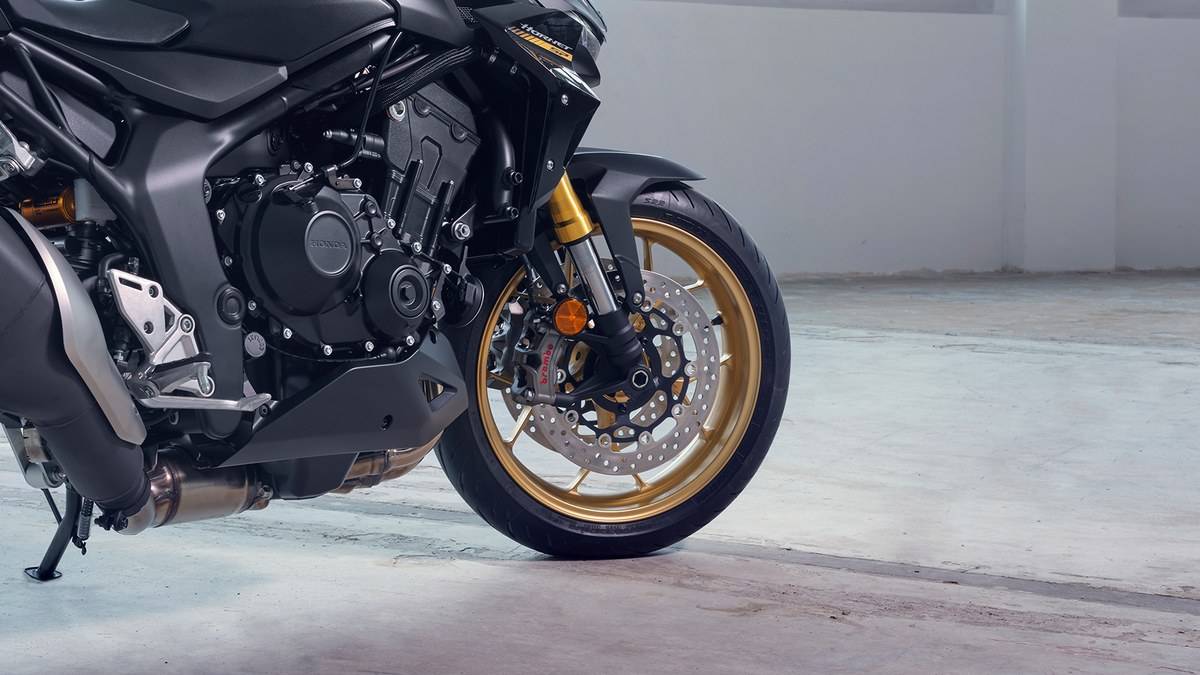
NEW DELHI: The Honda CB1000 Hornet SP uses twin 310 mm front brake discs with Brembo radial-mount calipers and an Öhlins TTX36 rear shock, according to Honda's India introduction. The SP badge identifies a specific hardware package. It should not be confused with the standard CB1000 Hornet specification described on overseas Honda websites.
| CB1000 Hornet SP hardware | Official specification |
|---|---|
| Front brakes | Two 310 mm discs, Brembo calipers |
| Rear brake | 240 mm disc |
| ABS | Dual channel |
| Front suspension | Showa SFF-BP inverted fork |
| Rear suspension | Öhlins TTX36 |
| Transmission feature | Standard bidirectional quickshifter |
Read the brake specification beyond disc size
Honda's overseas SP specification identifies the front calipers more precisely as four-piston Brembo Stylema units acting on floating discs. Honda's India introduction confirms the Brembo radial-mount arrangement and disc diameter. Those descriptions are consistent, while adding different levels of detail about the braking hardware.
The distinction matters because disc diameter alone cannot identify the SP. Honda's UK material gives the standard CB1000 Hornet the same front-disc diameter but Nissin front calipers. A specification copied from that motorcycle could therefore look plausible while assigning the wrong component to the SP.
For Indian readers comparing equipment descriptions, check the full model name first, followed by the caliper and suspension details. Do not use a generic Hornet photograph or a search result for a different market as proof of the fitted parts. The Hornet name covers motorcycles with substantially different engines and chassis.
The Öhlins rear shock is a separate part of the package
The India release names a Showa SFF-BP inverted fork at the front and an Öhlins TTX36 rear shock. Honda's US specification lists adjustable preload, compression damping and rebound damping for the SP suspension. These are hardware adjustments, rather than a promise that the motorcycle automatically chooses the right setting for every rider.
A suspension specification should be read alongside the operating instructions for the actual motorcycle. Recording the current settings before asking for an adjustment makes it easier to understand what changed. This is a practical suggestion for discussing setup with a workshop, not a set of recommended settings or an instruction to alter the bike without guidance.
The SP's hardware should also be distinguished from the standard model overseas. Honda's UK overview says that motorcycle shares the front-fork design but uses a Showa rear shock instead of the Öhlins unit. The rear suspension therefore offers another way to identify which specification an article or equipment sheet is describing.
Quickshifter and clutch are different controls
Honda's India release lists a bidirectional quickshifter as standard on the CB1000 Hornet SP, alongside a six-speed gearbox and an assist-and-slipper clutch. The quickshifter is an additional shifting aid. It does not turn the motorcycle into an automatic or make its clutch description irrelevant.
That distinction is particularly useful alongside the CB750 Hornet E-Clutch now discussed in the same broader family. Our Honda car prices: Amaze from Rs 6,97,700, City Rs 11,99,900, ZR-V Rs 49,99,900 deals with a different system. Its operating description should not be transferred to the CB1000 SP simply because both carry the Hornet badge.
For the same reason, avoid assuming every accessory shown overseas belongs to the Indian standard specification. The US and UK pages are used here to cross-check the named SP components, while the India announcement remains the basis for what Honda explicitly described for its Indian introduction.
Electronics sit alongside the mechanical hardware
The India introduction describes Sport, Standard and Rain riding modes plus two customisable User modes for the SP. It also lists Honda Selectable Torque Control and a TFT instrument display with RoadSync connectivity. These are separate parts of the equipment package, rather than extensions of the brake caliper specification.
A mode name does not establish a measured stopping distance or suspension performance on Indian roads. This article reports the fitted hardware and the functions Honda describes; it does not claim a road-test result. Tyres, surface conditions, loading and the rider's inputs remain relevant when assessing how a motorcycle behaves.
Owners should also keep equipment identification separate from recall completion. Our Honda CB1000 Hornet SP recalls: 29 bikes in gearshift campaign, 22 in fuel-hose action addresses the published campaigns. A motorcycle having the correct SP brakes does not establish whether a campaign affecting that particular vehicle has been completed.
Readers comparing other braking arrangements can use our Honda City price list: Rs 11,99,900 to Rs 20,99,900. Its different layout is another reason that a disc diameter should always be read with the rest of the braking specification.
A component name is therefore best treated as an identification tool. Actual adjustment, inspection and servicing should follow the documentation for the motorcycle concerned.
Official sources: Honda India introduction, Honda UK model overview and Honda's SP specification, checked on 6 November 2026.