Gurugram Traffic Police Target 24 Accident Black Spots on NH-48
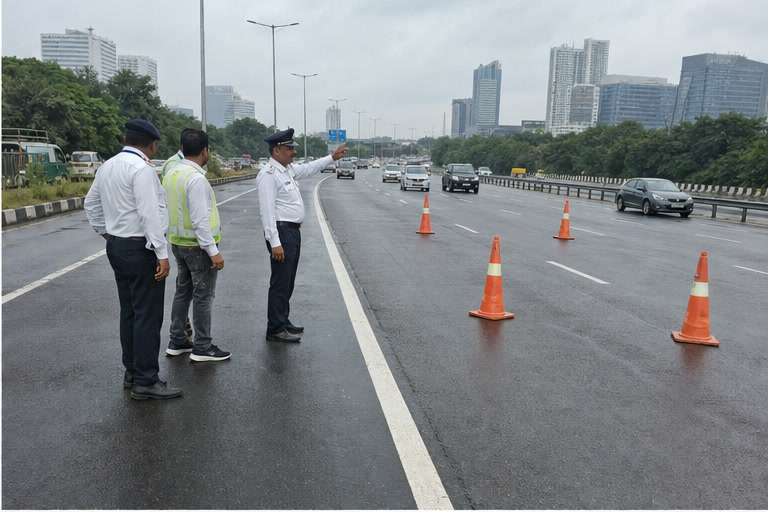
GURUGRAM: Gurugram Traffic Police are focusing on 24 identified accident black spots on the Delhi-Jaipur Highway, or NH-48, as part of an effort to reduce crashes on one of the region’s busiest road corridors.
A black spot is a location that requires concentrated safety attention because of its accident history or recurring risk pattern. Identifying a site is only the first step. Police and road-owning agencies must then determine whether the problem is linked to road design, merging traffic, visibility, lighting, speed, pedestrian movement or repeated violations.
The drive is expected to combine enforcement with engineering review. Enforcement can address speeding, dangerous lane changes, wrong-side movement and stopping in unsafe areas. Engineering measures may be needed where a junction, access point, median opening or service-road connection creates a recurring conflict.
The supplied information does not list the 24 locations or set out the intervention proposed at each one. It also does not state accident or casualty totals. Those figures should not be added without an official location-wise assessment.
Coordination is necessary because traffic police can identify behaviour and crash patterns, while the highway authority controls many physical changes. A useful black-spot plan should assign each correction to a responsible agency and set a method for checking completion.
NH-48 carries local commuters as well as intercity traffic, freight vehicles and buses. The mix of speeds and vehicle sizes makes predictable lane movement and clearly managed entries particularly important. Conditions can become more difficult during rain, when visibility falls and braking distances increase.
The objective is to reduce accidents, not to declare the highway accident-free before results are measured. Police data after the interventions will be needed to determine whether individual sites show a sustained improvement and whether risk shifts to nearby stretches.
Drivers can support the effort by observing speed limits, avoiding abrupt lane changes and following service-road and entry restrictions. The larger responsibility remains with enforcement and road agencies to ensure that the 24 identified points receive site-specific action rather than only temporary drives.
Related Stories

Gurugram Court Gives 20-Year Term in POCSO Case
Gurugram Logs 71 Percent Excess Rain in Weekly IMD Spell
GMRL Seeks 40,254 Sq M HSVP Land for Metro Stations

DTCP Seals 27 Buildings, Over 240 Rooms in Colony Drive
HSPCB Gives Sites Four Days to Install Dust Webcams