Cyclist Killed in Golf Course Road Crash; Biker Identified
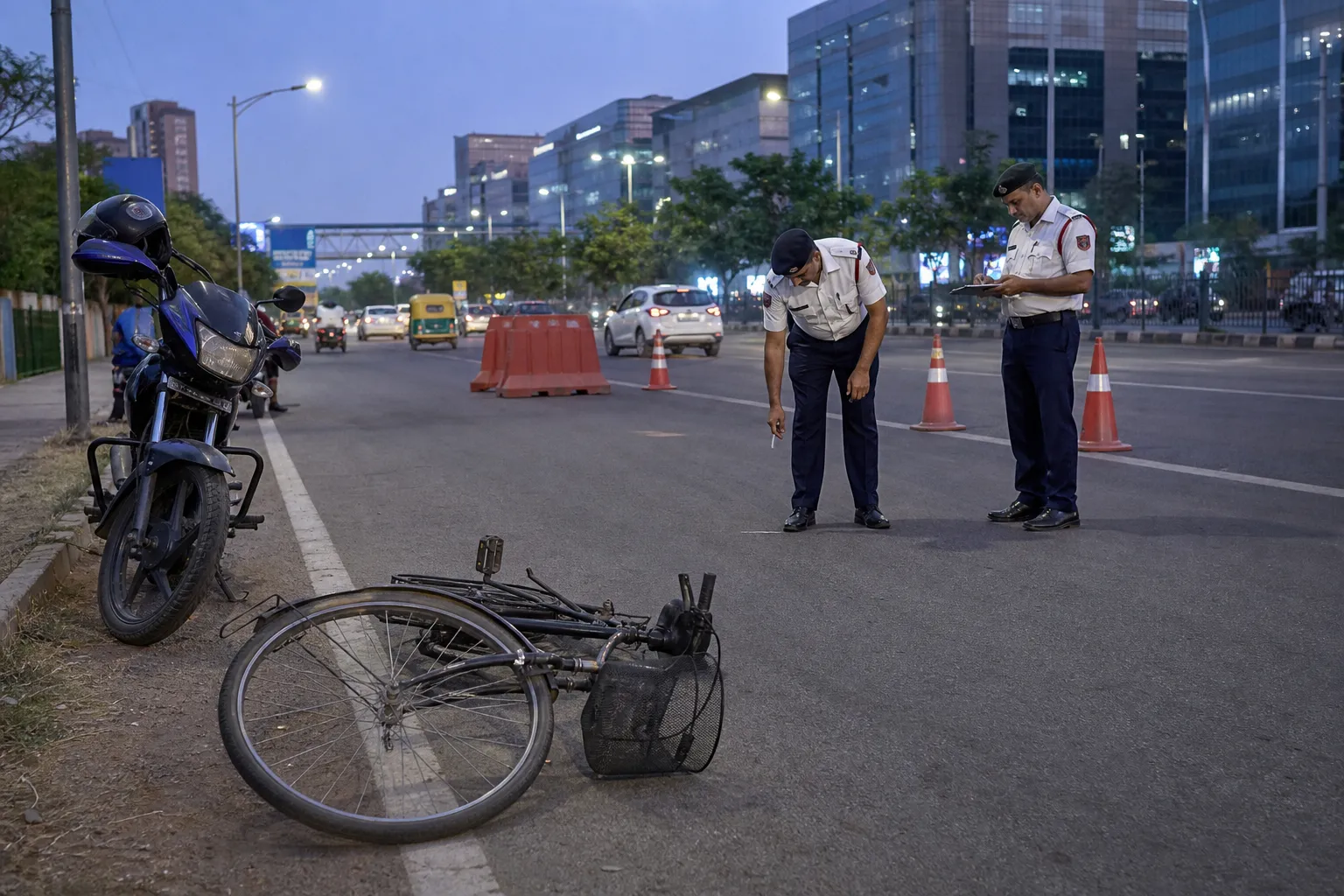
GURUGRAM: A 44-year-old housekeeping worker cycling home from Sector 43 died after a motorcycle hit him on Golf Course Road, turning a routine evening commute into another fatal reminder of how exposed cyclists remain on Gurugram's fastest urban corridors.
Police identified the victim as Khelari Prakash, a native of Barabanki in Uttar Pradesh who lived with his family in Aya Nagar Phase II, Delhi. He worked at Two Horizon Centre and had travelled about two kilometres from his workplace when the collision occurred between 6pm and 6.10pm on Saturday.
Investigators said the motorcycle, carrying a Delhi registration number, struck Prakash near Sector 43. Both men fell. The biker, who was wearing a helmet, survived with cuts and bruises, while Prakash suffered a severe head injury when he hit the road. Passersby gathered at the scene and arranged an ambulance to take him to a nearby private hospital.
Because of the seriousness of the injury, doctors referred Prakash to Safdarjung Hospital in Delhi. He died during treatment on Sunday. Following a complaint by his son, Vinay Prakash, police registered an FIR at Sushant Lok police station under sections 106 and 281 of the Bharatiya Nyaya Sanhita, relating to causing death by negligence and rash driving.
Gurugram police said the biker was also admitted for treatment and that his identity had been established. Officers said he would be arrested. Prakash's body was handed over to his family after the post-mortem examination.
The legal investigation will determine speed, responsibility and the exact sequence of the collision. Beyond the case itself, the location demands attention. Golf Course Road carries fast-moving traffic through a dense office and residential district, yet many housekeeping workers, security guards, delivery staff and construction workers rely on bicycles for daily travel. Their commute exists in the same road space as high-powered cars and motorcycles, often without a continuous protected lane.
A painted edge or a short cycle track that disappears at a junction does not offer meaningful protection. Safe cycling infrastructure has to remain continuous through intersections, service-road entries and access points where vehicles turn across a rider's path. Lighting and speed enforcement matter too, particularly during the evening shift-change window when traffic volume and worker movement overlap.
There is also a basic helmet gap. Indian law focuses helmet requirements on motorised two-wheelers, but a road impact can be fatal for a cyclist at urban traffic speeds. Awareness and affordable protective gear can reduce injury, though they cannot substitute for road design that separates vulnerable users from faster vehicles.
Prakash was two kilometres into his journey home when he was hit. That detail should matter to planners: short-distance workers are already cycling in Gurugram, whether or not the city has built for them. The response cannot stop at one FIR. A safety review of the Sector 43 stretch, backed by speed data and cyclist counts, would be a practical place to begin.
Related Stories

Mayor Announces Stricter MCG Drive Against Stray Cattle

Court Stays Further Eviction at Baba Balak Nath Temple Complex
HRERA Orders Rs 19.28 Lakh for Delayed Sector 82 Flat Possession

STF Arrests Agra Man With Six Country-Made Pistols in Sohna

FDA and Police Seize Codeine Syrup, Alprazolam in Sohna Raid