
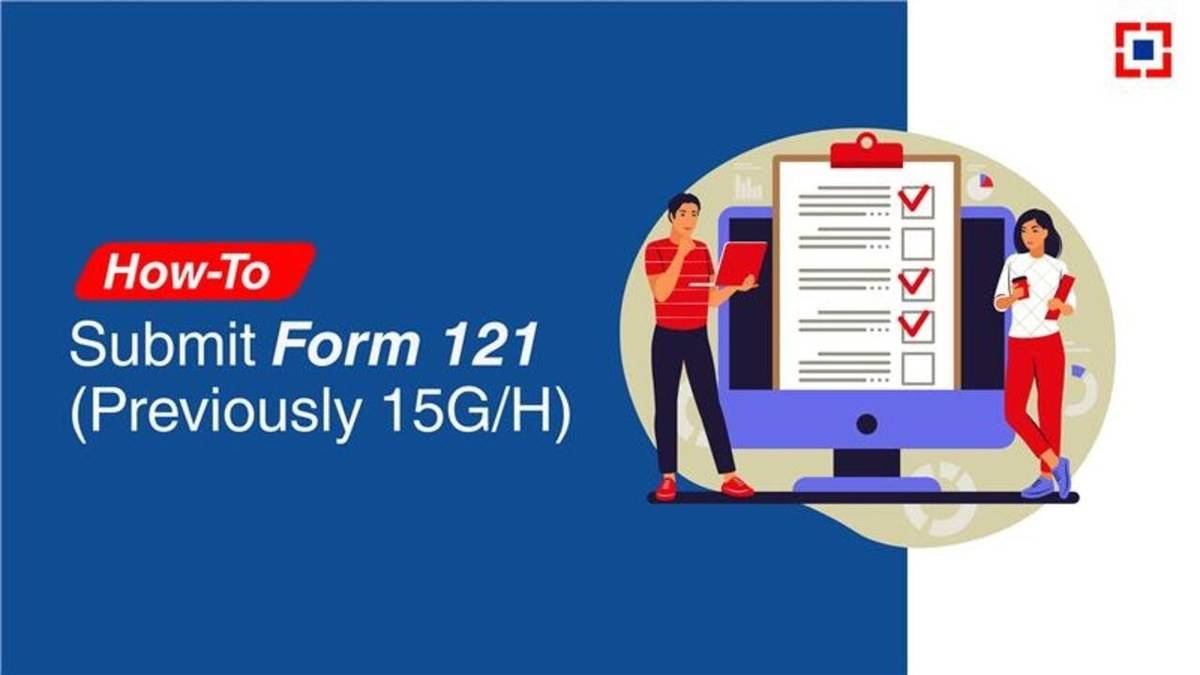
Form 121 is the new declaration replacing Forms 15G and 15H for tax years beginning on or after 1 April 2026. Eligible residents use it to ask a payer, such as a bank, not to deduct tax at source on specified income when the prescribed conditions are met. It is a declaration about expected tax liability, so receiving interest alone does not establish eligibility.
The Income Tax Department's official forms FAQ confirms the change for Tax Year 2026-27. It maps the former Section 197A provisions to Section 393(6) of the Income-tax Act, 2025. People searching for a fresh 15G or 15H declaration for this tax year should therefore check the Form 121 process.
| Question | Answer for the current declaration |
|---|---|
| Which form replaces 15G and 15H? | Form 121 |
| From which tax year? | Tax years beginning on or after 1 April 2026 |
| Who receives the taxpayer's declaration? | Each payer responsible for the relevant income |
| Is PAN required? | Yes |
| When should it be furnished? | Before the relevant income is credited or paid, preferably at the start of the tax year |
Who can submit Form 121 instead of 15G or 15H?
The department says the eligibility criteria continue under the new legislation. Under the earlier framework, Form 15G covered resident individuals below 60 and other eligible persons, excluding companies and firms, subject to income conditions. Form 15H covered resident individuals aged 60 or more. The new form combines those declaration routes without removing the underlying eligibility tests.
HDFC Bank's deposit FAQs on Form 121 identify resident individuals, Hindu Undivided Families and other specified eligible entities as potential users. Companies, firms and non-residents are not eligible. The bank also confirms that quoting PAN is mandatory: without it, the declaration is invalid and the payer must deduct tax at the applicable rate.
The central question is whether tax on estimated total income for the tax year will be nil. There is also an income ceiling condition for declarants other than resident individuals aged 60 or more at any time during the tax year. The aggregate specified income covered by the declaration must not exceed the maximum amount not chargeable to tax.
HDFC Bank's Form 121 and its instructions set out that distinction. The income ceiling condition does not apply to those resident senior citizens, but the declaration that tax on estimated total income will be nil still applies. Assess income across sources before signing: a small interest amount at one bank does not establish that overall tax liability is zero.
Do you submit Form 121 separately to every bank?
Yes. HDFC Bank expressly says the declarant must furnish Part A to each payer responsible for paying the income. If eligible interest comes from two banks, submitting a declaration to the first does not complete the task for the second. Keep a record of which payer received it and the tax year it covers.
A fresh declaration is required for each tax year. Do not assume a submission retained in an old account file automatically applies to the next year. The bank's FAQ describes Form 121 as optional, subject to eligibility, rather than a compulsory document for everyone holding a fixed deposit.
The taxpayer can submit the declaration on paper or online where the payer offers that facility. The payer has a separate electronic reporting responsibility. The Income Tax Department's Form 121 user manual describes a process using the deductor's TAN. Those reporting instructions are addressed to the payer, rather than a demand that every depositor obtain a TAN.
How to submit Form 121 through HDFC Bank
The bank's public submission guide provides one practical example. Its online service has its own verification requirements, including PAN updated in bank records and the customer being the primary holder of the relevant deposits. These are details of that bank's route, so customers of another institution should use their own payer's instructions.
- On HDFC Bank's website, open Digital Services under Need Help, then select Form 121 under Deposit Services.
- Enter the registered mobile number and requested identification details, then complete OTP verification.
- Select the appropriate Customer ID where more than one is linked, and complete the available identity verification.
- Enter the requested income details, including income covered by earlier declarations, estimated interest from additional deposits and other estimated income.
- Review the information, complete submission and download the acknowledgement. The bank says a Service Request ID is provided.
Have estimated interest details from all sources ready before beginning. The bank's guide also asks about previous declarations and income-tax returns for the preceding two financial years. Answer the actual questions presented rather than copying figures from an old form without checking the year and deposits involved.
What happens if Form 121 is submitted late?
The department recommends furnishing the declaration before income is credited or paid, preferably at the beginning of the tax year. HDFC Bank warns that a late submission can mean TDS has already been deducted. Depending on the applicable rules and the person's final tax position, that amount may need to be claimed through the income-tax return process.
Keep the acknowledgement alongside the interest record so you can check what was declared and when. For related deposit questions, read our guides to FD, RD and PPF rules, premature FD withdrawal calculations and bank statement narration.