
Form 10E is required to claim Section 89 tax relief on eligible salary arrears or advance income for assessment year 2026-27. The Income Tax Department advises filing it before the income tax return. Its current guidance also draws a distinction: Form 39 applies under the Income-tax Act, 2025 from Tax Year 2026-27, while AY 2026-27 claims under the 1961 Act still use Form 10E.
The similar year labels can cause confusion. An assessment year and a tax year are different references in these instructions. Before searching for a form, identify the period of the income and the law governing the claim. The calendar date on which you open the portal does not answer that question.
| Claim covered by official guidance | Form |
|---|---|
| AY 2026-27, relief under Section 89 of the Income-tax Act, 1961 | Form 10E |
| Tax Year 2026-27 onwards, relief under Section 157 of the Income-tax Act, 2025 | Form 39 |
| Form 10E filing mode | Online through the income tax portal |
What is Form 10E used for?
The department's Form 10E user manual explains that bunching salary payments into one financial year can create an additional tax burden. Relief addresses eligible income assessed at a higher rate because it arrived in advance or arrears. The manual also covers family pension and other specified receipts.
A delayed payment does not itself establish how much relief is due. The amount and the years to which it belongs matter. Keep those two questions separate: what was received, and which period did it relate to? A single bank credit may represent several years of arrears.
For a practical preparation example, suppose an arrears statement allocates Rs 40,000 to one earlier year and Rs 60,000 to another. The amount to reconcile is Rs 40,000 + Rs 60,000 = Rs 1,00,000. Entering that total entirely against either year would lose the allocation shown in the statement. These illustrative amounts explain record preparation; they are not a calculation of tax relief.
How to file Form 10E on the income tax portal
The published manual requires a registered individual user and an active PAN. It describes these steps for taxpayers filing the form themselves:
- Sign in to the official portal and choose e-File, Income Tax Forms, then File Income Tax Forms.
- Search for Form 10E, select the assessment year and continue.
- Choose the applicable income items and confirm personal information.
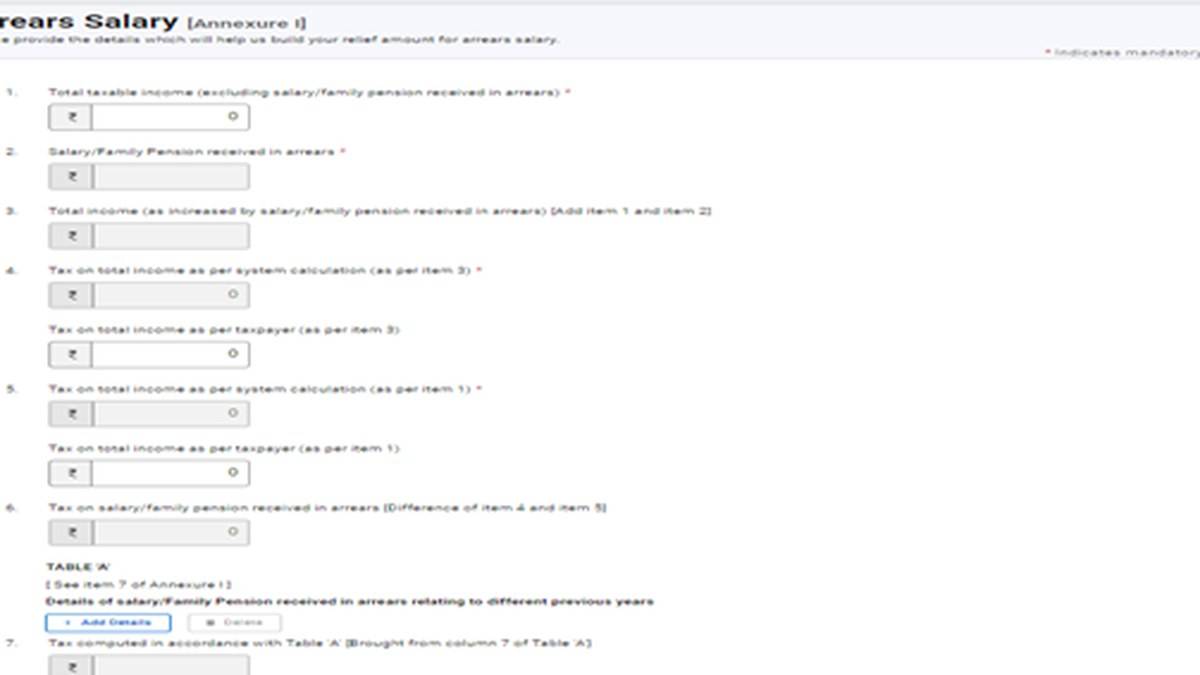
- Complete the relevant sections, including year wise arrears details where applicable, and save them.
- Complete verification details, preview the form and proceed to e-Verify.
The arrears section is separate from the advance salary section. Other sections deal with gratuity, compensation on termination and commutation of pension. Select according to the receipt being reported. Their appearance in the menu does not make every payment under those labels eligible for relief.
The manual says successful electronic verification completes submission and generates an acknowledgement number, communicated through registered contact details. A useful personal check is to retain that acknowledgement alongside the final form. Previewing or saving information should not be treated as proof that submission is complete.
What happens if Form 10E is missing?
According to the department's Form 10E FAQ, an ITR claiming Section 89 relief can still be processed if the form has not been filed, but the claimed relief will not be allowed. The department says the disallowance is communicated through an intimation under Section 143(1).
That distinction matters when checking a result: successful processing of the return does not mean every relief claim was accepted. Compare the relief entered in the return with the amount allowed in the intimation. Keep a copy of both, rather than relying only on the final payable or refundable balance.
The FAQ also says the form can be submitted online without downloading and submitting a paper copy. It advises filing before the ITR. It further explains that system calculated tax uses the default new regime for AY 2024-25 onwards, and the old regime for earlier years through AY 2023-24. Check the displayed computation against the facts of the relevant year.
When does Form 39 replace Form 10E?
The department's Income Tax Forms guidance explicitly preserves Form 10E for AY 2026-27 under the old Act. For claims under the 2025 Act, it specifies Form 39, due on or before the applicable return due date under Section 263(1)(c). A deadline for a particular taxpayer should therefore be checked separately.
Form 39 contains basic taxpayer and tax year details in Part A, followed by receipt details and computation tables in Part B. Its existence does not mean an AY 2026-27 Form 10E claim should be relabelled with the new tax year.
For supporting checks, read our guides to Form 16 and Form 26AS, AY 2026-27 tax regimes, and ITR rectification requests. Keep the employer's year wise arrears statement with those records so the reported receipt, form and return can be checked together.