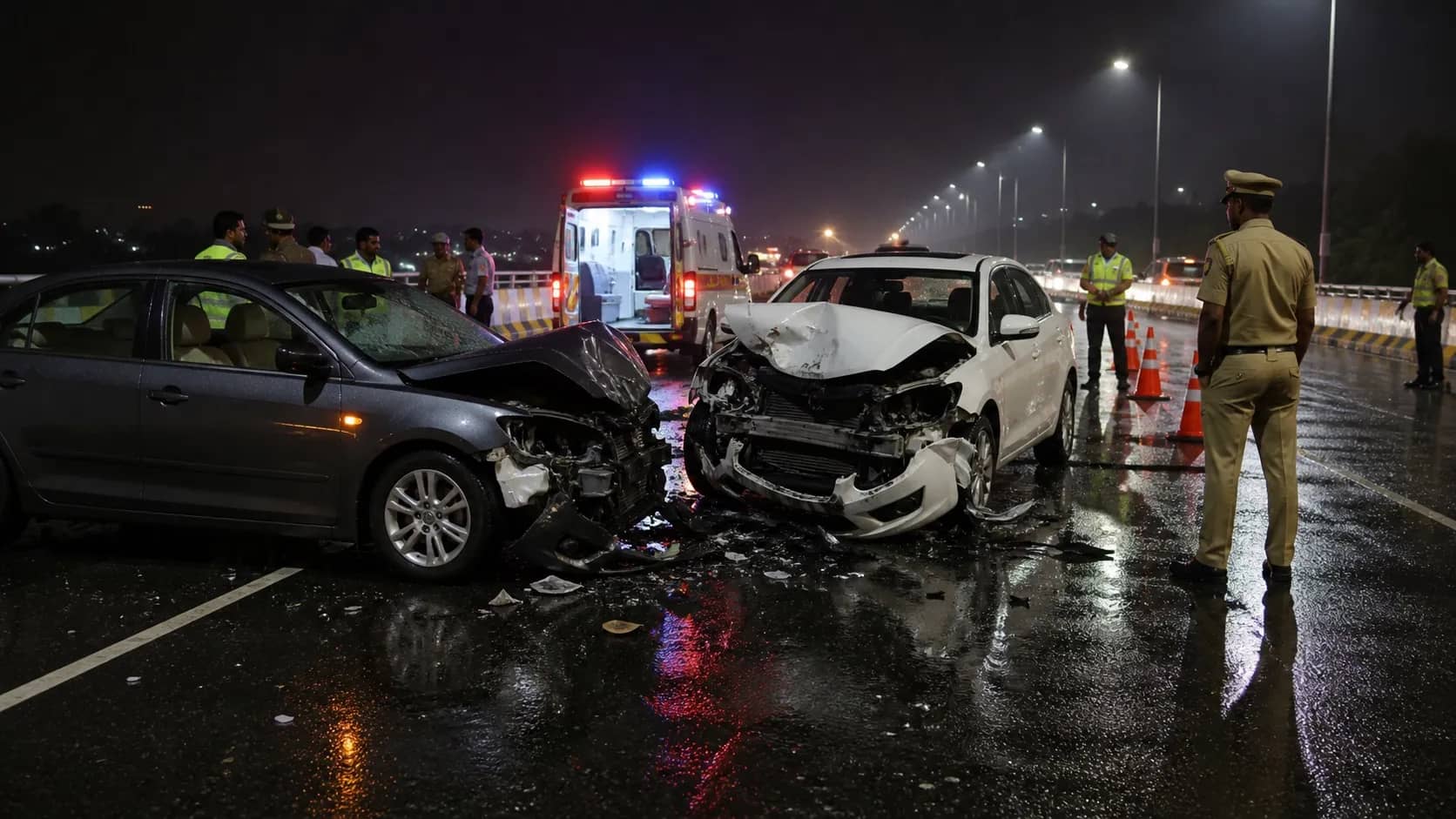
VARANASI: Eleven people were injured when two cars collided head-on on the highway near Chitrasenpur in the Mirzamurad area late on Sunday night. Local residents alerted police, and the occupants of both vehicles were taken to a private hospital for treatment.
The injured included travellers from Naini Chakagaon in Prayagraj and one person from Mirzapur. The published list named Ashutosh Ojha, Ranveer Mishra, Rajrani, Gaya Bodh Pandey, Sangeeta Pandey, Meena Devi Ojha, Sushma Mishra, Mamta Shukla, Manjile Shukla, Prachi Mishra and Monu. No fatality was reported in the initial account.
The wrecked vehicles and rescue activity slowed the highway for about half an hour. The precise cause of the collision has not been established publicly. Vehicle position, driver statements, road markings, speed and visibility will all matter to any police assessment, particularly because the crash occurred at night.
Head-on impacts produce severe force even when neither vehicle is travelling at an extreme speed. Seat belts in every row are the simplest protection, but rear passengers still frequently travel unrestrained. An unbelted person can strike another occupant during a collision, so the decision affects everyone inside the car.
Night driving adds fatigue, glare and uncertain distance judgment. On undivided stretches, a brief drift across the centre line can leave no recovery time. Drivers should reduce speed around curves and settlements, avoid overtaking without a fully visible return gap and stop when drowsiness begins rather than trying to push through.
Bystanders at Chitrasenpur played an important first-response role by calling for help. At any crash, however, people should first make the scene visible to approaching traffic and avoid pulling an injured person from a stable vehicle unless there is fire or another immediate danger. Incorrect movement can worsen spinal injuries.
The highway reopened after the vehicles and victims were cleared, but an engineering review may still be useful if the spot has a history of collisions. Reflective centre markings, functioning lights, rumble strips near a settlement and removal of visual obstructions can reduce risk without waiting for a major road redesign.
The recovery of the 11 injured people is the immediate priority. A confirmed police or medical update would clarify the severity of their injuries and the sequence of events. Until then, the collision should be reported as an accident under investigation, not reduced to an assumed story about speed or blame.
Families travelling together should also agree on a basic emergency routine: one person carries medical and identity information, another knows the insurance and roadside-assistance details, and everyone wears a belt before the vehicle moves. Those habits feel excessive until a crash leaves passengers separated and phones damaged.