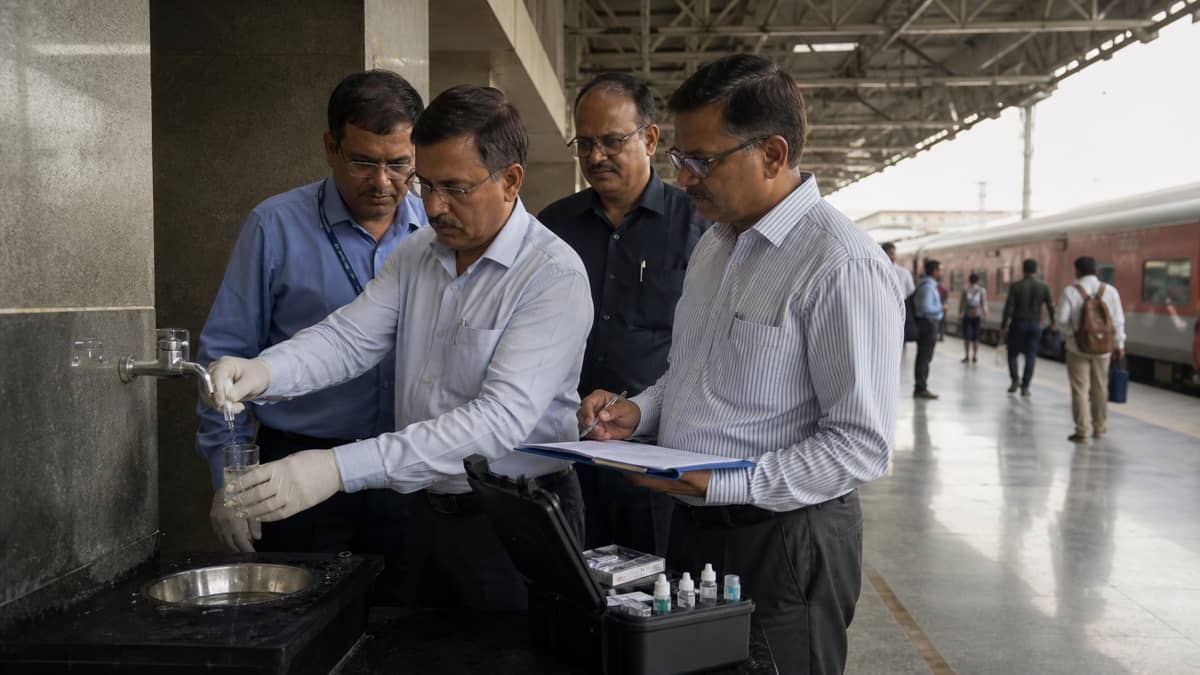
VARANASI: North Eastern Railway’s divisional railway manager Ashish Jain collected a drinking-water sample at Banaras railway station during a Monday inspection and asked officials to make quality checks a regular, documented routine.
The sample was examined with a field kit for chlorine level and E. coli or coliform contamination, according to the station report. Jain directed the team to maintain chlorination within prescribed standards and issue testing reports instead of treating a senior officer’s visit as the only occasion for scrutiny.
The initial report did not publish the numerical chlorine reading or the result of the bacterial test. It is therefore not accurate to claim that the water passed or failed. A field kit can provide a useful operational check, while microbiological safety may require a properly collected sample, a controlled laboratory method and a record of where and when the sample was taken.
Jain said supplying clean drinking water to passengers is a railway priority and referred to the Uniform Drinking Water Quality Monitoring Protocol used at stations. He also asked officials to inspect the internal and external cleanliness of storage tanks, confirm that lids are secure and keep the surrounding area free of waste and stagnant water.
Those details matter because water quality can change after treatment. A source may be safe while a dirty tank, damaged lid or poorly maintained tap introduces contamination later. Chlorine residual at the point of use indicates whether disinfection protection remains in the system, but too little and too much both require correction. The reading must be interpreted against the applicable standard by trained staff.
Banaras station handles travellers who may refill bottles just before a long journey. Test information should therefore be easy to find. A dated board or QR record showing the most recent sample location, parameter and result would give passengers more confidence than a general assurance. Any failed result should trigger isolation of the outlet, cleaning, retesting and a clear notice until it is restored.
Passengers also have a role. Bottles should not touch the tap mouth, disposable cups should go into bins and a leaking or foul-smelling outlet should be reported to station staff or the railway helpline. Visual clarity alone is not proof of safe water, so travellers should use designated drinking-water points rather than an unmarked service tap.
The DRM’s hands-on test made water quality visible for a day. The stronger outcome would be a schedule that continues without him: clean tanks, sealed lids, calibrated kits, independent laboratory checks and reports passengers can see. At a station named for the city, that routine is not a courtesy. It is basic public-health infrastructure.