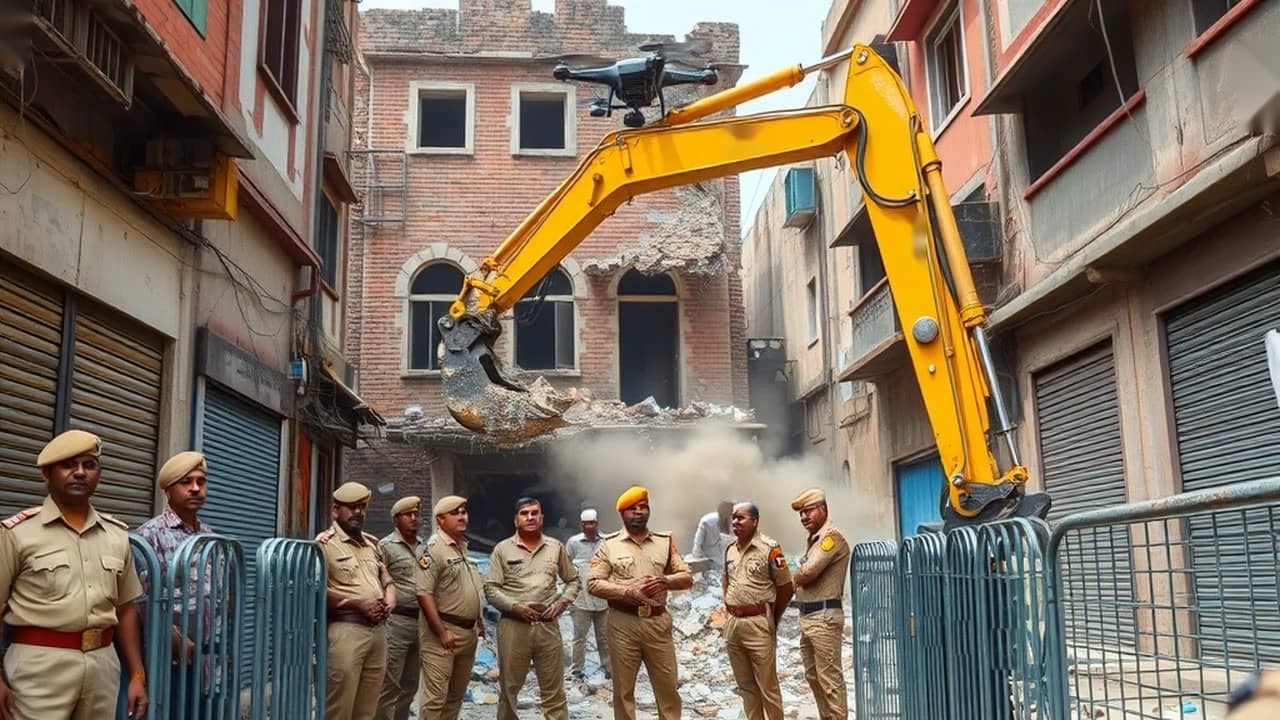
Excavators returned to Dalmandi on Monday afternoon after a gap of several months, as the administration pulled down the last few buildings standing in the way of the market's road-widening project. About 200 police personnel guarded the operation, and drones were flown overhead to watch the lanes.
The Assistant Commissioner of Police, Dashashwamedh, said the remaining five buildings were demolished during the drive and that it ended peacefully. Other accounts from the site put the figure at six houses for which the process began on Monday. Either way, the buildings taken down were the last of those still standing on the marked alignment.
The ground was prepared a day earlier. On Sunday, the Public Works Department carried out a munadi, a public announcement made house by house, at each of the remaining buildings, asking residents to vacate. By Monday afternoon JCB machines had moved in.
The scale of the project is easier to see in the overall count. A total of 181 houses were marked for the widening, and most of them had already been demolished in earlier rounds, which is why Monday's work was described as the final phase. The gap between those earlier rounds and this one had stretched into months.
Security was arranged to keep the old market's crowds well back. The deployment of roughly 200 police included women personnel, and officers of the rank of Superintendent of Police and Assistant Commissioner were present on the ground. Members of the public were kept away from the demolition sites, and the drones were used for surveillance and to spot any emergency quickly. Officials of the Varanasi Development Authority and the Varanasi Municipal Corporation were also at the spot.
With the last structures down, the work shifts below the surface. Once these buildings are cleared, a deep sewer line will be laid and electric cables will be taken underground, according to the accounts of Monday's drive. The PWD has already begun that sequence on the cleared stretches, as Dalimss News reported when the widening moved on to sewer lines ahead of a storm-water drain.
The plan described by the PWD's executive engineer in that update gives a sense of the finished street. The corridor, roughly 650 metres long, is to be rebuilt to about 17.4 metres overall, with a 10-metre road and 3.5-metre footpaths on each side. Ducts beneath the footpaths are meant to carry power cables, optical fibre and other utilities, and officials have pointed to December as the target for completing the package.
Putting cables underground is not a cosmetic detail in this part of the city. In September, a JCB clearing debris in the area struck an underground 11 kV line and left Ward 69 without power for much of a working day. Utility work done before the road surface is sealed is supposed to make such accidents less likely once the street is finished.
The stated aim of the whole exercise is traffic. Dalmandi is one of the oldest and most densely packed commercial pockets of the city, with narrow lanes that carry shoppers, handcarts, two-wheelers and deliveries at the same time. The administration has said a wider road will ease movement through the market and improve basic infrastructure, an argument familiar to anyone who has tried to push a loaded cycle rickshaw through the lane at midday.
Reaction on the ground remains mixed. Some residents support the project, while others see the loss of homes and shopfronts as a serious problem for their families, according to accounts from the area. The compensation side of the project has been reported separately, including who among the property owners has received payment, and no new compensation figures were released on Monday.
For the traders who remain along the stretch, the demolition was only one part of the disruption. Next come the debris clearance, the sewer trenches and the cable ducts, and the December target set by officials will decide how long the market lives with all three before the new road surface finally goes down.