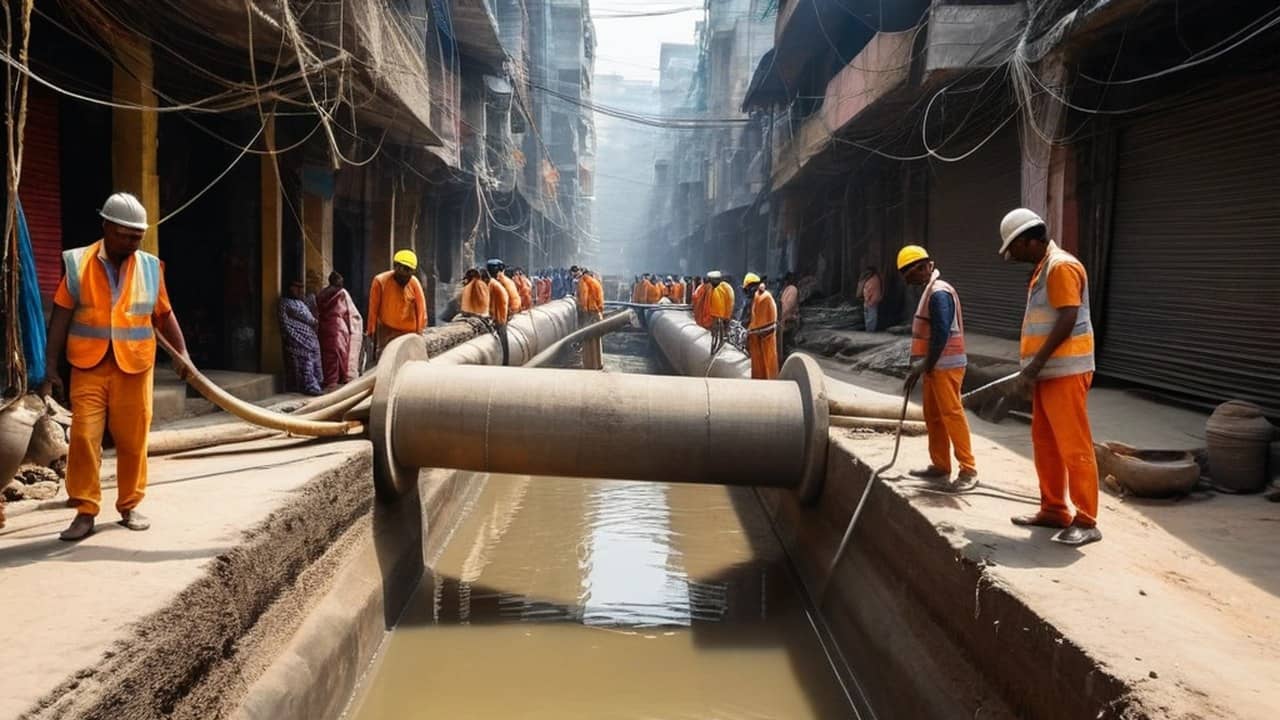
Dalmandi's long-promised widening has moved from demolition talk to underground work. Public Works Department crews have started laying sewer and drinking-water lines along the roughly 650-metre corridor, and a storm-water drain is next in the sequence so the rebuilt road does not drown in the first heavy rain.
Executive Engineer K.K. Singh said the project will first finish sewer and potable lines, then place the storm-water system meant to cut waterlogging on the carriageway and adjoining pockets. The corridor is to be rebuilt to about 17.4 metres overall: a 10-metre road with 3.5-metre footpaths on each side. Ducts under the footpaths will carry power cables, optical fibre and other utilities. Street lights and planting are part of the finished surface plan. Officials still point to a December target for completing the widening package.
On the sewer side, a deep trunk line is going in at roughly four to five metres in places. About 1.5 metres below the future road surface, 250 mm RCC laterals are planned on both sides. Chambers are to be built roughly every fifteen to twenty houses so nearby homes can connect, with links back to the deep trunk where needed. At two spots crews are using trenchless pushing with pits, jacks and a pushing machine so the full road width does not have to stay open. That choice is meant to keep some traffic alive while pipes go under.
Anyone who walks Dalmandi knows why drainage sits high on the brief. The old narrow alignment ponded quickly in monsoon, and shopfronts took the spill. Widening without a storm line would only rebuild the same puddle at a larger scale. Sequencing wet utilities before the final crust is standard practice; the public test will be whether chambers, laterals and the storm drain are actually live before the top layer is sealed.
Shopkeepers along the stretch will live with diversions and dust through the coming weeks. Pedestrians should expect temporary bridging over open trenches and night work where traffic pressure forces it. The verified civic facts for now are the 650-metre length, the 17.4-metre finished width, the sewer-then-storm order, the trenchless pockets, and the December aim stated by the PWD executive engineer. Earlier demolition and alignment work on Dalmandi cleared space for the wider cross-section; the underground phase now decides whether that space becomes a durable street or another ponded corridor. Trenchless pockets help, yet chamber construction still needs open cuts where house connections join. Residents should keep sewer gully traps clear once laterals go live, or the new network will silt as fast as the old lanes did. PWD's December target will be judged on whether storm water actually moves during the first serious rain after the crust is laid.