BHU CPR Day Puts 150 Students and Security Staff Through Hands-On Drills
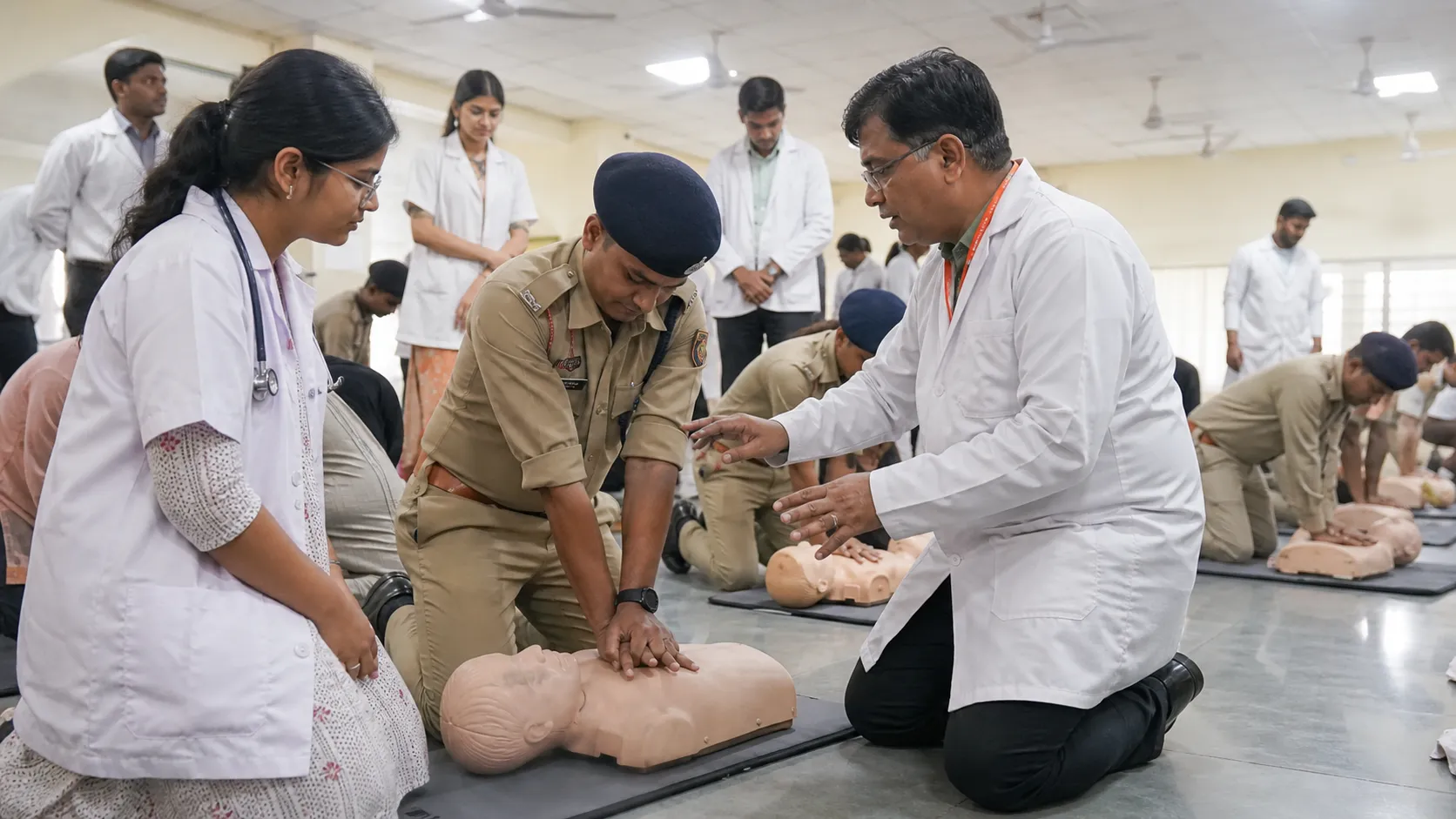
Around 150 participants at Banaras Hindu University moved beyond a lecture on emergency care and practised cardiopulmonary resuscitation, airway management and recovery positioning on training mannequins during a National CPR Day programme organised by the Proctorial Board and Institute of Medical Sciences.
The group included about 35 security personnel, roughly 100 final-year MBBS students and 15 physiotherapy students. Organisers said around 35 women took part. The mixed attendance mattered because medical emergencies on a large campus are not always first seen by doctors. Guards, classmates, hostel staff and passersby may be the people standing closest in the critical opening minutes.
Instructors discussed how to recognise cardiac arrest, stroke, unconsciousness, heavy bleeding, airway obstruction and injuries after road crashes. Participants then practised high-quality chest compressions, basic airway actions and the recovery position. The programme formed part of the wider “CPR Ready India” effort.
Prof Shashi Prakash Mishra from general surgery, Prof Manjari Mishra from anaesthesia and Dr Prakhar Jaiswal from general surgery led the medical instruction. Chief Proctor Sandeep Pokhariya and members of the proctorial team coordinated the session.
Hands-on practice is the difference between having heard of CPR and being able to begin it under stress. A person must identify unresponsiveness, call for help, arrange an automated external defibrillator where available and deliver compressions at the correct place and pace. Skills fade, so one workshop should be followed by short refresher drills rather than treated as permanent certification.
The university should also map where defibrillators, first-aid kits and emergency phones are located. Training someone to respond without giving them a fast way to summon an ambulance or find equipment creates only half a system. Clear signs and a campus emergency number should be visible in hostels, libraries, sports areas and crowded academic buildings.
Security personnel are a practical focus group. They patrol wide areas and are often called before medical teams arrive. Their training can be strengthened with scenario exercises: a collapse at a gate, a student choking in a mess or a road injury where traffic must be controlled as well as bleeding managed.
Medical students gain something different. They know the theory, but practising leadership, delegation and communication in a public setting prepares them for emergencies outside a ward. Physiotherapy students also bring experience with movement and patient handling that can improve team response.
CPR does not guarantee survival, and it should not be sold as a dramatic miracle technique. It buys time by maintaining circulation until advanced care arrives. That modest description is precisely why the skill is powerful.
BHU’s programme succeeded in putting hands on mannequins instead of limiting the day to speeches. Its next measure should be readiness: repeated drills, maintained equipment and enough trained people across each campus zone that the first responder is never too far away.
Sources and reporting
Based on the National CPR Day programme jointly organised by BHU’s Proctorial Board and Institute of Medical Sciences on 21 July 2026.
Related Stories

Court Issues Arrest Warrant for HSVP Brass

MCG Finalises Sohna Site for Fresh Waste

GMDA Seeks Station-Wise Metro Parking Plans

Thar Rams Rapido Cab After Sector 89 Quarrel
FDA Raids 3 Outlets Over Paneer Quality