Every year, when board exam results are announced, newspapers are filled with pictures of students who score 99% or more. Families celebrate, sweets are distributed, and many other parents begin to worry about their own children's marks. But behind these impressive marks lies an important question: Do high scores always mean that students truly understand what they have learned?
When India participated in the Programme for International Student Assessment (PISA) in 2010, the country ranked 72nd among 73 participating nations. PISA tests how well students can apply their knowledge to real-life situations rather than simply remember textbook information. The results raised concerns about whether India's education system was doing enough to develop students' practical understanding and problem-solving skills.
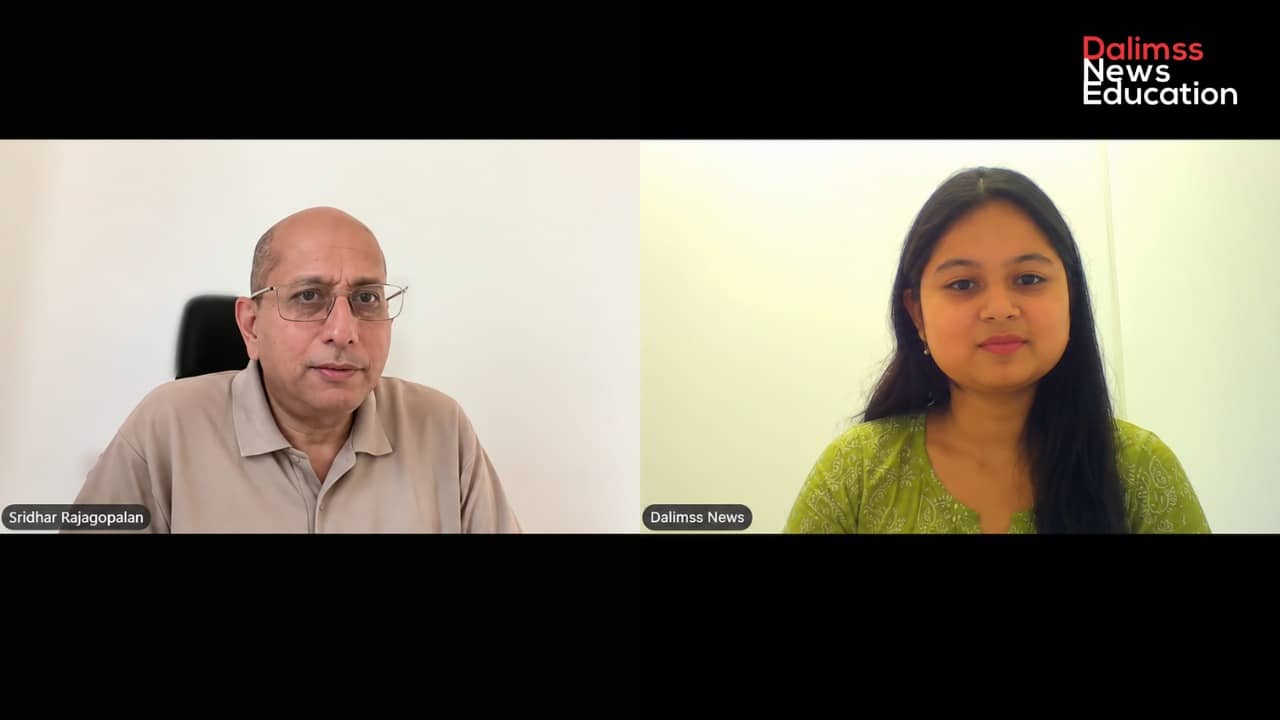
One person who has spent years working to address this problem is Sridhar Rajagopalan. An alumnus of IIT Madras and IIM Ahmedabad, Rajagopalan left his corporate career at IBM in the late 1990s to work towards improving education. After founding and running Eklavya School in Ahmedabad for six years, he established Educational Initiatives (Ei) in 2001.
Today, the organisation works with private and government schools in India and other countries to improve how students learn and how their knowledge is assessed.
In an exclusive online interview with Dalimss News Education, Rajagopalan discussed why rote learning remains a major problem in Indian classrooms, why high marks do not always reflect genuine understanding, how artificial intelligence (AI) is changing education, and why students need to learn how to think independently.
Why Rote Learning Is Behind Many Problems in Indian Education
Rote learning is often discussed as one of several problems in education, along with a lack of infrastructure, teacher shortages and an overloaded syllabus. However, Rajagopalan believes that memorising information without understanding it is one of the main reasons students struggle to develop independent thinking.
"Rote learning means learning mechanically without genuine understanding," he explains.
He describes how this problem can begin as early as primary school through a simple classroom example:
"A Class 4 question asks for three things made out of wood. A child thinks about their surroundings and writes 'door.' The teacher marks it incorrect, insisting: 'No, you must write what is in the textbook: cricket bat and chair.' That is where rote learning begins: you are actively commanding the child to stop thinking."
This example shows how children can be discouraged from thinking independently when teachers expect them to reproduce textbook answers instead of accepting reasonable alternatives.
The effects of this approach can be seen across the education system.
Teachers have less freedom to teach creatively: When teachers are judged mainly on completing the syllabus and helping students score well, they may have less time to encourage discussions, experiments and independent thinking.
Coaching centres become more important: When examinations follow familiar patterns, students often focus on memorising answers and practising repeated question formats rather than understanding the subject in depth.
Students struggle to apply their knowledge: Many students complete school with good marks but may find it difficult to solve unfamiliar problems, communicate their ideas clearly or use their knowledge in practical situations.
His concern is that education should not simply prepare students to reproduce information in an examination. It should help them understand what they learn and apply that knowledge in everyday life.
In the Age of AI, Memorising Is No Longer Enough
For many years, students and parents have followed a familiar path to success: memorise textbooks, score high marks, earn a degree and secure a good job. However, artificial intelligence is changing the skills required in the workplace.
"Anything mechanical, a computer will now do better, faster, and cheaper than your child," Rajagopalan observes.
As AI becomes more capable of handling repetitive tasks and retrieving information, simply remembering facts may no longer be enough to stand out. Students also need to understand concepts, ask meaningful questions and solve problems independently.
This change is particularly important for students studying humanities and social sciences, who sometimes face the perception that technical degrees offer better career opportunities.
When asked about the challenges faced by humanities students compared with those studying STEM subjects, he said:
"The world has changed. Fields once considered purely academic, such as philosophy and sociology, now have profound applications in areas like AI ethics and human-centered design. What matters is not whether you hold a degree in engineering or sociology; what matters is whether you have developed genuine mastery, deep inquiry, and independent problem-solving skills in that domain."
His point is that a student's abilities and understanding matter as much as the subject they study.
For example, philosophy can help students examine questions about right and wrong, fairness and responsibility in the development of AI. Sociology can help them understand how technology affects people and society.
As technology continues to develop, students from different academic backgrounds can contribute by developing strong knowledge of their subjects and learning to think critically.
Why Exams Should Help Students Learn, Not Just Judge Them
Educational Initiatives works to understand how effectively students learn and where they need additional support. Its assessment programme, ASSET, focuses on testing students' understanding of concepts rather than simply checking how much information they can remember.
Rajagopalan believes that examinations should help teachers identify students' learning gaps instead of serving only as a way to award marks.
Consider two types of questions.
A traditional textbook question: Define density. If mass is X and volume is Y, calculate density using the formula.
A student may be able to remember the formula and substitute the given values without fully understanding the concept.
A question that tests understanding: If you place a solid ice cube into a glass of water, what will happen to its position and why?
This question encourages students to apply their understanding of the properties of ice and water to explain what happens.
The difference is that the second question tests whether students can use what they have learned to explain a situation, rather than simply recall a formula. He believes that assessments should help both students and teachers understand what needs to improve.
"Assessment should not be a tool to judge, label, or humiliate a student at the end of a term," Rajagopalan argues. "It must function like a medical diagnostic: identifying exactly where a student’s conceptual gaps lie so the student can practice them, and showing teachers where their instruction fell short so they can adapt."
In other words, examination results should help teachers understand which concepts students have not understood and what changes are needed in their teaching methods.
This approach can make examinations a useful part of the learning process rather than simply a way to rank students.
Board Exams: Why Do Application-Based Questions Feel Difficult?
Changes in examination patterns have become an important part of discussions about education reform. Questions that test students' ability to apply concepts are intended to help them move beyond memorising textbook answers. However, these changes can also lead to complaints that examinations have become too difficult.
Rajagopalan believes that students may struggle with unfamiliar questions because they are used to practising the same types of questions year after year.
Rajagopalan says, "We are accustomed to 'familiar questions' where question types are identical year after year. When an exam asks students to actually think, it feels difficult only because we have never trained them to think. If a student is trained to think, a rote-memorization paper is actually the harder test because it demands verbatim regurgitation."
His argument is that students may find a question difficult not necessarily because the subject is too complicated, but because they have not been encouraged to apply their knowledge in new situations.
If students are regularly taught to understand concepts, ask questions and solve problems, they may become better prepared to handle unfamiliar examination questions.
He also highlighted the importance of careful planning when examination boards introduce changes to evaluation systems.
Digital evaluation methods, including on-screen marking, can help modernise the assessment process. However, such changes require proper preparation, teacher training where necessary, clear communication and quality checks to maintain public confidence.
Another concern is the pressure created by very high board examination scores. When thousands of students score between 98% and 99%, even small differences in marks can affect their chances of securing admission to competitive colleges.
To address this issue, he advocates moving from raw percentages towards standardised percentile-based rankings.
A percentile indicates how a student's performance compares with that of other students. Unlike a percentage, which shows the proportion of marks obtained, a percentile reflects a student's relative position within a group. Such a system could offer another way to compare performance and address some concerns associated with high scores and narrow admission cut-offs. However, its effectiveness would depend on how it is designed and implemented.
The larger question remains: Should examination results measure only how much information students can reproduce, or should they also reflect their ability to understand and apply what they have learned?
A Message to Parents: Why Perseverance Matters More Than Just Talent
The pressure to score high marks does not come from schools alone. Parents also play an important role in shaping how children understand education and success. When marks become the main measure of achievement, students may begin to focus more on examination results than on learning. This can leave little room for curiosity, experimentation and the freedom to make mistakes.
He believes that perseverance, the ability to keep working through difficulties, is an important part of long-term success.
"Even when looking at global figures like Sachin Tendulkar, brilliance alone is not what creates lasting impact. It is perseverance: how you handle failure, how you confront difficult problems, and whether you are willing to stick with a challenge when the answer doesn't come immediately. If a child is passionate about a subject, that intrinsic motivation will carry them further than any short-term score on a poorly designed exam."
His message to parents and teachers is to look beyond marks and encourage children to develop genuine interests in their subjects. Children should be allowed to ask questions, make mistakes and learn from their experiences. Instead of focusing exclusively on examination results, parents can also encourage them to explain their ideas, understand concepts and work through difficult problems.
A student who cannot immediately answer a question should not automatically be considered unsuccessful. With the right guidance and encouragement, such moments can become opportunities to learn.
Beyond the 99%: Rethinking the Purpose of Education
India's education system is going through several changes, from reforms under the National Education Policy to discussions about board examinations and the growing use of artificial intelligence. However, improving education requires more than changing examination patterns or introducing new policies. It also requires a change in how schools, teachers, parents and students understand the purpose of learning.
High marks can reflect hard work and achievement, but they do not always show the complete picture of a student's abilities. Education should also help young people develop independent thinking, clear communication, curiosity and problem-solving skills.
Rajagopalan's views highlight an important challenge for Indian education: students should not have to choose between scoring well and understanding what they study.
The aim should be to create a system in which academic achievement and genuine learning go hand in hand. The future will not belong only to those who can remember the right answers. It will also belong to those who can ask meaningful questions, understand complex problems and find thoughtful solutions.