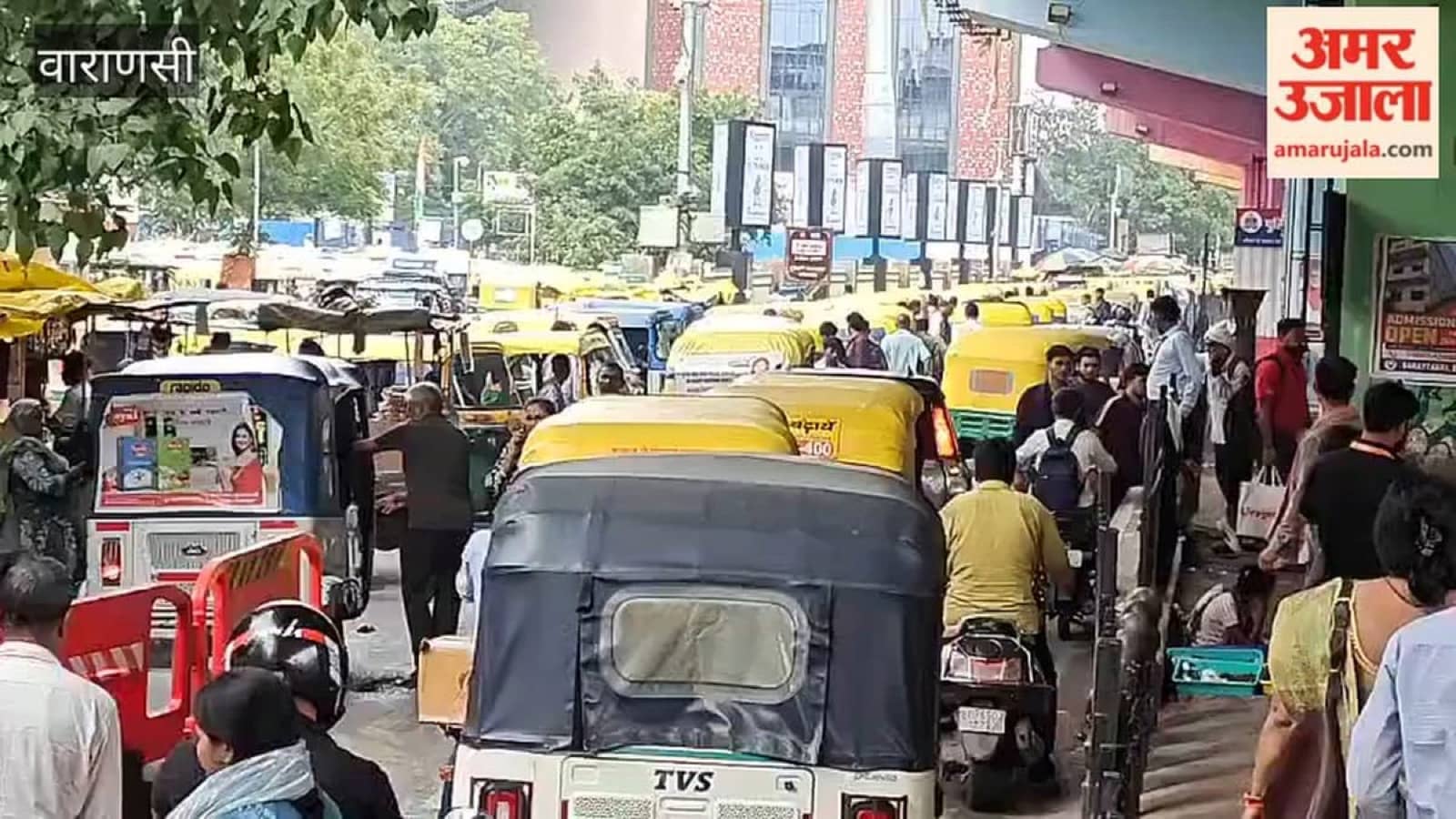
VARANASI: Traffic remained jammed outside Varanasi Cantt railway station from Wednesday morning as a dense concentration of auto-rickshaws constricted the main road and left passengers and other motorists struggling to move through the area.
Footage from the station approach showed vehicles packed across the carriageway, with autos stopping, turning and waiting close to the entrance. Cars and two-wheelers were caught behind the informal ranks while rail passengers carrying luggage had to cross between vehicles. The disruption continued at a location that already handles a constant mix of local traffic and people arriving for trains.
The Cantt frontage is not an ordinary junction. A train arrival can release hundreds of passengers within minutes, many of them looking for the same last-mile options. Drivers naturally move towards the gate to find fares, but when each vehicle waits at the point of maximum demand, the pickup zone stops functioning. Through traffic then loses a lane, passengers board in the roadway and the queue spreads into adjoining intersections.
Rain adds a second layer of pressure. Passengers are less willing to walk to a designated stand, drivers crowd under the nearest shelter and potholes or waterlogged edges make usable road space narrower. A system that works imperfectly in dry weather can lock up as soon as a shower overlaps with a busy train.
The answer is not simply to chase autos away for a few minutes. Station management, traffic police and transport unions need a pickup pattern that drivers can follow and passengers can understand. A short waiting limit near the gate, a separate queue farther back, space for app-based cabs and a protected pedestrian route would reduce the conflict between boarding and through movement. Enforcement has to be continuous enough that compliant drivers are not undercut by those who return to the entrance.
Passengers can also reduce risk by using marked stands and refusing to board in the middle of moving traffic. Families with children or older relatives should remain on the footpath until the vehicle reaches a safe point. Drivers should not block bus bays, zebra crossings or the path used by ambulances.
Wednesday's congestion was reported as an auto-driven jam, but it reflected a larger design problem: too many different movements compressed into one unmanaged strip of road. Varanasi Cantt is often a visitor's first encounter with the city. A station forecourt should help people disperse. When it becomes a parking lane, a pickup bay and a through road at the same time, nobody gets away quickly.