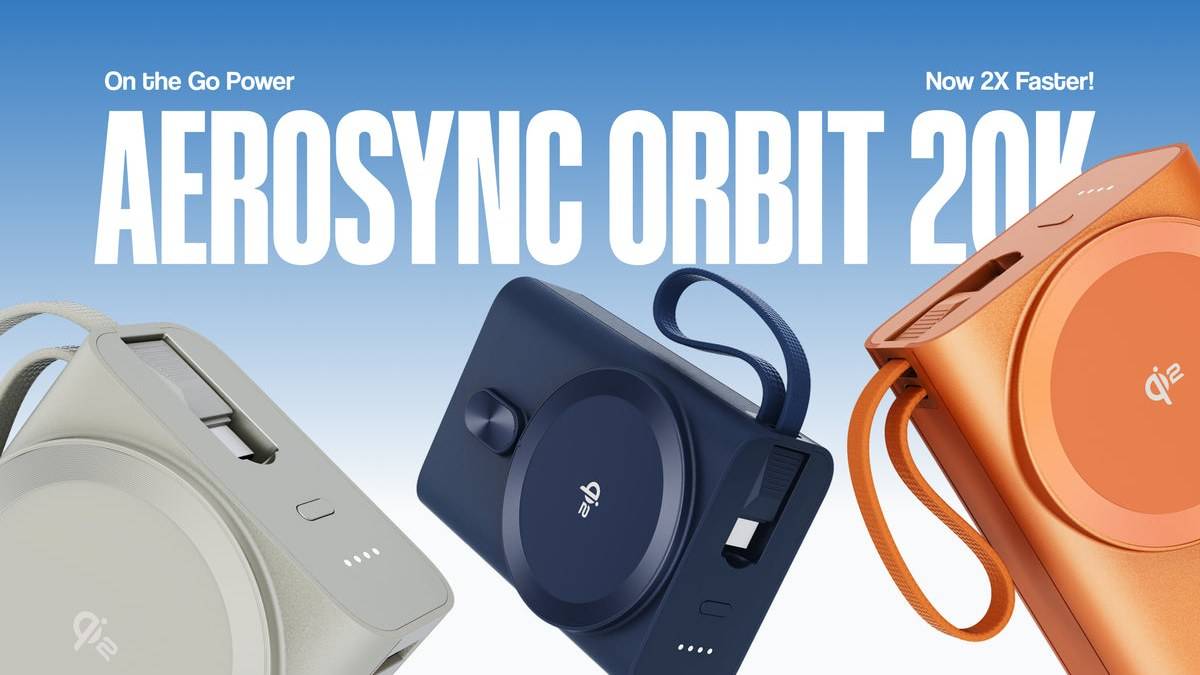
NEW DELHI: Ambrane AerosynQ Orbit 20K supports up to 35W through its Type-C socket or attached Type-C cable, and up to 25W wirelessly. The power bank itself accepts up to 20W input. These are separate ratings for different jobs, and the official manual says output is divided when multiple wired connections are used.
| Connection or feature | Official rating |
|---|---|
| Type-C socket output | 35W maximum |
| Built-in Type-C cable output | 35W maximum |
| USB-A output | 18W |
| Qi2/Qi2.2 wireless output | 25W maximum |
| Type-C input | 20W |
| Battery capacity | 20000mAh |
| Selected Black listing | Rs 3,199, including taxes |
Price as of 11 November 2026, 00:25 IST. The amount above is the displayed price with Black selected on Ambrane's page. This article explains the charging specifications; it is not a complete price list for every finish. No separate prices are inferred for other colour selections.
Who it is for
Orbit 20K is aimed at someone who wants the choice of magnetic wireless charging and a ready-to-use Type-C lead in the same power bank. A practical example is a commuter who prefers attaching the bank to a compatible phone while moving between meetings, then using a cable when the phone is resting on a desk.
The important question is which of those uses actually fits the owner's handset. A magnetic attachment can be convenient even when the phone's wireless charging specification is below the bank's maximum. Paying attention to the phone and case combination avoids treating the highest number on the power bank as a guaranteed everyday result.
35W output does not mean 35W input
The output rating describes energy being supplied to a connected device. Input describes replenishing Orbit's own battery. Since Ambrane lists the latter at 20W, the 35W wired-output headline does not establish the speed at which the bank will recharge. Plan charging the bank as a separate task from topping up a phone.
For someone heading out early, the practical implication is to prepare the bank in advance rather than assuming a short stop at a wall socket restores it fully. The documents do not justify a universal recharge promise for every adapter and cable combination. Checking that the bank has actually charged is more useful than relying on an assumed time.
Its attached Type-C lead and separate Type-C socket carry the same individual maximum. That offers flexibility over which connection to use, but does not establish that both can sustain their individual maximum together. The manual explicitly says power is shared during multiple-port use. This report therefore does not add the separate ratings into a simultaneous-output claim.
The USB-A socket is listed at 18W. Keeping that connection in the plan may help someone organise an existing cable collection, while reserving the attached Type-C lead for a compatible phone.
Magnetic alignment and wireless speed
The manual instructs users to position the phone over the charging circle and activate charging with the power button. It specifies a gap below 4 mm for optimal wireless charging. An included magnetic ring provides an alignment option for compatible devices without a built-in magnetic attachment arrangement.
The ring should be understood as an attachment aid. The sensible compatibility check remains whether the phone supports wireless charging and which charging mode it supports. Adding a ring does not, by itself, establish that an otherwise unsupported handset gains the bank's fastest wireless mode. That distinction matters when assessing accessories for an existing phone.
For Qi2.Ready Android phones, Ambrane's manual calls for a compatible Qi2-certified cover to obtain the maximum wireless output. This is a specific case requirement, so a reader should check the exact handset and cover together. A generic claim that the phone fits against the bank is insufficient evidence for the highest charging rate.
The attached cable has its own routine
Ambrane describes lifting the Type-C connector from the end of the hanging loop to use the built-in lead, then returning it carefully afterwards. Try that motion before taking the power bank out for the day. A cable integrated into the product is convenient only if the user knows where the connector is and how it is stored.
Laptop use deserves a separate check. The official page warns that 35W may be slow for some Type-C laptops, and the manual says the bank may not charge every such laptop. Treat this as a conditional capability, rather than assuming a Type-C connector makes it a replacement for every notebook's regular adapter.
For other ways of carrying reserve power, see our MiniCharge 20 report, Stellar 20K price guide and AerosynQ 4 wireless-charger explainer.
Official sources: Orbit 20K product specifications and Orbit 20K operating manual.