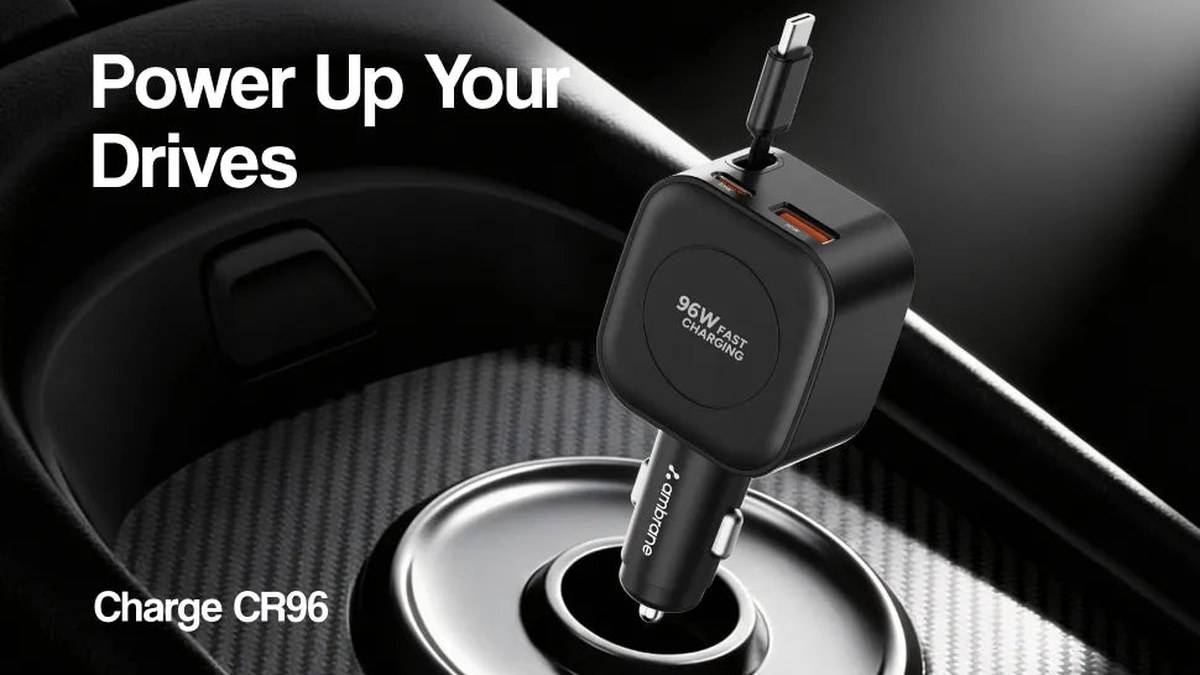
NEW DELHI: Ambrane Charge CR96 has a built-in 78 cm retractable Type-C cable, a separate Type-C socket and a USB-A socket. Its manual advises starting the vehicle's engine before using the charger. For an owner setting it up in a car, cable routing and the power limit of each connection matter more than the large combined wattage printed in its name.
| Item | Official specification or instruction |
|---|---|
| Retractable cable | 78 cm, Type-C |
| Connections | Type-C socket, built-in Type-C cable, USB-A socket |
| Input rating | DC 12.5V to 14.7V |
| MacBook charging | Up to 30W |
| Listed product price | Rs 1,099, including taxes |
Price as of 11 November 2026, 00:25 IST. The official page identifies the product as a 96W car charger for a standard 12V cigarette-lighter socket. This guide uses the company's product page and operating manual; it does not claim a measured charging speed or a tested fit in a particular vehicle.
Who it is for
The CR96's distinctive feature is the attached cable. It suits a car in which a Type-C phone is regularly charged but a loose lead is often left at home, borrowed or tangled with other items. The additional sockets leave room for devices using separate cables. That makes it an accessory for an established in-car charging routine.
For an Indian family sharing a car, assign the built-in lead to the device most often connected near the centre console. Before relying on it for a rear-seat passenger, physically check the route and reach while parked. The stated length alone does not establish whether it reaches a particular seat, phone mount or storage compartment.
Set up the retractable lead
Following the manual, insert the charger into the vehicle socket, extend the attached Type-C connector and connect a compatible device. When finished, guide the cable back into the body. Ambrane specifically cautions against letting it retract abruptly. Treat the retracting mechanism as a moving part that needs controlled handling.
A useful parked-car check is to connect the phone where it will actually sit during a journey. Look for a route that leaves the cable relaxed at both ends. If the only usable position requires the connector to be pulled sideways, reconsider the phone's placement rather than assuming the retractable lead can accommodate the strain.
Passengers should also agree where the cable goes when it is unused. Keeping it attached to the charger solves the problem of losing a separate lead, but the driver still needs an orderly cabin. Rehearse connecting and putting it away before the first trip, so the mechanism is familiar when the car is in regular use.
Include any regularly used cup holder or storage lid in that parked check. A workable cable route should remain workable when those everyday parts of the cabin are being used.
Understand the individual charging limits
The product specification gives 30W for the Type-C socket, attached cable and USB-A socket, with PPS listed at 33W maximum. The manual's simultaneous-use table assigns 30W to each active connection in its paired combinations. Its three-connection entry is 33W plus 33W plus 30W, producing the advertised 96W total.
Those entries describe different operating cases. The 96W figure should therefore never be read as the output available to a single phone. Ambrane also explicitly describes MacBook support at up to 30W. A reader hoping to replace a laptop's usual high-power adapter should begin with that device-specific limit, rather than the combined figure.
For a journey involving a laptop and phones, prioritise what needs energy during that particular drive. A laptop needing a substantial recharge presents a different task from a phone maintaining its battery while travelling. The CR96 documentation does not provide a reliable full-charge time for every device, so this guide does not attach one to either scenario.
Use the engine and socket instructions
Ambrane recommends use after starting the engine to avoid draining the vehicle battery. Its stated electrical input range is more specific than the broad car-compatibility language on the shopping page. Follow the vehicle's own socket instructions too, especially when deciding when to unplug accessories after a journey.
The manufacturer's care instructions say to disconnect the charger before cleaning and avoid water, forceful cable pulling and use with damaged connectors. In practice, inspecting the retractable connector while putting the cable away provides a natural opportunity to notice damage. Continued operation is not a substitute for addressing a damaged lead.
For charging away from the car, read our Ambrane MiniCharge 20 report, PowerMini 20 price guide and Charge D100 and Charge 100 comparison.
Official sources: Charge CR96 product page and Charge CR96 operating manual.