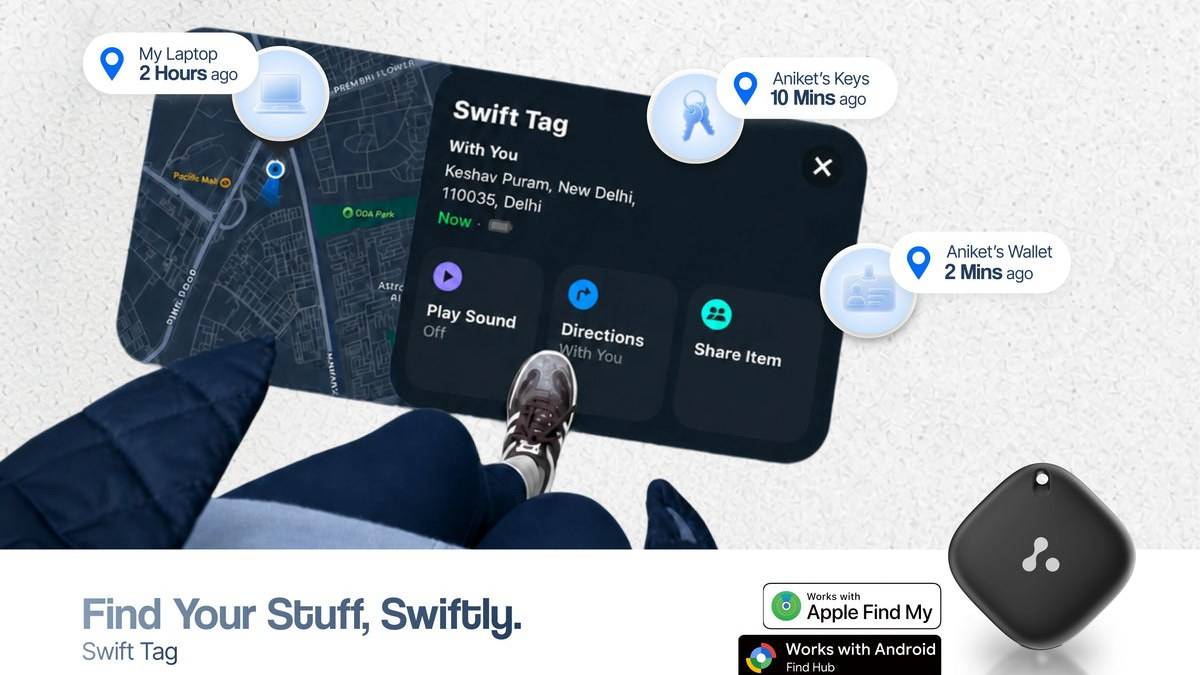
NEW DELHI: Ambrane lists the Swift Tag in Black at Rs 999, including taxes. The ALT-01 item finder works with Apple Find My and Google Find Hub, uses a replaceable battery and does not require a SIM card. Its purpose is to help find belongings such as keys and bags through the supported phone networks.
| Variant or feature | Official listing |
|---|---|
| Swift Tag, Black | Rs 999, including taxes |
| Model | ALT-01 |
| Phone networks | Apple Find My and Google Find Hub |
| Battery | Replaceable CR2032, up to one year claimed |
| Audible alert | 60dB |
Price as of 11 November 2026, 00:24 IST. Black is the only colour shown on the page checked for this report. The displayed product price is the basis here; promotional code panels are excluded. This is a specification and setup report based on company documentation, rather than a hands-on test.
Who it is for
Swift Tag makes most sense for someone whose problem is remembering where an everyday object was left. Think of a commuter moving a key ring between an office bag and a weekend bag, or a household trying to find a misplaced backpack before leaving home. The practical starting point is deciding which object deserves the tag.
Its support for both phone ecosystems is relevant in a household with different handsets. However, the compatibility statement should not be read as a promise that the same tag can report to both networks simultaneously. The official material checked provides separate setup paths. Choose the intended phone and follow the matching instructions before attaching the tag to something valuable.
A sound and a map answer different questions
Ambrane lists Ring, Alert and Lost functions. The sound is intended to help locate a nearby object, while the network features address belongings that have moved beyond the immediate search area. A map location and an audible search are different tools, so the useful first question is whether the missing object is probably nearby.
For a bag somewhere inside the home, playing the alert may be more useful than repeatedly looking at the map. For luggage left elsewhere, the network view becomes the relevant starting point. These are practical examples of how to approach a search, not promises about recovery speed or how often the location will refresh.
The absence of a SIM or built-in GPS is central to understanding this model. Do not plan around a continuously updated route from a moving object. The product depends on its supported finding networks. For an Indian reader considering it for a daily commute, the sensible test is to check its behaviour on familiar journeys before relying on it during a trip.
Pair it before the day you need it
The manual's Apple route starts in Find My: add an item, choose the option for another supported item and complete the connection. Give the tag a recognisable name. A label tied to the actual object is likely to be more helpful during a hurried search than an unexplained default product name.
On Android, the manual describes bringing the powered tag close to the phone with Bluetooth and the network connection enabled, then accepting the connection prompt. It says the pairing screen appears automatically when the finder is activated nearby. If pairing has not completed within five minutes, the tag powers down and needs to be switched on again.
That timeout matters during initial setup. Prepare the phone first, then activate the tag, rather than leaving the finder waiting while searching through menus. Afterwards, try the sound function while the object is in view. This gives the owner a familiar reference for the alert before a real search becomes urgent.
The manual also explains unwanted-tracker alerts and says location communication through Find My is encrypted. For a family sharing bags, this is a reason to explain what the attached finder does before handing an item over. A tracker should have a clear owner and an understood purpose, especially when the tagged object regularly changes hands between people.
Battery replacement is part of ownership
Ambrane's battery-life figure is an upper claim, rather than a guarantee for every usage pattern. The replaceable cell means the device does not have to be treated as disposable when the battery runs down. Keep the model's battery requirement with the purchase record, and check the tag before journeys where a failed finder would be particularly inconvenient.
Readers comparing tracker ownership can also consult our Ambrane AerosynQ 4 price: Rs 2,299 for the Grey finish and Apple AirTag price list: Rs 3,790 to Rs 12,900. For another small accessory with a separate ownership question, see the Ambrane Charge 25 price: Rs 649 for the Black GaN adapter.
Official sources: Ambrane Swift Tag product page and the Swift Tag user manual.