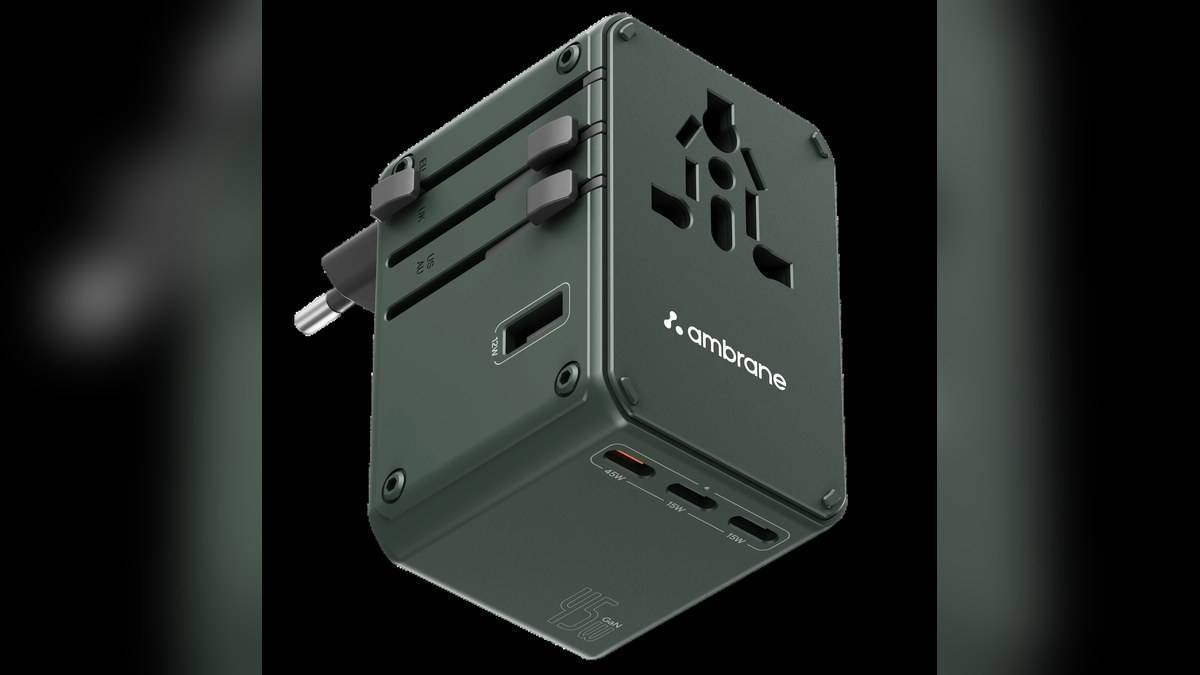
NEW DELHI: Ambrane lists the ATA-04 international travel adapter at Rs 1,999, including taxes, for the Green selection. It combines a universal AC socket with USB charging, led by a Type-C output rated up to 45W. Its appeal is bringing plug adaptation and gadget charging into the same travel accessory. Price as of 18 November 2026, 00:21 IST.
| ATA-04 detail | Official figure |
|---|---|
| Displayed price, Green | Rs 1,999 |
| Maximum DC output | 45W |
| AC socket maximum | 2500W |
| USB-C outputs | C1: 45W; C2/C3: 15W maximum |
| USB-A outputs | A1/A2: 12W maximum |
| Connections | Three USB-C, two USB-A, one AC socket |
| Input range | AC 110V to 240V |
| Listed weight | 164g |
What is included in the model's role
The opened store page shows Green as its colour selection and does not expose a separately priced capacity or power variant. The product is a travel adapter with mains input, rather than a battery pack. Its quoted AC socket allowance and USB output describe different connections and must be read separately when planning what to plug in.
Ambrane lists changeable pins for US, UK, Australian and European standards, a universal socket and compatibility across more than 150 countries. That broad manufacturer claim is useful as an overview, but a traveller still needs to match the destination's actual socket arrangement. The country-count claim does not replace checking the particular connection needed on a trip.
A practical example is an Indian traveller carrying a USB-C laptop, phone and earbuds to a hotel abroad. The USB ports may reduce the number of separate charging bricks in the bag. The universal socket provides a place for another device's own mains adapter. Those are distinct benefits, and neither establishes that every appliance is suitable.
Why the main USB-C socket matters
The port labels are important because the USB-C sockets do not have identical ratings. The first is the laptop-oriented connection. The others serve a different output tier, while the USB-A sockets offer another route for existing cables. A reader looking only at the prominent laptop-charging label could otherwise overlook the difference between the physical sockets.
The manufacturer manual supplies a clearer explanation of shared output. Using C1 with C2 or C3 is listed as 30W plus 15W. Combining C1 with a USB-A output is listed as 30W plus 12W. Those examples show why the single-port headline should not be promised to the laptop while other gadgets are simultaneously connected.
For all USB outputs together, the manual gives a combined ceiling of 45W. It also lists a 10A fuse with a spare included. These details make the ATA-04 a compact shared charging point, but they do not provide a complete speed forecast for a particular laptop-and-phone combination. Device requirements and the chosen connections remain part of that assessment.
Using the changeable pins
The manual says only one plug type can be extended at a time. It describes holding the release button while sliding the desired plug selector until the pins lock, then pressing the release again to retract them after use. That operating sequence is useful to know before arriving at a hotel socket with the adapter already loaded with cables.
Ambrane also advises inspecting the adapter for damage, keeping it away from wet conditions and unplugging it when unused. Its instructions say not to modify or dismantle the unit. These are manufacturer operating directions, rather than an independent assessment of electrical safety or a claim that the accessory can accommodate every travel appliance.
The product specifications do not establish an AC voltage-conversion function. Accordingly, this guide does not describe the ATA-04 as a voltage converter. Someone taking an appliance abroad should check that appliance's requirements separately instead of assuming that a matching plug shape or the adapter's AC power label resolves every compatibility question.
ATA-03 is the simpler official alternative
The official ATA-03 page displays Rs 799 for Black and describes a universal AC travel socket with changeable pins. It lists the same broad regional plug standards and a 2500W maximum AC output, but does not list the ATA-04's USB charging array. That comparison explains the category difference without inventing USB capabilities for the cheaper product.
For someone who already carries suitable mains chargers, socket adaptation may be the main requirement. For someone trying to consolidate USB charging, the ATA-04 adds a different function. This is a distinction in the published specifications, with no hands-on assessment here of plug fit, packing convenience, temperature or long-term durability.
Our related RAAP G65 guide, Charge D100 comparison and Charge X33 and i45 comparison cover other charger arrangements. The ATA-04's distinctive feature is the combination of destination plug selection, an AC socket and shared USB output, rather than simply its largest wattage figure.
Official sources: ATA-04 product page, ATA-04 manual and ATA-03 rival listing.