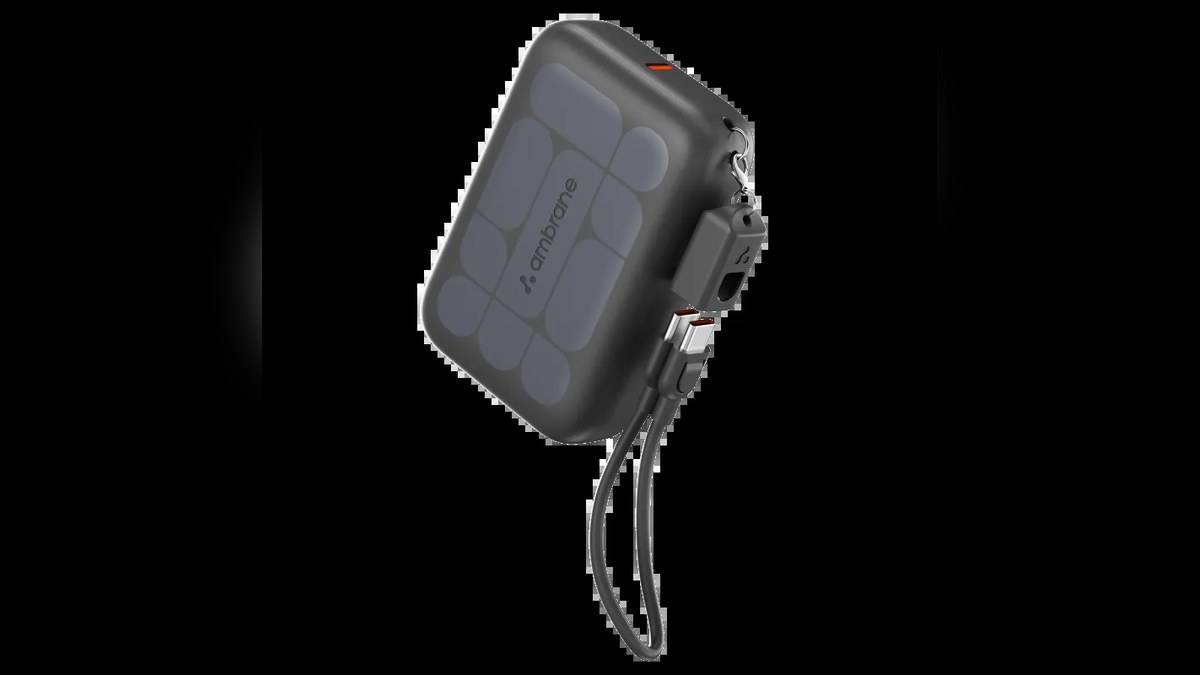
NEW DELHI: Ambrane's PowerMini 10 is listed at Rs 1,399, while the Loop 10 shows Rs 2,999 on the official store. Both advertise a 10000mAh battery, up to 22.5W charging and a detachable Type-C cable loop. The higher listed price does not establish a higher battery capacity or faster headline output. Price as of 18 November 2026, 00:21 IST.
| Detail | PowerMini 10 | Loop 10 |
|---|---|---|
| Displayed price, Black | Rs 1,399 | Rs 2,999 |
| Battery capacity | 10000mAh | 10000mAh |
| Advertised maximum output | 22.5W | 22.5W |
| Physical ports | USB-C and USB-A | USB-C and USB-A |
| USB-C input maximum | 20W | 20W |
| Laptop charging | Not supported | Not supported |
Similar headline figures, different listings
PowerMini 10's page lists Black, Green, Purple and Yellow. Loop 10 lists Black, Blue and Orange. The table records the Black selection opened for each model. It does not assign the same price to every other colour without checking its selected listing. Neither page establishes a separate battery-capacity variant under these exact model names.
The store's coupon panels are separate from the product-price field and repeat promotional text across multiple products. This comparison uses the numerical product price beside the model name. It does not apply a coupon, calculate a sale price, or treat the crossed-out reference amount as the amount payable.
The useful question is why a buyer would need one of these specific designs. A cable that doubles as a carrying loop may reduce the chance of leaving the charging lead behind. It also requires understanding how the cable detaches and reconnects, rather than assuming the loop is a permanently wired output.
How the cable arrangement works
The PowerMini manual describes unfolding the hanging loop to expose a Type-C to Type-C connector, placing one end in the bank's Type-C port and connecting the other to the device. Afterwards, the cable goes back into its loop position. The same manual identifies the Type-C socket as bidirectional, used for input or output.
Loop 10's instructions likewise describe pressing the sturdy end of its hanging loop to release a detachable cable. This matters when reading the phrase in-built cable on the store page. The instructions describe a removable lead connecting to the bank's own socket, so the cable arrangement should not be mistaken for an additional independently rated charging port.
Someone who keeps a bank in a work bag can therefore assess the loop as a storage convenience. Someone whose phone uses a different connector still needs a suitable cable. The loop does not remove the need to match the connection at the device end, and neither product is presented here as a wireless charging bank.
Charging speed needs the protocol detail
Loop 10's manual separates its output modes: QC and PD are listed at up to 20W, PPS at up to 22W, and SCP/VOOC at up to 22.5W. Its advertised maximum is therefore a supported-mode ceiling. The manual also explains that connecting multiple devices divides the available output, rather than reproducing the single-port maximum at every socket.
PowerMini 10's manual lists Type-C output up to 22W and USB-A up to 22.5W, with PD, QC, PPS and VOOC support. It recommends a compatible QC or PD adapter for refilling the bank and describes an LED indication for fast charging. These are manufacturer specifications, with no independent speed measurement supplied by this comparison.
The Loop page gives an approximate refill time of 3.5 hours using a 20W PD charger. No matching measured refill result is available here for PowerMini 10, so that figure cannot establish a speed advantage. Both manuals explicitly exclude Type-C laptop charging, which is a more decisive limitation for readers carrying a computer.
What the comparison can establish
The shared capacity and output labels leave price, cable handling and colour selection as visible differences in the opened listings. There is no verified weight comparison or independent runtime test here. Claims about pocket comfort or the exact number of phone refills would need evidence beyond the headline battery rating.
For alternatives already covered, see the MiniCharge 20 guide, PowerMini 20 guide and AerosynQ Snap 2 guide. They provide context for different models; their features should not be transferred to these smaller wired banks merely because the names share a brand.
The cable loop also changes how the bank is packed after a charging session. Restoring the detachable lead to its holder keeps the supplied connection with the bank. A reader comparing these products can assess that arrangement separately from battery capacity, because the published capacity does not distinguish the two models.
Official sources: PowerMini 10, Loop 10, PowerMini manual and Loop manual.