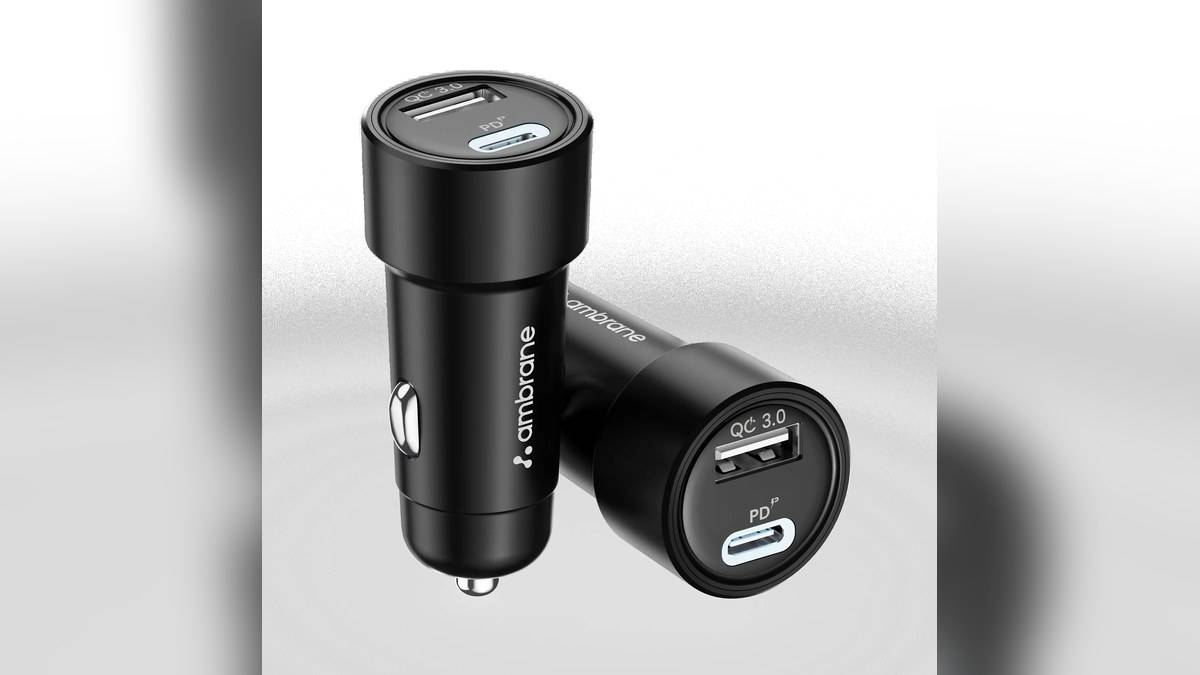
NEW DELHI: Ambrane lists the C51 car charger at Rs 399 and the C85 at Rs 949, including taxes. Both have USB-C and USB-A outputs, but their roles differ: the C51 offers up to 33W through USB-C, while the C85 raises that ceiling to 65W and explicitly supports compatible Type-C laptops. Price as of 18 November 2026, 00:20 IST.
| Official specification | C51 | C85 |
|---|---|---|
| Displayed price, Black | Rs 399 | Rs 949 |
| USB-C maximum | 33W | 65W |
| USB-A maximum | 18W | 20W |
| Total maximum | 51W | 85W |
| Input | DC 12V to 24V | DC 12V to 24V |
| Connections | One USB-C, one USB-A | One USB-C, one USB-A |
What the price difference changes
The extra spending on the C85 principally changes the USB-C side. Its USB-A rating is only modestly higher. That makes the distinction relevant to someone carrying a laptop between appointments, whereas a driver charging a phone and a passenger's accessory has a different requirement. The advertised total should be read alongside each individual port's limit.
Neither model gives a phone the full combined rating through a single cable. Ambrane identifies Power Delivery and Quick Charge 3.0 on both product pages. These are compatibility claims, rather than measured charging results for every handset. There is no basis here for promising a particular battery percentage by the end of a commute.
Both opened listings select Black. No differently priced colour or capacity version is shown for either model. The figures above are the displayed product prices, without applying the store's promotional codes. They describe the official listings at the reporting time, rather than a guarantee that checkout or future pricing will stay unchanged.
Phone charging and laptop charging are different jobs
The C51's specification sheet names phones, tablets, headphones and other electronics. The C85 manual adds Type-C laptops to that list. A laptop user therefore has an explicit manufacturer compatibility claim on the dearer model. The practical next check is the computer's own charging requirement, rather than assuming that every connector shaped like USB-C accepts power.
For a field worker, the useful scenario is a laptop connected during a drive between sites while a phone occupies the remaining output. For a family car used mainly for navigation and calls, the question is whether the devices actually need the larger USB-C allowance. This distinction explains the two models more clearly than their combined wattage labels alone.
A separate wall adapter remains a separate category. Our Ambrane RAAP G65 guide covers a mains charger, while the Charge D100 and Charge 100 comparison concerns another kind of charging setup. Those products should not be confused with a vehicle-socket accessory.
The manuals add useful operating detail
Ambrane's C51 instructions say to insert the charger into the vehicle's cigarette lighter socket, connect the device using the appropriate USB cable, then disconnect and unplug after use. They recommend starting the engine before using the charger. Cable routing should leave the driver's controls unobstructed, a point that matters when the socket sits beside the gear selector.
The C85 manual also warns that some vehicle sockets remain powered after the engine is switched off. It advises unplugging the charger during extended engine-off periods because continued use can discharge the vehicle battery. This is a limitation of relying on the car as a power source, rather than a promise of unlimited charging while parked.
Both manuals restrict use to the stated vehicle electrical systems and advise checking the vehicle handbook. They also say not to use a damaged connector or expose the charger to moisture. These manufacturer instructions are more useful than treating the small adapter as a permanent fixture that never needs inspection.
What remains outside this comparison
This is a specification and price comparison, with no hands-on temperature, durability or charging-speed test. Ambrane describes protective circuitry on both products, but that does not establish a measured advantage for one over the other. The pages show a six-month warranty badge; any claim still needs to meet the applicable manufacturer terms.
For power away from a vehicle, our MiniCharge 20 guide describes a battery-based alternative. That is a different use case from the C51 and C85: the car chargers depend on the vehicle supply. The meaningful comparison here is the required output, available cable and intended device, with the C85's laptop-oriented USB-C capability providing the clearest distinction.
The car socket position also affects the usefulness of either model. A passenger connecting an accessory needs a cable that reaches without crossing the driver's controls. This is a layout question the charging ratings cannot answer, and the manuals' cable-routing instruction deserves attention alongside the output comparison.
Official sources: C51 product page, C85 product page, C51 manual and C85 manual.