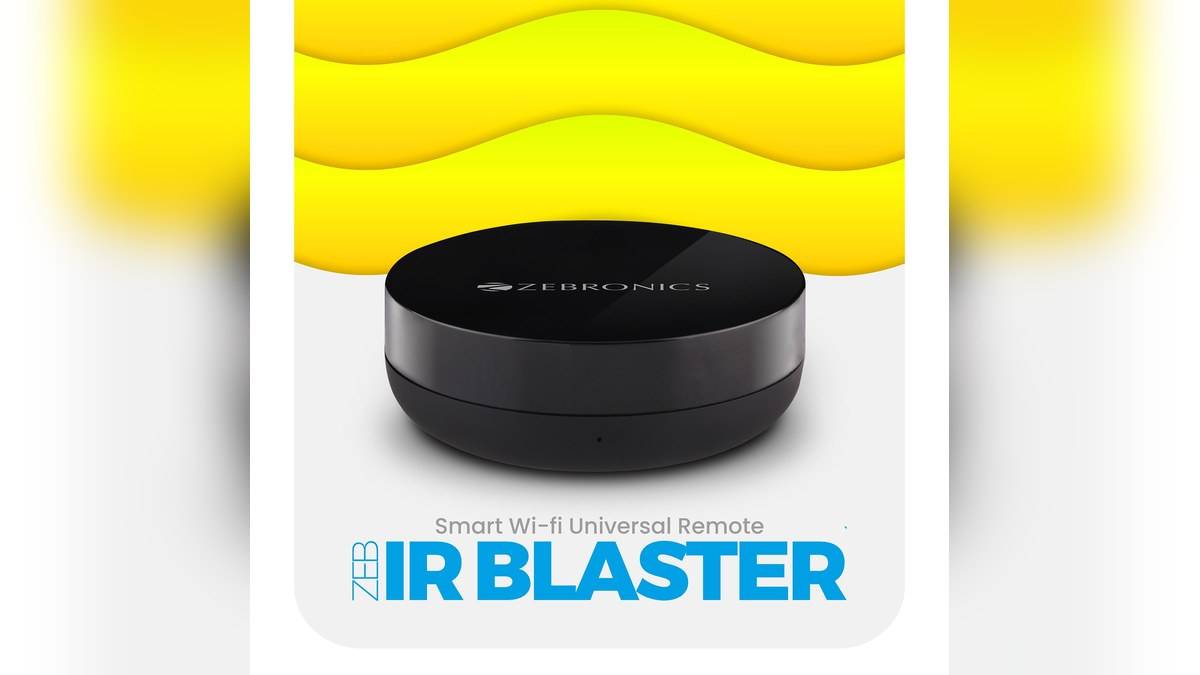
NEW DELHI: Zebronics lists the Zeb IR Blaster smart Wi-Fi universal remote at Rs 1,999, including tax. It is intended to control infrared-operated appliances such as televisions, air conditioners, set-top boxes and speakers through the Zeb Home app. The official specifications give 2.4GHz Wi-Fi, an infrared range of up to 8m and a DC 5V, 1A power input.
| Item | Official specification |
|---|---|
| Displayed price | Rs 1,999, tax included |
| Wi-Fi | 2.4GHz, 802.11b/g/n |
| Infrared frequency | 38kHz |
| IR range | Up to 8m |
| Size and weight | 68mm diameter x 28mm height; 62g |
| App | Zeb Home for Android and iOS |
| Listed contents | IR Blaster, cable and user manual |
Price as of 18 November 2026, 00:20 IST. The product page shows Black and White colour choices, but this guide reports the displayed price rather than assuming a separately verified price for each selection. It does not describe a newly announced launch or a confirmed reduction from an earlier selling price.
Start with the remotes already in the room
The clearest use case is a living room where several appliances still depend on their own infrared handsets. Make a list of the commands the household actually uses, including input selection, temperature changes or volume. Ask for those functions to be demonstrated with the exact appliance models, rather than treating basic power control as proof of complete compatibility.
This is particularly important if a remote offers both simple buttons and more complex menus. An app replacement is useful only if the controls needed in daily use are available and understandable. Keep the original remotes during setup so that any missing function can be identified before the new arrangement becomes the household's default.
Zebronics describes app control from anywhere with an internet connection and promotes 360-degree operation. Those descriptions explain the intended convenience, but they should not be read as a guarantee that a signal will reach every appliance throughout a home. Plan the location around the room and the equipment that needs control.
Wi-Fi reach and infrared reach are separate checks
The network link gets commands to the blaster; the final appliance-control link is infrared. A successful app connection therefore does not, on its own, prove that the television or air conditioner has received a command. During setup, look at the appliance itself and confirm that each requested change actually happens.
Try the intended position with the room arranged normally, including cabinet doors and furniture. Moving the blaster for a demonstration and then hiding it away afterwards can make that demonstration less useful. Agree a permanent position before deciding whether the arrangement is convenient enough for daily use.
The official data sheet repeats the 2.4GHz requirement and the up-to-8m infrared figure. Check that the chosen Wi-Fi network provides the required band. The page does not establish a separate 5GHz connection option, so a household should verify its network settings before expecting setup to proceed automatically.
Voice support needs a practical demonstration
The product page uses built-in Alexa wording, while the official data sheet says it works with Alexa. The documents do not explain the voice-input hardware or the exact setup path. Treat voice operation as something to demonstrate with the supplied unit and the intended account before relying on it as the main control method.
For an older family member or a guest, the app should not make familiar tasks harder. Ask the person who normally uses the television or air conditioner to try the controls after setup. Clear appliance names and an understandable layout may matter more in that room than a long list of possible automation features.
How it differs from a broader smart-home hub
One rival approach is the Tapo H110. TP-Link's India page describes support for 18 types of infrared appliances, Tapo sensor integration and Matter connectivity. It also says a Matter controller is required for setup of the Matter connection. Those ecosystem features are distinct from the basic task of replacing infrared handsets.
No current official rupee price for the H110 was verified for this guide, so there is no price ranking between them. Instead, consider whether the requirement is simply appliance control from an app or a larger system involving sensors and other smart-home platforms. Avoid assuming that a feature described for one hub is present on another.
The Zebronics package list names a cable but does not name a power adaptor. Confirm the power arrangement with the seller. For related reading, see our Zeb AHDPDSL24 price: Rs 2,999 for the home CCTV dome camera, Zebronics smart plug price list: Rs 2,099 to Rs 2,990 and Zeb HDTVI D5 and B5 both cost Rs 5,999: CCTV models compared.
Official sources: Zeb IR Blaster, its official data sheet and the Tapo H110 page.