Almost 5 Out of 10 Banarasi Sarees in Market Are Fake
Varanasi, July 26
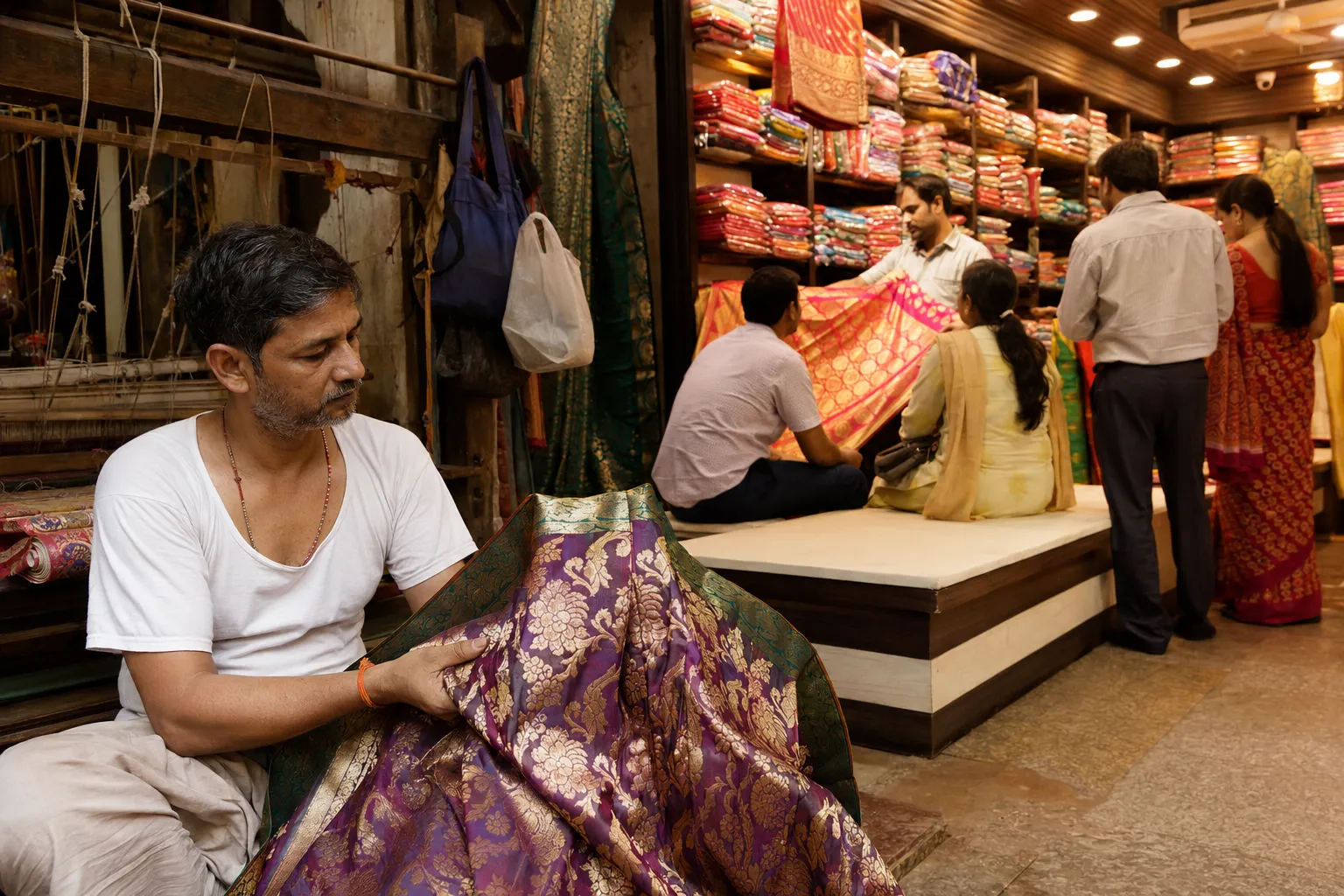
Walk into any saree shop in the city these days, whether it’s the busy lanes of Madanpura, the showrooms near Golghar, or even the newer markets outside the old city, and you will hear the same line repeated with confidence: “Madam, yeh pure Banarasi hai.”
But the truth, which many of us in Varanasi have known for years and which weavers keep repeating quietly, is far more uncomfortable. A large number of the sarees being sold under the Banarasi name are not Banarasi at all. They are machine-made copies, mostly coming from the powerlooms of Surat in Gujarat.
An old observation by industry observer TK Rout, still widely referred to by people in the trade, put the figure of fakes at around 45 percent. That means nearly every second Banarasi saree being sold in the open market is either a powerloom copy or a synthetic imitation. In the cheaper and mid-range segment, the number is almost certainly higher.
I spent two days last week speaking to weavers and small traders in Peeli Kothi and Lohta. The frustration is the same everywhere.
“A design that takes us 40 to 60 days on the handloom is copied in Surat within hours,” said Saeed, a master weaver whose family has been in this work for three generations. “They sell it for ₹4,000 or ₹5,000. Customers think they got a bargain. We lose the order, and the next generation of our children does not want to sit on the loom.”
Another weaver, who asked not to be named, put it more bluntly: “The customer wants the look of Banarasi at the price of a Surat saree. The shopkeeper is happy to give them what they want. Who is asking whether it was woven in Banaras or not?”
Even within Varanasi’s own textile trade, estimated between ₹200 and ₹300 crore, only a small fraction, around 5 percent according to recent industry reporting, still comes from genuine handloom artisans. The rest is powerloom production, much of it designed to look like traditional Banarasi work.
The problem is not new. For more than a decade, Surat’s powerlooms have been flooding the market with cheaper versions using art silk, polyester, and synthetic zari. These sarees are light, shiny, and easy to produce in large numbers. Genuine handwoven Banarasi silk with real or tested zari is heavy, takes weeks, and costs significantly more. The price difference is so big that most buyers simply do not question it.
What makes the situation worse is that many of these copies are sold right here in Varanasi. Traders buy them in bulk from Gujarat and put them on shelves labelled as Banarasi. The Geographical Indication (GI) tag that was granted in 2009 was supposed to protect the name. In practice, enforcement remains weak.
For the ordinary customer, identifying the difference is not always easy. Real handloom Banarasi usually has slight irregularities in the weave, floating threads on the reverse side, and a certain weight that machine-made pieces lack. The zari feels different too. But when the saree is already folded and the lighting in the shop is bright, these differences are easy to miss.
The impact on the city’s weavers is visible. Many younger people from traditional weaving families have already left for other work, some even going to Surat itself to operate powerlooms. The old lanes that once echoed with the sound of looms are quieter than they used to be.
This is not just a story about fake sarees. It is about a craft that has defined Banaras for centuries slowly being diluted in its own city. When people buy a Banarasi saree, they are not only buying fabric. They are buying the idea of Banaras. When that idea is sold as a cheap machine-made copy, something more than a saree is being lost.
The next time someone tells you a saree is pure Banarasi, it may be worth asking a few more questions. The answer might not be as simple as the salesman would like it to be.
Related Stories
Railways Orders Weekly Puja Special 09465 via Varanasi Through November
Hindi Diwas Marked Across BHU, Sanskrit University and Kashi Vidyapith
Lohta Police Register FIR After Bhitari Villager Alleges Hostage Beating
Baragaon Police Book Named Youths After Kazisaray Tea-Stall Assault and ₹1,900 Loot
Ganeshotsav Opens Across Varanasi Pandals With Modak Bhog and Pran Pratishtha