What Carrom Teaches Young Children About Focus, Patience and Thinking Ahead
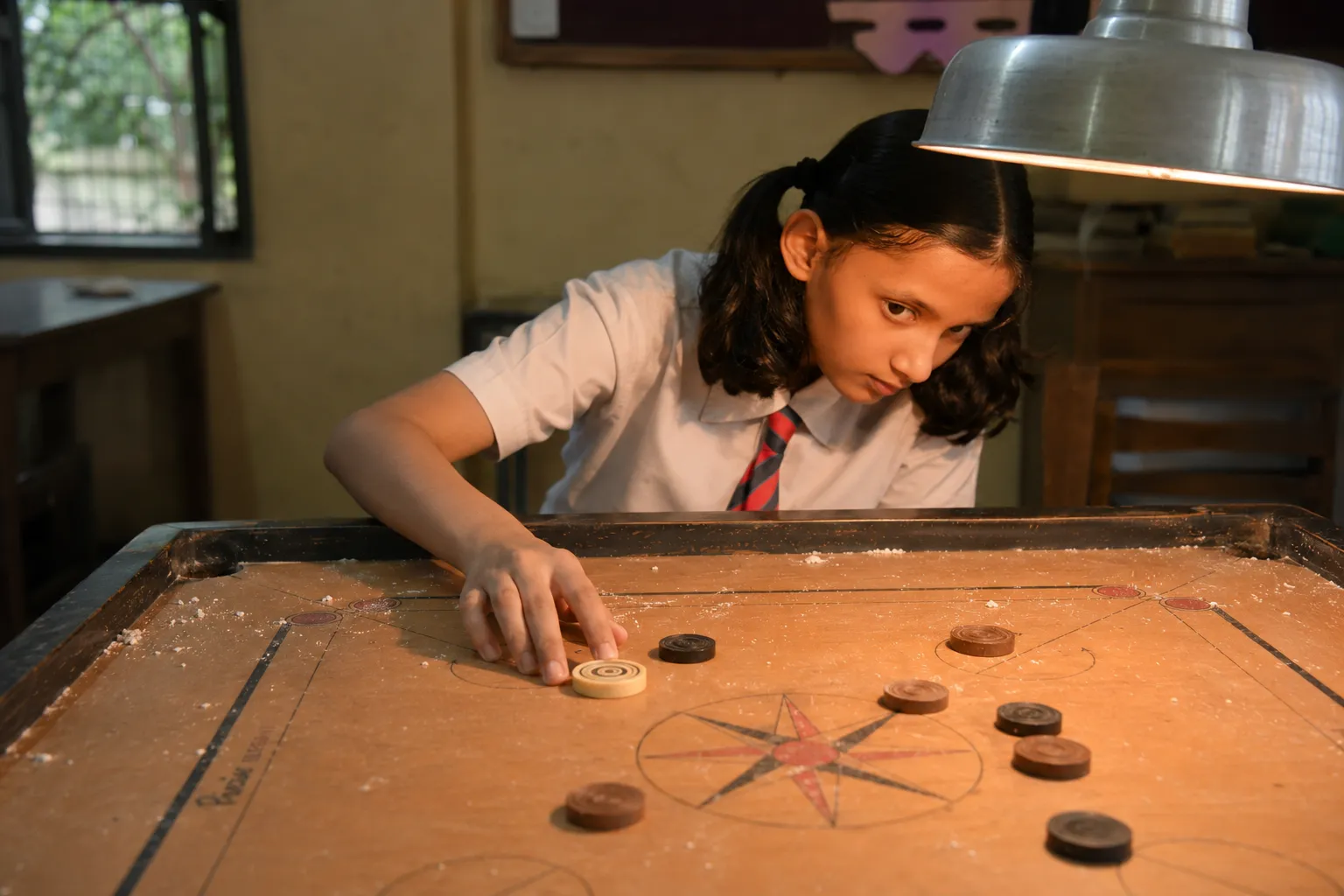
There is a particular expression children wear before a difficult carrom shot. The chin drops, the eyes narrow and the rest of the room seems to disappear.
I saw that expression repeatedly at a recent inter-house carrom championship at Dalimss Sunbeam School, Sigra. Under low-hanging metal lamps, the boards sat in circles of warm light. Around them were school children who, a few minutes earlier, had been talking and moving about with the usual restlessness of a competition day. Once a match began, however, the mood changed.
I found myself watching their faces more than the scores.
One player would lean forward to inspect a narrow route to the pocket. Another would place the striker, lift it, wipe the board lightly and begin again. Some looked impatient until it was their turn; then came the pause. They had to decide whether to attempt the obvious coin, try a rebound or play safely and leave less for the opponent.
That pause is where much of carrom’s value lies.
A Small Board Carrying Several Decisions
Carrom is often spoken of as a simple indoor game. The rules may be easy to learn, but the board is not simple once the coins have scattered.
A child has to read distance and direction, judge the force of a flick and imagine what will happen after the striker makes contact. A clean-looking shot may be blocked. A harder coin may be better placed. Pocketing one piece can disturb three others. The board keeps changing, so yesterday’s successful shot—or even the shot played a minute ago—may no longer be useful.
In educational language, this draws on several parts of what is called executive function: holding information in mind, resisting the first impulse, planning an action and changing course when circumstances change. Put less formally, the child has to look, think, choose and then live with the choice.
After years of reporting on education, I have become wary of the phrase “brain-building activity”. It is attached too easily to toys, apps and school programmes. Children do not become more intelligent merely because an adult puts that promise on a poster.
The research on board games is more restrained—and more believable. Studies involving children suggest that regular play can give useful practice in attention, inhibition and cognitive flexibility. Reviews also point towards benefits for motivation and face-to-face interaction.
The evidence is promising, but it is not specific enough to claim that carrom raises IQ or produces better examination marks. There is far more research on board games as a broad category than on carrom itself, and some studies have small samples.
What can be said with confidence is that carrom repeatedly asks a child to use these skills. Whether those skills later travel into the classroom depends on many other things, including teaching, sleep, health, home life and the opportunities a child receives.
The Discipline of a Finger Flick
The brain is only part of the story. Carrom is also a game of fine physical control.
The eyes select a line and the finger has to reproduce it. A flick that is slightly too hard, too soft or a fraction off-centre changes the result. The board is an unforgiving but fair instructor: it shows the mistake immediately.
I watched children learn from that feedback without anyone giving a lengthy explanation. After sending a coin past the pocket, a player often used less force on the next attempt. After striking too directly, the child changed the angle. No worksheet was required. The board had already answered.
This coordination between what the eyes perceive and what the hand does is known as visual-motor integration. It plays a role in many childhood tasks, from drawing and handwriting to handling objects accurately.
Research has found links between children’s fine-motor and visual-spatial abilities and certain academic outcomes, particularly mathematics and written expression. That does not mean a few games of carrom will improve handwriting or maths. It means that precise movement and spatial judgement are genuine developmental abilities, not minor accomplishments to be dismissed because they happen during play.
Carrom also teaches force in a way a child can feel. Too much enthusiasm can be as unhelpful as too little. The best shot is not always the hardest one. That is a physical lesson, but it is a rather good life lesson too.
The Usefulness of Missing
The successful shots drew the smiles, but I learned more by watching what happened after a miss.
A child who misses cannot instantly try again. The turn passes across the board. The player has to sit with the error, watch the opponent and wait for another opportunity. In those few minutes lie patience, frustration and self-control—the less glamorous parts of competition, but perhaps the more important ones.
Children are not born knowing how to lose well. They learn it in small encounters: a race they do not win, a question they answer incorrectly, a coin that stops beside the pocket instead of falling into it.
Carrom delivers frustration in manageable portions. The consequence is real enough to matter, but small enough to recover from.
Of course, a competitive game does not automatically build character. Adults can ruin the lesson by shouting instructions, disputing every decision or treating a school match as a verdict on a child’s ability. When adults remain measured, however, the board gives children room to make decisions, make mistakes and correct themselves.
There is a difference between guiding a child and playing the shot through the child’s hand. Carrom is most useful when the thinking still belongs to the player.
Learning to Share Attention
The championship also reminded me of something easily lost in discussions about children and screens. Carrom is social in a very physical way. Everyone looks at the same board. Players observe one another’s movements, wait for turns, follow a common set of rules and respond to the same unfolding situation.
Screens are not villains, and digital skills are part of modern childhood. But a shared tabletop game has a different social texture. There is no private feed and no personalised version of events. If a player breaks a rule, others see it. If someone makes a fine shot, appreciation travels around the board. Even silence is shared.
Carrom can also cross generations with unusual ease. A grandparent and a child do not need the same vocabulary, reading level or familiarity with technology to play. The board provides the subject of conversation. Skill matters, but age does not automatically decide the winner.
For parents, the game does not need to be turned into another lesson plan. Fifteen or twenty minutes at home, with adults resisting the temptation to correct every move, can be enough.
Asking, “What were you trying there?” is usually more useful than saying, “You should have played this coin.” The first question invites the child to explain a decision; the second merely replaces it.
One caution is necessary. Carrom is a seated indoor game. It should sit alongside outdoor play and sport, not take their place. Children still need vigorous movement, sunlight, sleep and unstructured time. No responsible account of carrom’s benefits should pretend otherwise.
By the end of the session, I was less interested in which house had collected the most points. What stayed with me was the sight of a child holding a finger behind the striker, waiting an extra second and changing the shot.
Nothing dramatic happened in that second. No one could measure a sudden increase in intelligence. The child simply looked again, reconsidered and made a decision.
For a developing mind, that is not a small thing.
Dalimss News Education
Sources and reporting
First-hand observation of children participating in the inter-house carrom championship at Dalimss Sunbeam School Sigra, supported by a review of research on board-game play, executive function, attention, visual-motor coordination and child development.
Related Stories
Infant screen time linked to brain network changes and teen anxiety in Singapore cohort study

VMC Steps Up Cleaning and Lighting Ahead of Ramnagar Ramlila From 25 September

Phoolpur Police Recover Missing 16-Year-Old From Pindra After Three Days
BHU Dairy Science Team Wins Indian Patent for Milk–Aloe Antacid Tablet
IMS-BHU Opens Seventh Paediatric Dialysis and Apheresis Training Module