Varanasi: The Timeless City of Lord Shiva, Faith, Culture and Civilization
Editor’s note: This is an opinion article based on the author’s general research and analysis. It does not present original reporting or interviews.
A City of Faith
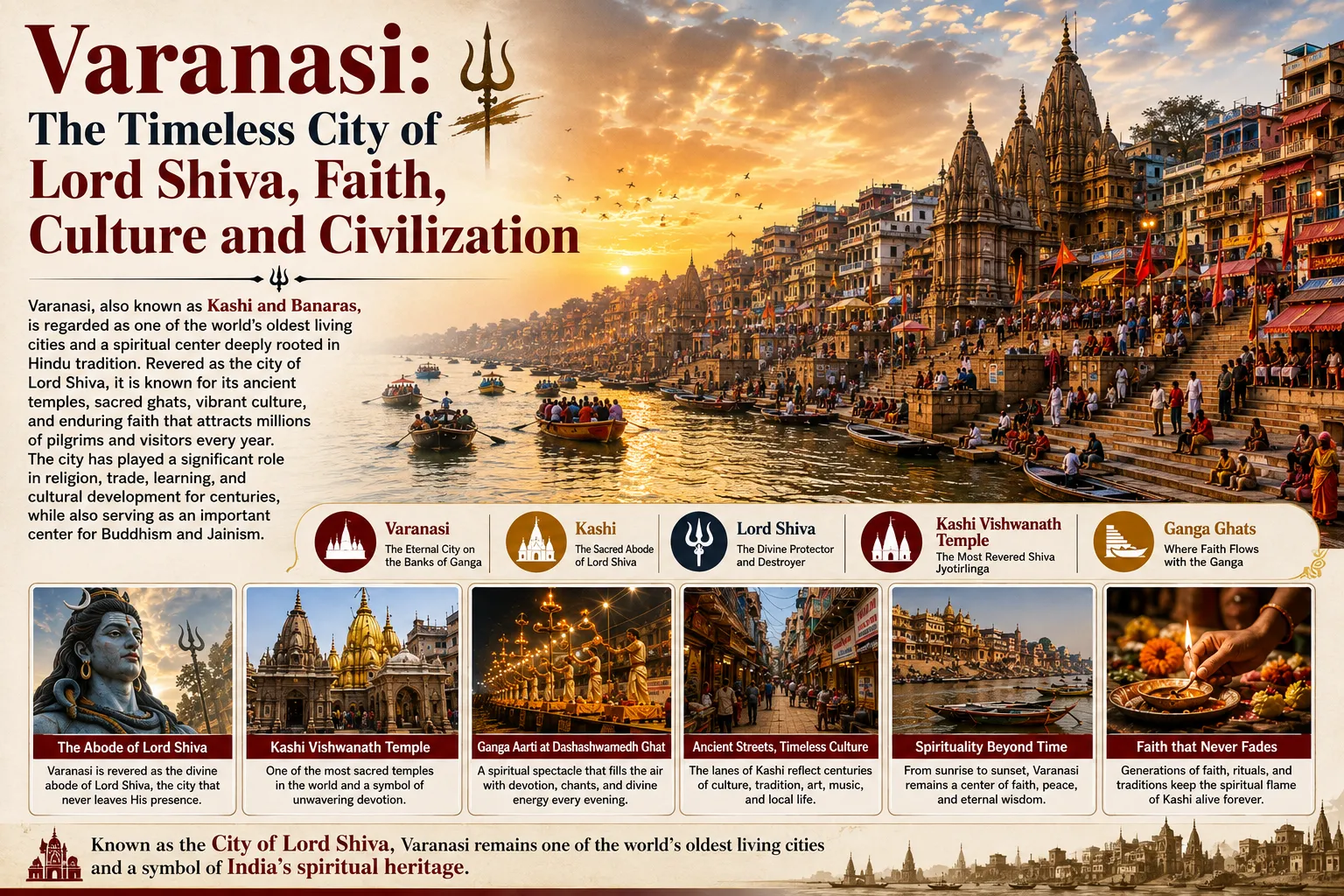
Banaras is the city of Lord Shiva. It is famous for its wide and narrow streets, lined with small and large shops selling betel leaves (paan) and thandai. The city's fragrance and its thousands of temples, all connected by unshaken faith, draw people to it.
The river front steps, or ghats, feel as though a loved one is calling you home. The land of the Ganges is like a mother's embrace, where rays of light dance across the waves and stretch across the sand as the sun sets gently behind the clouds.
The air fills with the sounds of evening aarti and devotional bhajans, and birds fly free to the rhythm of these tunes. When you visit the Ganga ghats, time seems to stand still. You feel detached from life's joys and sorrows, wishing this exact moment would last forever. On the banks of the Ganga, you witness a true diversity of colors, much like the confluence of the Ganga and Yamuna themselves. The city is a sacred pilgrimage site for both Hindus and Buddhists. This is Banaras, the city of Lord Shiva, Bhole Ki Nagri.
Names and Origins
Banaras is one of the oldest living cities in the world. It is also known as Varanasi (the city of salvation), Vishwanath Nagari, and Kashi. Lord Vishwanath is regarded as the master of this universe, and the city is considered the land of liberation, where one attains salvation. According to a deep-rooted belief, anyone who passes away here is freed from the endless cycle of life and death. It is also called the "City of Ghats," since it has more than 100 of them.
According to the Puranas, the city is believed to be so ancient that Lord Shiva created it to reside with Goddess Parvati before the Earth itself existed. Kashi can be considered older than history and tradition, and older still than the Puranic accounts that describe it. Whenever one tries to trace the history of Kashi, the evidence leads back to Vedic literature.
The earliest known use of the word "Kashi" appears in the Atharvaveda. It also appears in the Shiva Purana, Brahma Purana, Agni Purana, and Matsya Purana, as well as in the Mahabharata and the Ramayana. Queen Sumitra, wife of King Dasharatha and mother of Lakshmana, was a princess of the Kashi kingdom.
Ancient Kashi: Faith, Trade, and Learning
The Kashi Khanda of the Skanda Purana contains roughly 15,000 verses describing the city's various pilgrimage sites. Before the 6th century, Banaras was not only a center of Vedic dharma but also a thriving commercial and industrial hub, famous for its muslin, silk, perfumes, ivory, and sculpture. Historical records confirm that by the 6th century BCE, Varanasi was already the largest and most important city in the country.
Conquest and Continuity Through the Medieval Period
During the medieval period, the city was part of the Kannauj kingdom before passing under the authority of the Pala rulers of Bengal. After King Jaichand's defeat in the battle of 1194 CE, Muhammad Ghori entered Kashi, plundering the city and destroying several Hindu temples. The widespread looting drove many scholars living in Banaras to migrate elsewhere.
In the 16th century, the Mughal emperor Akbar once again encouraged the city's religious and cultural life. During his reign, however, Banaras was briefly renamed Mohammadabad. Toward the end of the 17th century, in 1669, Aurangzeb demolished part of the Vishwanath temple and built the Gyanvapi mosque on the site.
Around 1700, the Marathas began a new revival in the city, constructing the ghats seen today. In 1780, the Maratha queen Ahilyabai Holkar rebuilt the Kashi Vishwanath temple. As Mughal power declined through the 18th century, Awadh emerged as an independent state, with Banaras as its subordinate territory, and it was during this period that the British began establishing their authority in India.
Chait Singh and the East India Company
Following the Battle of Buxar, the Treaty of Allahabad was signed with Awadh in 1765; Chait Singh was king of Banaras at the time. When the Nawab of Awadh, Shuja-ud-Daula, died in 1775, his son Asaf-ud-Daula succeeded him. British Governor-General Warren Hastings used this transition to press the new Nawab into signing a fresh treaty, under which Banaras was handed over to the East India Company and Chait Singh became a Company subordinate, obliged to pay an annual sum of 22 lakh rupees. No further demands were meant to follow, and Chait Singh was to be left to rule Banaras in peace. Citing financial pressure, however, Hastings soon violated these terms.
In 1778, Hastings demanded an additional 5 lakh rupees from Chait Singh as a war subsidy. In 1779 and 1780, the Raja sent 2 lakh rupees as a gift, but Hastings pressed further, demanding extra subsidies and an additional cavalry unit. Chait Singh apologized and said he could not meet the demand.
Hastings responded by fining him 50 lakh rupees and marching on Banaras. The Raja met him at Buxar and placed his turban at Hastings's feet in submission, but Hastings refused any discussion before reaching Banaras. Once there, he ordered Chait Singh's arrest, and Chait Singh's nephew was installed as the new Raja, with the annual tribute raised from 22 lakh to 40 lakh rupees. In this way, the rulers of Banaras were reduced to little more than pensioners of the East India Company.
The Spiritual Heart of Banaras
Banaras is bound to Hinduism by an unbreakable thread. It is a deeply spiritual place where one can feel the essence of "Subah-e-Banaras," the divine mornings, and the city of Mahadev carries an unmistakable sense of pride and spiritual freedom: a place, as tradition holds, where devotees are as carefree and detached as Lord Shambhunath himself. In popular belief, it is regarded as the holiest city for Hindus.
According to the Hindu Puranas, Banaras is the ancient name for Varanasi, formed from the confluence of two rivers, the Varuna and the Assi. Many rivers run through the city, but this particular confluence is what sets the sacred land apart. Tradition holds that Kashi was founded by Lord Shiva himself, who came here to reside with Goddess Parvati and promised never to leave.
Because Kashi is known as Shiva ki Nagari, the city of Shiva, it carries the same qualities associated with Mahadev himself: carefree, easily pleased, divine, and extraordinary. No vision of Kashi is complete without Shiva, and his imprint is said to be present in every corner of the city.
The Kashi Vishwanath Temple
Among the thousands of temples dedicated to Lord Shiva, the most prominent is the Kashi Vishwanath Temple, one of the twelve Jyotirlingas on the banks of the Ganges. Tradition holds that King Harishchandra rebuilt the temple in the 11th century, but its history from the 11th to the 15th centuries was one of repeated destruction. In 1194, Qutb-ud-din Aibak destroyed it on the orders of Muhammad Ghori; it was rebuilt in the 13th century, only for Firoz Shah Tughlaq to order its destruction again, followed by demolition at the hands of the Sultan of Jaunpur, Mahmud Shah, in 1447.
In 1585, Pandit Narayan Bhat restored the temple with support from Raja Todar Mal, one of Emperor Akbar's Navaratnas. On April 18, 1669, Aurangzeb ordered it demolished once more. Maharani Ahilyabai Holkar had it rebuilt in 1780, and in 1835, Maharaja Ranjit Singh donated 1,000 kilograms of gold, used to construct the temple's golden spire (kalash).
Other Sacred Sites of Banaras
Banaras is also home to numerous other temples. The Sankat Mochan Hanuman Temple, established by the poet Tulsidas, hosts a world-famous annual music festival. The ancient Mandah Devi temple is known for its large pond, the Vishol Kund, and the temple of Mata Annapurna, near the Vishwanath temple, is said to be the first temple in the world where devotees receive prasad, blessed food, before it is formally offered to God.
According to Hindu belief, death is as much a part of life's journey as anything else, and Kashi is considered the city of salvation. At Manikarnika Ghat, the last rites of the dead are performed day and night, and the fire of the funeral pyre is never extinguished. This is why people from across the country come here in their final moments, having completed their life's duties, to seek salvation. As in Mathura, Vrindavan, or Haridwar, an ancient temple can be found in nearly every corner of the city; Shiva is said to reside in every particle of Kashi.
Situated along the Ganga with more than 100 concrete ghats, Banaras takes on the shape of a bow along the riverbank, and the people who live along these ghats have a distinctive way of life shaped by that geography.
Buddhism and Jainism in Kashi
Culture and tradition live in every part of this city. In the 6th century BCE, Lord Buddha delivered his first sermon near Banaras at Sarnath, now a UNESCO World Heritage Site, where he formally established the Buddhist Sangha with five bhikkhus (monks). In this sense, Buddhism can be said to have begun here.
Kashi is also a major pilgrimage site for Jainism. Of the religion's 24 tirthankaras, Varanasi is considered the birthplace of three: the 7th tirthankara, Chandraprabhu; the 11th, Shreyansanath; and the 23rd, Parshvanatha. Notably, Shreyansanath was born at Sarnath itself, the same site sacred to Buddhism. Several ancient Jain temples stand in Banaras, including one dedicated to Suparshvanatha, alongside the Jain temple at Jain Ghat and the Parshvanatha birthplace temple in Bhelupur.
Saints, Poets, and a Composite Culture
In the 8th century, Kashi, the land of Mahadev, drew Adi Shankaracharya, who composed the "Kashi Vishwanath Ashtakam" here. Banaras is also the birthplace of the saint and social reformer Kabir; the city is considered incomplete without him, and his ashram stands in the Kabir Chaura neighborhood, itself world-famous for its musicians.
Sant Raidas, the guru of Mirabai, was also born in Banaras, and Goswami Tulsidas composed the "Ramcharitmanas" at Assi Ghat. The city is home to the Aghor Sampraday as well, whose most prominent saint was Baba Keenaram; its ascetics, known as Aghoris, are recognized worldwide for their mysterious meditation practices.
Banaras is not defined by any one tradition alone. It is a place where temple bells and the mosque's Azaan (call to prayer) both bring peace to the ear, and the city teaches coexistence by example. It is also the city of Mirza Ghalib, who wrote a beautiful poem for it titled "Chiragh-e-Dair," or "The Lamp of the Temple." It is the city where the great shehnai player and Bharat Ratna recipient Ustad Bismillah Khan would sit at the Balaji temple to practice his music. This blending of traditions defines the Ganga-Jamuni tehzeeb, the composite culture, of Banaras.
Food and Craft
The food culture of Kashi is itself a tradition, famous even in Bollywood and Hollywood for its paan (betel leaf); the food here is hard to describe in words. The Banarasi saree, too, is world-famous and has been the first choice of Indian women for centuries, now popular abroad as well. In this way, the city continues to teach a way of eating, dressing, and living rooted in peace.
Conclusion
Many have come to rule Banaras, and many have come to destroy its heritage. All of them came and went, leaving Varanasi essentially untouched, because Banaras is the city of Lord Shiva.
Sources and reporting
Opinion article drawing on the author’s general background research about Varanasi. No original interview or named primary source is documented in the article record.
Related Stories

Court Issues Arrest Warrant for HSVP Brass
MCG Finalises Sohna Site for Fresh Waste

GMDA Seeks Station-Wise Metro Parking Plans

Thar Rams Rapido Cab After Sector 89 Quarrel

FDA Raids 3 Outlets Over Paneer Quality