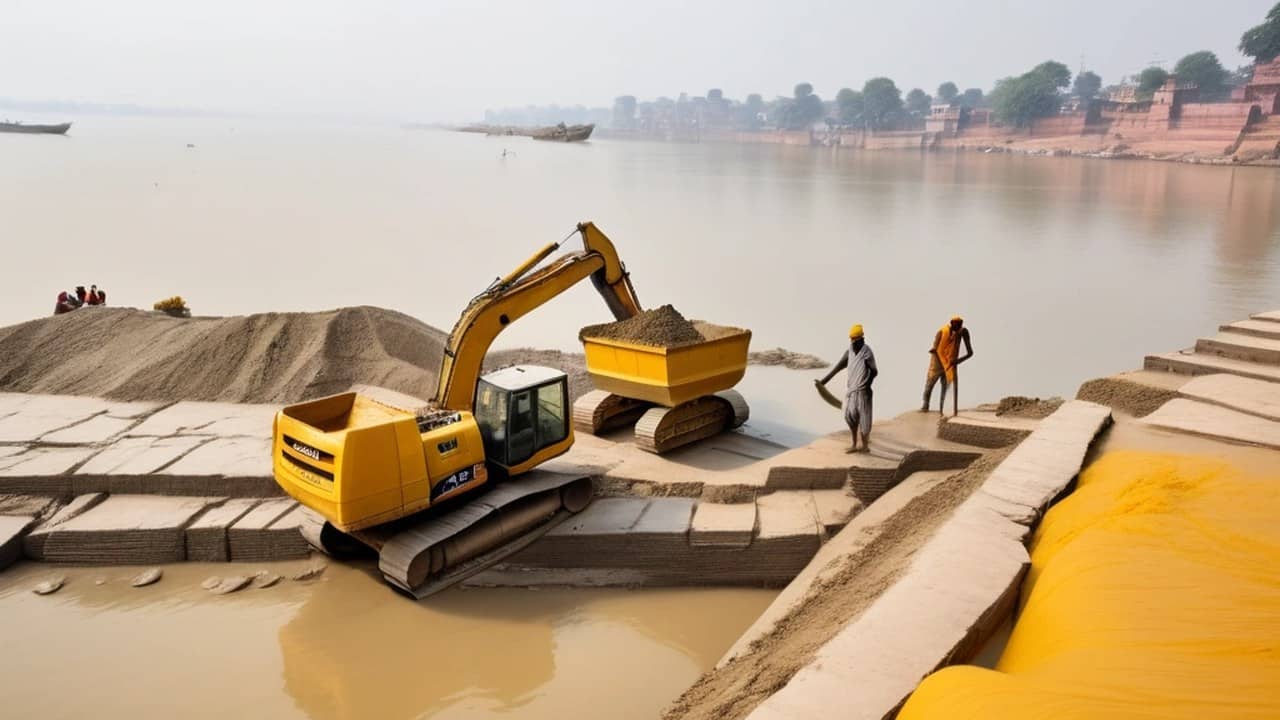
The Ganga has pulled back from the steps, and what it left behind is a layer of mud. From Assi in the south to Rajghat in the north, silt is lying on the stairs of the ghats and across the lanes that lead to them, and the Varanasi Municipal Corporation has begun clearing it with JCB machines and pumps.
The silt has been reported at Assi, Mahanirvani, Manikarnika, Darbhanga, Ahilyabai, Rajghat, Rana Mahal, Jain Ghat and Sakka Ghat, where the approach lanes are covered in silt. The mud makes walking difficult for pilgrims, tourists, boatmen and the shopkeepers who work along the river. Manikarnika and Harishchandra ghats, where people come every day for last rites, are the most affected because of the steady footfall.
The corporation's teams are working ghat by ghat. At some places, water pumps are being used to wash the silt down, and at others a JCB is scooping the mud off the stone. Work has also been speeded up at Namo Ghat, the venue for the Indian Air Force display later this month, where a JCB has been put on the ground to remove silt and the area is being made ready so that visitors have no trouble during the event.
At Manikarnika, the municipal administration worked with Namami Gange on a cleaning drive. Around 100 kg of cloth and other waste was taken out of the ghat, with the team led by Rajesh Shukla, convenor of Namami Gange for the Kashi region, and municipal sanitation workers.
People who work at the ghats described the problem in plain terms. Vineet, who conducts rituals at a ghat, said the silt has pushed the water away from the steps, so visitors have to walk a long way over mud to reach the river and bathe.
Boatmen have been affected as well. Because of the silt, it is hard to seat passengers on the boats, and the boatmen have built a path of planks and jetties so that people can get on board safely. That is only a stopgap. Conditions are expected to return to normal only after the silt is fully cleared.
The timing is awkward. Motor boats were allowed to run again on Friday after 62 days, as we report in our story on motor boats resuming on the Ganga, and the first passengers have to get from the muddy steps to the boats. At the same time, Pitru Paksha ends on Saturday with Sarva Pitru Amavasya, one of the busiest days of the year at the ghats, followed by Navratri from 11 October.
The corporation's civic drives have been going on elsewhere in the city too. Earlier this week we reported on the ward-by-ward checks of street lights and night cleaning that run until 19 October. The silt on the ghats is a separate job for the same sanitation teams.
The calendar adds pressure. The air show at Namo Ghat is being held as a state event, and Municipal Commissioner Himanshu Nagpal has said the corporation will carry out a special cleanliness drive from 20 to 26 October to control bird activity around the city and the venue.
Namo Ghat is the part of the riverfront that the administration is watching most closely. The Indian Air Force display there is planned for the last week of October, and the corporation's plan for the venue includes barricades on the routes that lead down to the river and mobile toilets, according to its public relations officer. The dates and the wider arrangements are set out in our guide to the Varanasi air show. Clearing the silt from the ground at the ghat is the first step before any of that can be put up.
For visitors in the next few days, the practical advice is simple. Wear footwear that grips, because the lower steps and the lanes to Manikarnika, Harishchandra, Assi and Rajghat are muddy and slippery. Children and older relatives should be kept away from the water's edge where the mud is soft. The corporation has not announced a date by which the cleaning will be complete.