Deep Apartment Excavation Damages Two Homes in Susuwahi; Three Detained
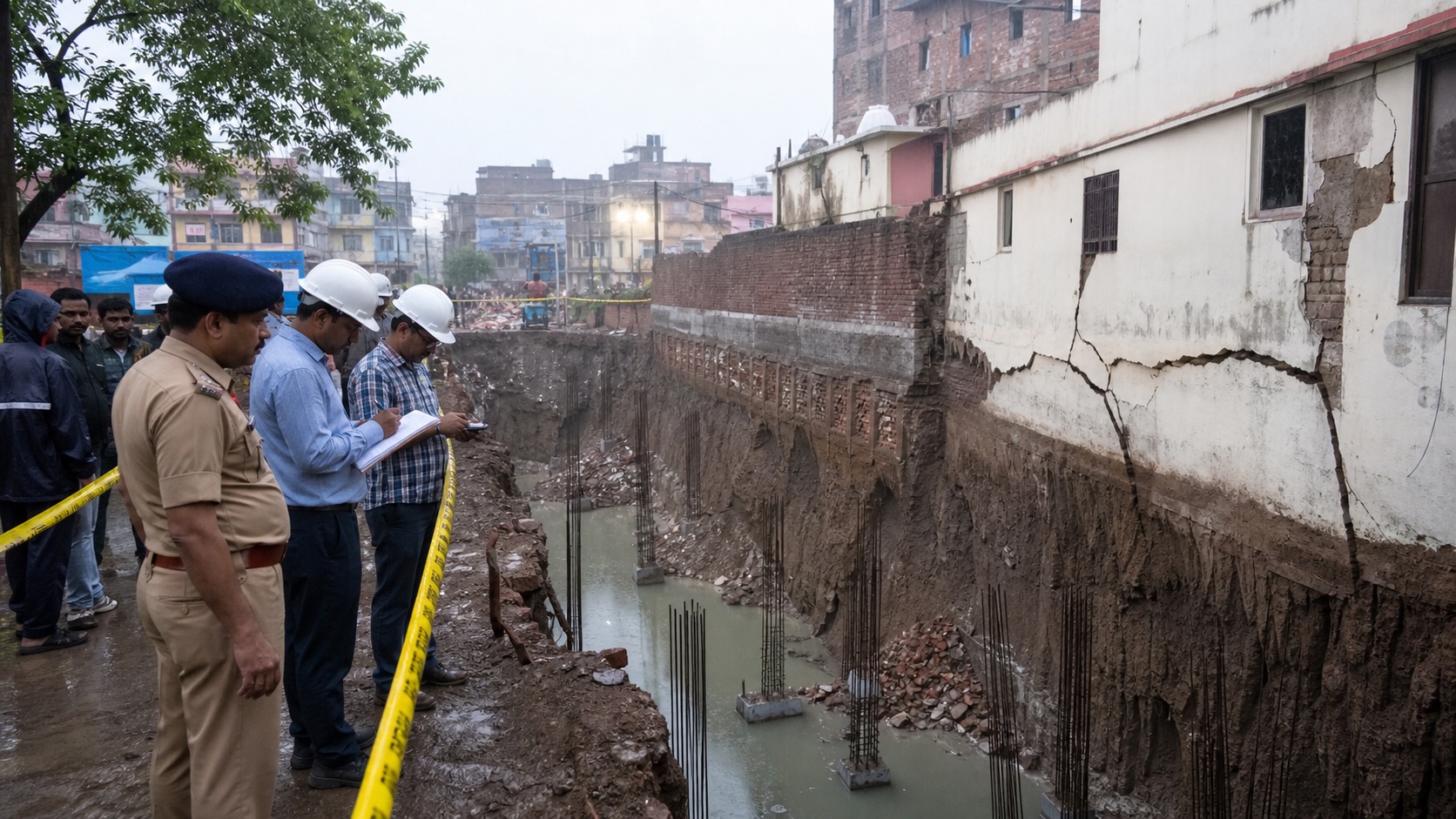
Varanasi: A rain-filled excavation for an apartment project in Susuwahi became a midnight emergency after sections of two neighbouring homes collapsed, forcing residents to move belongings and call the police. The incident occurred in the Chitaipur police-station area, where a basement pit reportedly extends about 35 to 40 feet below ground on a roughly one-bigha construction site.
The project, locally identified as Shivoham, had accumulated water during heavy rain. Residents said a retaining wall at the excavation failed, followed by the gate and part of a wall at Brijesh Rai’s house. The rear portion of a closed house belonging to Mayashankar and Arun Shankar was also reported damaged. No casualty was reported in the initial account.
Dial-112 personnel reached the area after residents heard the collapse. Police from the Lanka side also inspected the site, and three people associated with the construction work were taken into custody for questioning. Detention at this stage does not establish responsibility; investigators will have to determine who controlled the site, what approvals were in place and whether required safeguards were followed.
Neighbours say they had objected to the depth of excavation before the failure. That claim should be checked against written complaints, messages to officials and the builder’s site records. It matters because building safety is not only an engineering question after a wall falls. A functioning oversight system should record warning signs while there is still time to install shoring, improve drainage or suspend work.
Deep basements in dense neighbourhoods can alter pressure on adjoining foundations, particularly when soil becomes saturated. Safe excavation normally requires a geotechnical assessment, designed retaining support, pumping arrangements and regular inspection of nearby structures. The precise cause in Susuwahi must be established by a qualified structural and soil team rather than inferred from photographs alone.
The immediate priority is to keep people away from the edge, drain water without triggering further soil movement and assess whether the damaged homes can be occupied. Families should not be pushed back into a structure simply because the rain has stopped. Cracks, tilted walls and undermined foundations can worsen after the first visible collapse.
Municipal and development authorities should publish the sanctioned plan, basement permission and inspection history, with personal details redacted where necessary. If deviations are found, work must remain stopped until a documented corrective design is approved. If the project complied, the technical failure still requires explanation and repair at the responsible party’s cost.
Susuwahi is seeing rapid construction because demand around BHU and the southern city continues to expand. That growth cannot be allowed to transfer structural risk to an older house next door. The overnight collapse is a warning that the safety boundary of a construction site does not end at its tin fence.
Sources and reporting
Based on police and resident accounts from Susuwahi on 7 August 2026. Responsibility for the damage remains under investigation.
Related Stories
DTCP Seals 17 Sites in Sushant Lok Drive
GMDA Warns STP Defaulters of Disconnection
SOG-2 and Sigra Police Arrest 47 After Rathyatra Gambling Raid; ₹21.11 Lakh Seized
GMDA Elevated SPR Tender Nears Final Nod
ED Searches Kanda Premises in Vatika Probe